

Alex Hutchinson is a National Magazine Award-winning journalist who writes about the science of endurance for Runner’s World and Outside, and frequently contributes to other publications such as the New York Times and the New Yorker. A former long-distance runner for the Canadian national team, he holds a master’s in journalism from Columbia and a Ph.D. in physics from Cambridge, and he did his post-doctoral research with the National Security Agency. He is the author of Endurance and a new book, The Explorer’s Gene. Alex joined host Robert Glazer on The Elevate Podcast to talk about The Explorer’s Gene, how leaders can gain by being adventurous, and more.
—
Listen to the podcast here
Alex Hutchinson On The Explorer’s Gene
Our quote for this episode is from Joseph Campbell, “The cave you fear to enter holds the treasure you seek.” My guest, Alex Hutchinson, is a National Magazine Award-Winning Journalist who writes about the science of endurance for Runner’s World and Outside and frequently contributes to other publications such as The New York Times and The New Yorker. A former long-distance runner for the Canadian national team, he holds a Master’s in Journalism from Columbia and a PhD in Physics from Cambridge, did his Post-Doctoral research with the National Security Agency. Alex is the author of Endure and his new book, The Explorer’s Gene. Alex, welcome back to the show.
Thanks a lot for having me, Bob. I have your voice in my head every Friday when I get your Friday forward email. I’ve been looking forward to having an actual live conversation.
Alex Hutchinson’s Journey: From Runner To Science Journalist
Thank you. I looked it up, you were episode 23, so really one of our maybe first half year of episodes. I know I have some long-term loyal audience, but that may be pushing the threshold. People can go back after this. Can you give us the short version of your background and how you got into studying endurance and exploration?
I started out with two things in my life. I was a serious runner, as you mentioned. I would say until I was 28, running was the most important thing in my life. In parallel, my academic path was in physics. I did a PhD and worked as a researcher. Neither of those things points exactly to where I am now, but if you take the two overlapping circles and say, “Where does that Venn diagram meet,” the science side of me and the interest in human performance and endurance united. I realized in my late twenties, I wanted to do something that allowed me to incorporate both those things. I pivoted to journalism and I was able to, maybe to my surprise, find a niche of writing about performance, but from a very science-driven perspective.
I know you contribute to a bunch of the magazines we talked about, but have you made the Substack plunge yet?
I haven’t yet.
You must be playing around with it. I think I got something saying you were on it.
I think I finally registered because a bunch of the people, the newsletters I read, have moved to Substack, so I finally have a proper account. Yeah, it’s interesting. I write essentially a weekly column for Outside magazine, where every week basically, I’m writing about a new study. That is the form of writing that would be a Substack if I wasn’t outside magazine. Right now, I’m happy where I am. Outside gives me a good home in terms of being surrounded by other writing like me. Let’s be honest, I’ve thought about it and it certainly is an interesting world.
It seems like, because Substack is everyone who’s the owner of their little niche, their little thousand fans. We’ll see where the wave takes you. These magazines have had to endure considerably over the last couple of years.
It’s more than the last couple of years, it’s been, let’s say, a challenging Millennium for mainstream publishers. I don’t know what it’s going to look like in ten years. For right now, there’s the fun of the entrepreneurial aspect of owning your own brand but there’s also administrative overhead. There’s a part of me that just enjoys being able to say, “I don’t want to have to worry about building audience and admin. I just want to write my articles.” I have the luxury of doing that right now.
The Evolution Of Endurance: Beyond Physical Limits
You’ve got a great platform, so you go with what works. You were just coming out with Endure when we had you on last. A lot of people in the last few years have had their endurance and resilient tested, I think, maybe as much mentally as physically. We had the pandemic and then we had all of these ups and downs and yins and yangs since then. I’m curious, how has your thinking maybe evolved since that interview on the book, as you’ve seen? I think the most complicated macro environment people had operated in a while.
Yeah, it’s definitely been an evolution. When I wrote that book, when I was thinking about it and writing about it, I envisaged it as being a book for runners, essentially, and cyclists and mountain climbers. When I came out, I was pleased and surprised that a few people like you saw it and saw it in its broader capacity. I definitely always thought of endurance as broader than just running, but I just didn’t know that whether other people would see that. Nobody wishes for a pandemic.
Vaccine companies do.
There’s a small number of people, and I am definitely not one of the people who was wishing for a pandemic, but the idea that the pandemic as a marathon, those sorts of metaphors are emblematic of a broader shift. All these runners who over the years have been saying, “Marathons teach me about life,” they were right. There really is some parallel. People are thinking of endurance and performance more broadly, seeing the parallels between the physical world, the mental world, the business world and the professional world.
I can tell you, I remember in our business at the time, and there’s been some general decline in resilience. I think it’s becoming a more rare metal these days than otherwise. We’ll get into the scientific basic of that, but I remember when COVID hit, our business was thrown into total chaos and panic and otherwise, and we knew a lot about a lot of our employees. I knew a lot about their backgrounds and their struggles from a lot of the personal development stuff we had done, and vulnerability. I did a lot of leadership trading where we had these honest discussions. I would just see something where there’s a mom over here dealing with two kids with special needs whose husband was going to lose their job.
They were like, “I got this. I’ve been through worse,” because they had a really challenging childhood. They’re like, “We’ll figure it out.” I’m talking to someone else who’s single, who’s got a roof over their head and food and still has their job, and they can’t get out of bed or in abject panic. I remember the time being like it’s not the actual environment or the challenge, because that objectively looks a lot harder than that, but this person can’t even function. This person’s like, “I got it. We’ll figure it out.” I don’t know, that was just pretty striking to me.
It’s interesting. My 2018 reaction might’ve been like engaging in an endurance sport is a laboratory for developing these skills. I think now I would zoom way out, and to your point about societal changes, it’s like my kids are 9 and 11, so it’s about childrearing a lot now. It’s like, “To what extent am I exposing them to challenges versus protecting them from all challenges, bulldozing all challenges aside from them? How does that scaffold then up into 10, 15, 20 years from now, their ability to handle challenges, to deal with setbacks, to negotiate with stress?
We’re all hardwired to protect our kids. For Millennium, that was physical dangers. I think somehow, as the physical dangers subsided every day, we started to correlate maybe not trivial physical dangers or emotional dangers. Unfortunately, both of those are muscles that you have to build. I think a lot of folks have managed to get into their twenties without much stress. It’s like you’re going to try to run a marathon and you haven’t run more than a mile. It’s just not going to go very well a bit. Maybe you just didn’t realize that the marathon was reality, not the small light sprints you were doing.
As a parent, it’s hard. Nobody wants to impose hardship on their kids. Nobody wants to impose hardship on themselves. Obviously, we do run marathons and stuff like that, so it’s hard to see that. How is it beneficial to my kids if I let them get socially rejected or get tetanus from a rusty nail or whatever? Accepting those risks is what gives them the opportunity to negotiate with them, hopefully in a safer context than real life when they’re dealing with the pandemic or whatever.
The Science Of Resilience: Pushing And Recovering
Scraping your knee does not mean that one should never run again. It sounds crazy to say, but there’s some metaphors. You spend a lot of time looking at the science. What does the science say about the importance of resilience and also the harm when it runs low? I had Tasha Eurich on. She was talking about her new book. You can’t just redline forever without consequence. She was actually telling me some famous quote, or the person died like four months later or whatever. Whatever doesn’t kill you makes you stronger. That person died like six months after the quote from getting sick from something. I was like, “That’s pretty funny. I haven’t heard that story.”
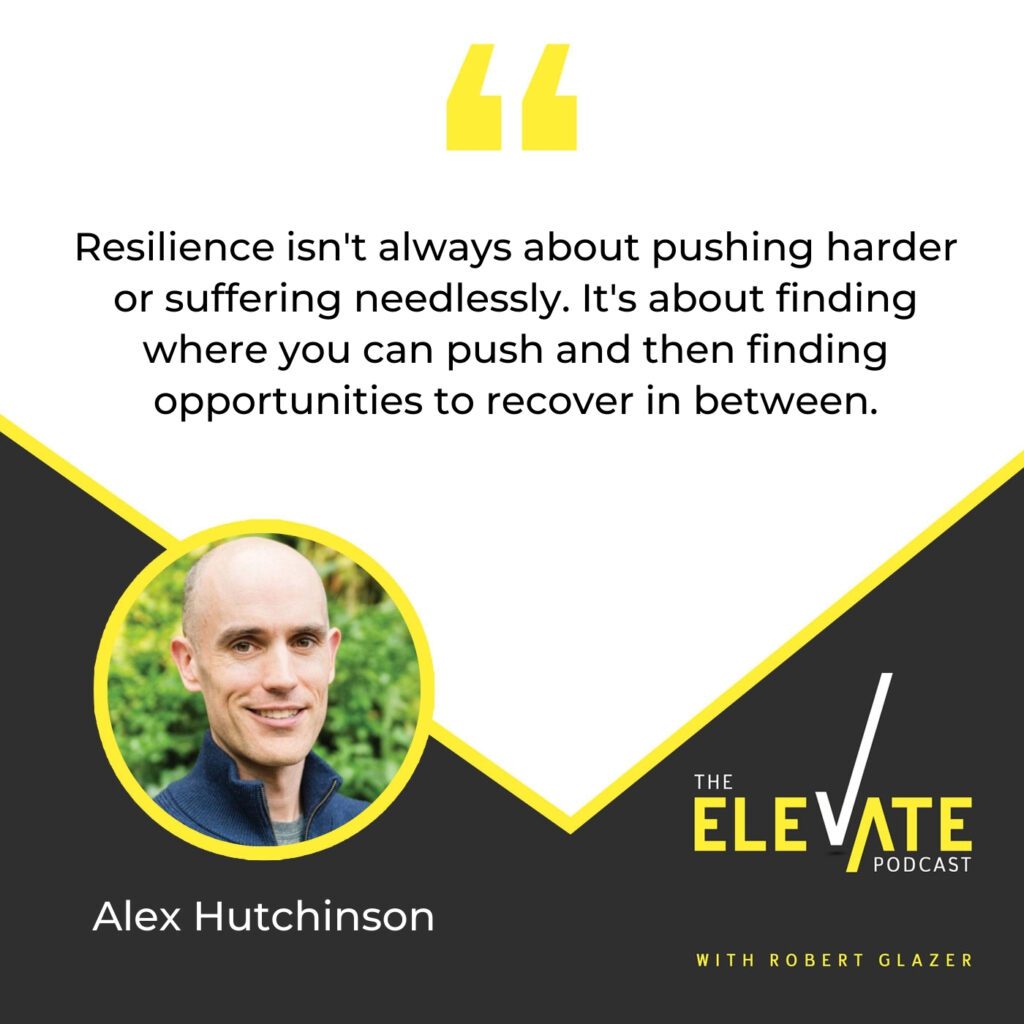
That is awesome. I’ve got to look that one up. There’s a temptation, especially for people like me who write books about endurance, to glorify pushing. It’s always better to keep pushing harder. The harder it is, the better. One thing you learn pretty quickly in running is that if you do your hardest workout on a Monday, and then you try to do another hard workout on Tuesday, and then you try to do another hard workout on Wednesday, you’re not even going to make it to the marathon, let alone perform your best. The science is clear, but also just the realization that it’s a balance. Resilience isn’t always about pushing harder or being willing to suffer needlessly. It’s about trying to find the places where you can push and then finding opportunities to recover in between.
I have gotten a pretty good look at that since getting a WHOOP. I’m sure you could dive into this, but it tells you you’re ready to take on a lot today, or you overdid it and pushed it, and then you see how that impacts your sleep and recovery and it tries to coach you to what can you reasonably take on now?
I’m a big fan of using tools like WHOOP, to connect to your own senses, to be able to feel that, because it’s an art that I think separates really top performers from people who may run into problems is being able to really intuit when they can push and when they can’t. I apologize for continually going to running metaphors.
We understand them, so that’s good.
Think of them symbolically or metaphorically. If you’re in the middle of a race, the data can tell you what you whether you’re on the pace that you should expect to run, but only you will know in that moment whether you’re having a great day and feel better than even the data could have predicted or worse.
None of it explains the last mile burst that everyone gets. There’s no data that explains that.
If you’ve got your GPS watch telling you to run such and such a pace, and you just stick to that, you’re leaving something on the table because in the same way that every 12-year-old kid in gym class can sum up a sprint in the last 100 meters of their gym mile or whatever, that’s true for the world class marathoners too.
We all have a reserve that we’re able to tap in at the end. That comes from something that transcends the data. I think devices like are great WHOOP are great for teaching you what signals to pay attention to that tell you what it means or what it feels like to be really ready to go, or what the warning signs are for you that tell you that you need to back off and save your matches.
Defining The Explorer’s Gene: Risk, Curiosity, And The Unknown
Let’s switch into exploration your new book, The Explorer’s Gene, hints that some people might just be born explorers. I want to also understand that definition of explorers is maybe more expansive than people think of. You illustrate this by profiling a family where one generation after another pushed the boundaries of exploration. Talk about how do you define explorer? I’d love to hear a little bit of what you learned about their story.
The definition of exploring is it’s a spectrum. On one extreme, you could say exploring is if you are the first human to do something at all, like Christopher Columbus.
Is that like developing Facebook?
The other extreme exploring is like you’re lying on the sofa and you’re bored of what you’re watching on TV, so you change the channel and you’re exploring the airwaves. On the one hand, if you say exploring is only if you’re the first human to do something, that’s very restrictive, so it’s not relevant to us. If it’s every time you do something different that’s not meaningful, you’re not becoming a better person by changing the channel.
For me, the elements of exploring, basically, exploring involves going towards the unknown, taking a pathway where you don’t know what the outcome is going to be. There’s uncertainty, there’s risk, there’s the possibility of failure. I would also say that there’s usually challenge involved. The added thing would be it’s usually fun on some level that you’re doing it because you’re attracted to it. It’s not out of a duty. You’re intrigued. We’re drawn to this unknown. I would say, to your point, that some of us are maybe born to explore. I would actually modify that and say all of us are born to explore in some level, in some way, some of us more than others.
I do find, even in business, there are two types of people in the world. Obviously, I see a lot of entrepreneurs. This is where it borders on visionary or delusionary or a liar, depending on how you want to look at it. There’s this hill up there, and we are going to plant our flag on that white hill, and there’s moats and alligators and forests and whatever, and we are just going to do it. I have no idea how we’re going to do it.
There’s another person who’s like, “We can’t even talk about that until I get on my map and see how we’re going to get around the river,” and even the person in the first scenario, whatever they think the plan is, it’s not going to be the plan, but I think they’re pretty good at just flipping it. Whereas the other person, it’s like the inverse. It’s like, must have plan first before goal. I see this.
We can all think back to sitting in class in fifth grade thinking that kid over there, he had maybe now we call it ADHD, but you would say that that kid had the explorer’s gene or whatever. He always wanted to know what was inside the pencil sharpener case or whatever. For sure there’s differences in the way we’re wired, but I think there’s also differences in the way we express curiosity. I would say maybe the person who needs the map and is seeing the barriers, they also want to know what’s at the top of the hill, but because of the way they’ve been brought up or the way they’re thinking about this, they’re just concerned about getting there.
It’s not that they don’t want to get there, but that they may be overwhelmed by the possibility of risk. The idea of exploring is obviously tied to risk and you can be curious about what’s down the unknown while also maybe being overly sensitive to the possibility of failure, which is a barrier that maybe you can help people get look past.
The idea of exploring is tied to risk; you can be curious about the unknown while being sensitive to the possibility of failure.
Looking at the family and thinking about risk taking and nature versus nurture, because obviously, if I grow up in an explorer family and I’m always on a mountain, I’m going to be more likely to explore. How much of risk taking do you think is nature versus nurture?
I hate to give the cop out answer because it’s both, it depends. Some of the research I looked at was migration decisions. Traditionally, when people talk about immigrating from one country to another, when social scientists look at it, they think about what’s they call net network theory. It’s like people who are more likely to migrate, if they know others who have migrated, if they have contexts
So bad, that sting is worse than leaving.
Yeah. In a given city, maybe the situation’s bad for everybody, but some people have a cousin who’s already migrated somewhere, so they have someone who’s going to know the language, who’s going to get the plane ticket for them, who’s going to do all these things. That was the traditional view. The thing is, it’s like even if you equalize all those factors, some people are just more likely to go. That’s why there is this genetic element. There’s a gene that is linked to the way our brains process dopamine, which is a marker of prediction error.
Hence the ADD piece.
That gene is linked to ADD. Some people are just more responsive to the idea of the unknown, and then more able to handle it. Once we’re in a situation where life is unpredictable, some people can roll with that. To your point, other people get paralyzed, but the idea of, “This is not going the way I planned it out.” There’s some genetics there, but I think it would be a mistake to over attribute it. It’s a cop out to say to people the reason that you don’t want to ever do anything is you’re just not wired as an explorer.
When I talk to people about exploring, because I’ve been writing a book on it, lots of people will say, “That’s interesting, but I’m not an explorer.” I actually don’t accept that. Not just because I want them to buy my book, but because people think of exploring as like parasailing or something. You may not want to do something crazy like that, but I would bet that you’re exploring in some aspects. You’re curious and exploratory in some aspect of your life, whether it’s the foods you cook or the career choices you make, or the music you listen to.
I was thinking, because we operate so much more in the digital world, but it’s the non-linear, the non-safe, the doing it without knowing the outcome. Is that the characteristics of the exploring more generally, it sounds like?
You can frame it in terms of this idea of the explore exploit dilemma, which is something that’s relevant on a personal level, also on an organizational level. Are you spending on R&D or are you marketing your current project? The choice always comes down to are you going to stick with what whether there’s a particular outcome or are you going to take a chance? It’s never about we’re going to explore because that seems like the better option.
Fundamentally, the definition of exploring, you don’t know. It could be better, it could be worse. What the what the math shows in the long run and what experience shows us is that when you explore, on average, it’s probably going to be worse in a single case. You’re probably going to take a hit, but by exploring consistently, you end up with better outcomes in the long-term because 1 of every 3 times or whatever, you discover something that’s better.
Is it better to have a portfolio of explorations than to bet it all on one?
Yeah. I’d say that’s a pretty good rule of thumb for life, whether you’re in the casino or whether you’re in the boardroom. Take chances, but don’t bet it all on black.
Explorers lead followers, and some of them lead them to their death, metaphorically, whether it’s a company or actually literally in history, probably more. Is there any way to know a responsible explorer to follow? Do they not even know whether they’re falling off the cliff or getting to the mountain?
I don’t think there’s an easy diagnostic test. One thing that’s interesting when you look at the history of exploration is that quite often, you have the great explorers who do this audacious mission of discovery, discover something new. That’s where the history book usually ends, and then they led another expedition four years later and it was a dud. Six years after that, they sailed off the edge of the earth and died.
Maybe their survivor bias. You never hear about the people who went out and didn’t come back in the first place.
Even if you assume that those guys were idiots, it’s like even the guys who you thought were geniuses, they turned out to be idiots five years later. Christopher Columbus had a miserable post-1492 career.
So much luck. This is in stock pickers too. Someone gets it right and the whole world coalesces around them. There’s this woman, Cathie Wood. I’m just amazed by. She had a great year in 2020 and has underperformed the market 100% since then. Everyone is still fascinated by her, although you would’ve made money in any other fund but hers in the last five years.
I’m not like a finance guy, but it is incomprehensible to me that people seem to be impervious to the data that nobody could beat the market without their own built-in alpha or whatever. Nobody can build it beat the market decade after decade. We’re attracted to it. In the same way that we love the idea of great exploring tales, we love the idea of the genius who can beat the odds.
Overcoming Fear: The Explorer’s Mindset
It can’t be that explorers and risk takers don’t have fear or uncertainty. What is it that you found? Are they less afraid than most people or have they learned to box that in or judge it correctly or get ahold of their emotions? There’s got to be something there.
If we are looking for what are the hallmarks of not just being an explorer, but being a consistently successful explorer with longevity, not just getting a few things right, it’s obviously more than just following the itch of like, “I want to try that, let’s go do that.” One of the patterns that I found most interesting, there’s a guy named Dashun Wang at Northwestern University who studies career trajectories.
He does these big data analyses of career trajectories of artists, scientists and movie directors, tens of thousands of people, plugs it into a computer and looks at the way that the arcs of their career. One of his findings is most people tend to have hot streaks one or more hot streaks in their career where there’s a period of a few years where they’re just producing some of their best work. There’s a great incentive.
They peak earlier, if you believe some of the research of Arthur Brooks and stuff, than most of us want to believe.
What’s interesting in Dashan Wang’s data is his initial hypothesis was you’d get this intersection between youthful vigor and creativity and experience maybe in your 30s, but he found people have hot streaks in their 50s, 60s, 70s.
Maybe it’s just luck. People have studied this on basketball teams. Look at the Celtics. They shoot the most threes ever. When it works, they crush you. When it doesn’t work, it just doesn’t work.
They could use the same strategy next year and it could fail.
Even game to game, I’m not sure.
With the hot streaks, so Dashun Wang had this data in the like 2017 or something that came up that everyone has hot streaks. The next question was, how do we get hot streaks? He has this huge data set, tens, tens of thousands of people trying to figure out what predicts the onset of a hot streak. He got interested in exploration versus exploitation. If you’re a painter, is every painting that you do similar to the one before, or is it radically different?
If you’re a scientist, is every journal article you do in a similar field citing similar papers or is it all over the map? What he found is exploration does not produce hot streaks. Exploitation, just doing the same thing over and over the grind, 10,000 hours, that doesn’t produce hot streaks either. The combination of exploitation followed by exploration doesn’t produce hot streaks. If you have a period of exploration followed by a period of exploitation, then that raises your probability of a hot streak by something like 20%.
It sounds like it’s still about the wind.
The wind matters a lot, but if you’re looking for ways of putting your thumb on the scale, and this fits with stuff like David Epstein’s book Range really went deep on this idea of have a period of exploration to find a good fit for your skills and your interests. You can’t just keep exploring. This is a point that I think about a lot in terms of my own career. It’s like, do you just keep blowing in the wind or once you find something that you think is a good fit, then you have to say, “I’m going to turn off my sensitivity to, I’ll always want to do something different or new for a while, and I’m going to go and knuckle down and pursue this opportunity that I’ve found.” You want to have cycles of exploration followed by cycles of exploitation, I think, is the message from that.
You want to have cycles of exploration, followed by cycles of exploitation.
Also, a whole lot of good timing and luck.
You can do everything by the book and everything right, but if the stars aren’t aligned, then you don’t take it personally. That’s the way of the world.
Mind Over Body: Mental Dynamics In Exploration
I know in Endure, you’ve famously explored how our brains can either be a limiting factor or superpower and pushing physical performance. In thinking about looking at world-class explorers pushing into the unknown, do you see similar mind over body dynamics at play?
I think the brain part of exploration is really about, first of all, having the interest and willingness to pursue the unknown, and then being able to tap into your internal sense of which direction is interesting. There’s a sweet spot for everybody where things are not too predictable, but again, as we were talking about earlier in the show, it’s not about picking the craziest or most radical. If you’re an explorer, it’s not like parachute me naked into the jungle and let’s see if I can survive. It’s finding something that’s, that’s in that sweet spot.
Once you’re pursuing that, I think actually other traits like resilience or persistence or endurance, and also making good decisions, being smart and risk analysis. The exploration sets you on the road, but the explorers who are really successful in getting to their goals have to bring in a whole suite of other skills. What starts you on the journey isn’t what gets you to the end of the journey.
The exploration sets you on the road. But the explorers who are truly successful in reaching their goals bring in a whole suite of other skills. What starts the journey isn’t its end.
What can you tell from the why? Is it just that people are wired to do this stuff, or they want to BHAG or they are so bored? What makes people pick these ridiculous things that seem impossible?
Probably there’s some childhood trauma sometimes.
That’s always the easy answer. “Mom said I couldn’t do it.”
The why was a big focus of what I was interested in. You can answer it on different levels, from it’s the dopamine or it’s evolution. If you go really deep into this neuroscience, there’s a theory in neuroscience these days called predictive processing, which is basically that the whole point of our brain is to predict the world around us. A precondition of being alive, whether you’re a person or an amoeba, is to be able to tell what’s going on around you so you can respond to it so that there’s no lines jumping out from behind the nearest tree.
There’s a philosophical paradox there that is like if all we want to do is to be able to predict the world, what we should really crave is heading into my closet, turning out the lights and closing the door. It’s called the dark room problem at philosophy. The way we get out of this is to say that actually what we want is not just to predict what’s going to happen right now, we want to predict more broadly what’s going to happen in the future.
To do that, we need to learn about the world. It turns out that in order to make the best predictions to minimize the surprise that we encounter in the world, it helps to be drawn to have an uncertainty bonus when there’s things we don’t know about. If there’s something we don’t know about, we are drawn to try and answer or find out about the thing we don’t know, because that’s going to teach us about the world so that we will know if there’s a line that’s going to jump out from behind. The deep level answer is that we’re wired to the unknown, because that’s going to keep us alive.
To make the best predictions and minimize surprise in the world, it helps to be drawn to uncertainty.
We’re just wired to touch that burning stove, the flame on the stove.
Yeah, especially if someone says, “Don’t touch it.”
“Don’t touch it.” “Why? What does it do?”
“Don’t touch it.” “I wonder why. Is it because it’s really good?”
It’s like this need to answer the unanswered in some way.
When you’re for a hike in the forest and there’s two trails and one is less traveled, it’s not like you’re sitting there consciously thinking, “I need to learn about the world so that my descendants will know what’s down that path to the left.” It bubbles up through various Millennia of evolution where the people who were more likely who wanted to find out what’s over the horizon, they’ve found more food sources, they found new places to live, they found better ways of hunting, and so they passed on their genes.
It comes down to us through the prism of evolutions that people are successful. I can say cavemen 100,000 years ago who were curious did better than those who weren’t. I can say in the modern world now, people who order from new restaurants more often on food delivery services tend to rate their meal over the long-term will rate their meals higher because they’re discovering more restaurants that they like. Exploration pays off in very mundane ways as well as deep ways.
I once heard that the best chefs had low dissociative barriers. They were willing to put things and combine things that other people would like. They were non-traditionalists. That’s the fusion and stuff. It’s just like they took risks that other people wouldn’t take.
As a result, they created flavors that people hadn’t encountered before. It’s maybe not that the food is on some objective, absolute scale of delicious is better. It’s just that we like it because it’s new to us. We’re getting some prediction here. It’s like, “I haven’t tasted this before. That makes it more interesting to me.”
I started putting peanut butter on my yogurt.
No, that’s too far.
My wife is like, “That doesn’t go together.” I’m like, “How’s it different than these acai bowls that we get with all this peanut butter and stuff dumped on it?” It worked. Actually, the dairy peanut butter thing works for me. Maybe not for everyone.
I can’t condone it. Although my kids got into actually cottage cheese and peanut butter.
I’ve done that too. It seems disgusting at face value, but it is a nutritious protein breakfast.
I promise to try it.
It is. It goes to that chef thing. You form some bias in your mind that that doesn’t go together. I’m not thinking of a great example now, but there’s probably other things. You’d have a peanut butter ice cream dessert, with dairy, you’d be like, “This is amazing.” Of course, peanut butter sauce on the ice cream. It’s weird how our mind forms like these, “This is how it should be.” I think the people that challenge that sounds like outsize rewards.
Yeah, or mockery or a mix of both.
I’m comparing my myself as a peanut butter and cottage cheese person to a mountain explorer
The Christopher Columbus of afterschool sandwiches.
Unconventional Exploration Stories: The Burke And Wills Expedition
Exactly. I’m just as bold. You have some famous stories in the book, but you also have some ones that are a little more off the beaten path or unconditional. Can you share one of those lesser-known exploration stories that had resonated with you?
One of my favorites is the Burke and Wills exploration in Australia. I lived in Australia for four years, and I’d never heard of Burke and Wills, but they’re the Lewis and Clark of Australia. They were the first to traverse the interior of Australia. There are a couple interesting things about the story, and this was in about 1860. One is that there was actually a race going on between people in Adelaide and Melbourne.
They each had exploring expeditions, because whichever expedition made it, they were about to build a telegraph across the interior of Australia that would connect to the rest of the world. It’s like both cities wanted to be like, “We want to be the ones that have the telegraph coming to our city.” There were these two very different explorations. One the Stuart Expedition was actually six different expeditions, and he was super cautious.
He made six expeditions over like four years. He would go basically from waterhole to waterhole, and he wouldn’t move his expedition until his advanced scouts found the next waterhole because it’s a desert in Australia. Each expedition, he’d make it a little bit farther. The Burke and Wills were going from Melbourne, and they were basically the opposite, because they were bold or geniuses or idiots. They got about halfway across the country to a place called Cooper Creek, which was the limits of where explorers had been before.
They were just like, “We can’t find any waterholes.” They’d scouted around looking for the next waterhole, couldn’t find it. They were just like, “Screw it. Let’s take four camels. We’ll load ten days’ worth of water on their backs. We’ll take four men and we’ll just go for it. We’ll just head out and hope that we encounter a water hole before we run out of water.”
They weren’t going to leave enough battery in the battery pack to get back.
They may have chosen to like, maybe after six days, they would’ve turned back.
They were going towards into the deep risk zone.
As it happens, they found water holes just in the nick of time and over and over again. They won the race. They made it to the North Coast first.
Did they mark them too? Is that for future?
They were surveying as they went. They knew where they were, but then they had to make it back. They had left the rest of their exploring party and all their supplies halfway across the country at Cooper Creek. When they left, Burke, the leader of expedition, was like, “Wait for us here for three months. We’ll be back within three months.” The second in command, Wills, rides back. He’s like, “Wait for us for four months, please. Just give us a chance.”
They make it back. It’s a brutal trip back. One of the four guys dies. They eat their camels. They make it back 4 months and 5 days after. They had asked the guy to wait four months. They get back 4 months, 5 days. They get to the camp. The fire is still smoking. The expedition had left a few hours earlier.
No way to call them on their cell phone.
The method of communication was that they’d carved into a tree dig. You could still go in Australia, it’s a famous tour site in the middle of the country, the dig tree. They dig by the tree and find some supplies. It’s not enough to get them back though, because they’re too weak. They’re like, “Plan B, we’re going to go in a different direction towards a slightly closer settlement.” Burke and Wills leave, then their party feels guilty for abandoning them. They go back and come back to the dig tree. They don’t realize that Burke and Wills have been there and then left because Burke and Wills didn’t tell them. They leave, then Burke and Wills go back. They miss each other by a few a few hours or a day multiple time. Burke and Wills end up dying of starvation. It’s not a happy tale.
I thought I was going to have a happy ending after all that. How do they all know that they missed? Who knew the meta story of that to know that they missed them or did someone just pieced it together by all the timing afterwards?
The relief party, they stayed alive and they were able to keep notes and even Burke and Wills were keeping journals. There was a third person with Burke and Wills who survived, interestingly because Birkin wills were like, “You aboriginal people, get away from us. You’re probably going to try and steal our stuff.” The third guy was like, “Can you take care of me?” Burke and Wills starved death. The third guy actually lived and was able to recount the last few days because you let the Aboriginal people in the region take care of them.
There’s a lot of lessons to be learned here. How they navigated is very interesting. The race between the two approaches, the way they navigated across the country in those two different methods, you can see the same thing if you put mice in what’s called a Morris water maze and put a hidden like platform so they’re swimming in a pool and they have to find the one platform where they can rest. They’ll use a similar range of tactics to what humans use in a virtual maze or what humans use to explore a continent like Australia.
As this story shows, extreme exploration is not all about triumphs. It comes with brutal challenges, failures, a lot of probably life-threatening calls. What did you learn about resilience and perseverance from the explorers that you studied? Do they have an above average amount, do you think? Do you have to? I always say it’s similar to entrepreneurship. Entrepreneurship is sexy in the rear-view mirror. Everyone’s like, “It’s a successful company for fifteen years.” There were twenty near death experiences along the way.
I tell everyone, that’s why I love the show, how I built this because all these companies, you hear there are multiple near death moments when they were a day away from going out of business. It’s just more of a healthy perspective. What do you think? There must be a little bit above average, I would have to think.
You read the journals of explorers and it’s unfathomable how brutal the conditions were. I said with a smirk that Burke and Wills made some bad decisions and died of starvation. What they did is an incredible tale of endurance and perseverance. I think that’s part of what attracts us to these tales of exploration. People do love it. It’s part because the idea of discovering the unknown is interesting and alluring to us, but it’s also because we get to see people at their best being willing to keep going when the circumstances are bad. In a way, the geographical form of exploration is an illustration of the burn the boats philosophy where once you get deep enough into the wilderness, you don’t have the option of turning back.
You see people at their best willing to keep pushing. I guess the challenge is for those of us who are not trying to hack through the bush in the middle of the jungle is to understand that resilience and performance and persistence is available to us, and hopefully, we can tap into it without the life or death. That motivation can get us there rather than the fear of death.
Fostering A Culture Of Exploration: Leading With Curiosity
I think you’ve made a point and there’s a lot of data that we need to push out of our comfort zones, we need to break out of routines. Not a lot of great stuff happens in our complete area or discovery in comfort. What are some good ways to do that? How do leaders in particular foster culture of exploration and curiosity on their teams?
One thing I would say that I think is important to keep in mind, or helpful to keep in mind is that undertaking difficult challenges is not just about the hypothetical rewards that await on the other side. I think the best attitude you can cultivate in a team is the idea that actually doing hard things is worthwhile for its own sake. There’s an idea called the effort paradox. A psychologist named Michael Inzlicht coined the term in about 2017, 2018, which is the idea that sometimes we value things not in spite of the fact that they’re hard, but because they’re hard.
Doing hard things is worthwhile for its own sake.
The idea is like, you climb a mountain and you might say, “I’m willing to do this hard thing because it’s an amazing view at the top,” but that’s not actually how mountain climbing works. Mountain climbers often deliberately take harder routes to the top. If there’s an escalator up the back of the mountain, they don’t care. They want to be climbing the mountain. They actually value it.
It’s like people that love to practice. Tim Ferriss talks about that.
It’s not that they love it for what they get at the end of it. It’s that they actually love the process. Do it for the journey, not the destination is something that you hear all the time. It’s something that I think I have to hear like over and over again because even though I think about this a lot, of course, I get fixated on the destination and what’s the outcome going to be. I have to remind myself that actually, independent of the, I’m doing this thing and I’m valuing it independent of what the destination is. An example that I would give is, I spent my twenties trying to make the Olympics as a runner, and I didn’t make it.
Frankly, I didn’t come all that close. At 28, I moved on to something else. I remember even at the time pausing to think like, “Here I am moving on as a failure, as a runner.” I don’t regret for a minute of how I spent my twenties. Being fully engaged in something and giving 100% to a goal was so fulfilling. There’s evidence in the psychology literature that things that are challenging, we find them more meaningful. Defining the meaning of life is another challenge. If you ask people, “What was this thing you did? Did you find it meaningful?” The harder it is, whether it’s having kids or raising kids or buying furniture from Ikea or whatever the case may be, we tend to find those things more meaningful.
The more challenging things are, the more meaningful we find them.
Assembling furniture from Ikea. That’s hard. If you want a life challenge, get something with 450 screws and stick people instructions.
There’s research on what’s called the Ikea effect. If you have grappled with those 450 screws and the allen key and the pictographic instructions and put together your piece of furniture, you will value it more highly. You will ask for a higher resale price than if you bought the same thing preassembled. As we sit here, I’m looking to my left at the bookcase that I bought I don’t know how many years ago, and that I’ve assembled and disassembled.
You’re like, “It’s appreciated. I want more money than when I bought it.”
Every time I struggle with it, it gets more valuable because it’s a part of my task. Not to get fixated on the end point, but we’re doing something that’s hard and this is giving us purpose, and that’s an important thing.
Personal Transformation: Living The Explorer’s Philosophy
I’m curious on a personal level, after immersing yourself in the world of all these extreme explorers, has it changed you or your philosophy in any way in terms of how you approach your life?
There’s a couple of things. One thing is that I’ve sworn off turn by turn directions on my GPS.
Little micro struggles.
I don’t want to be too alarmist, but there’s evidence that if you don’t use those parts of your brain, like the hippocampus where you’re mapping the world, actually, there was a famous study in 2000 where London taxi drivers have big hippocampus because they have to memorize so many streets. It goes the other way. If you never have to think about where you are and look around, first of all, it affects the structure and size of your brain.
Second of all, it affects the nature of your experience. It’s like being the passenger in a car versus being the driver. I want to be the driver of my life at least when it’s convenient. That’s one thing that’s changed. The other thing I would say is I think a lot about my kids. As we were talking about earlier, trying to get over that sense of protecting them from every risk.
I did a podcast conversation where we were talking about this, and at the end, I got off and I was like, “My kids are 9 and 11. I don’t think they’ve ever been to a store by themselves to buy something.” I was like, “Kids, get over here. Here’s $10. We need some milk. Go to the gas station, get some milk. Figure out how that stuff works.”
They came back and they’d done a lot of parts right. They had tipped the guy after buying milk. I was like, “That’s a good generous impulse. You don’t have to tip when you buy milk.” Anyway, so I’m trying to be more conscious of giving them opportunities to explore in the way that I was given opportunities when I was their age.
Do you get to show Modern Family up in Canada? Do you watch that at all?
We do. I’ve only seen it a few times, but I’m familiar with that.
There’s an episode where the teenage daughter’s applying to college and there was like, “What’s something you had to overcome?” She’s like, “I really can’t think of anything, mom. I don’t have anything.” The mom takes her on a drive to see something and has her get out of the car and leaves her on top of a mountain, takes her cell phone and was like, “Figure out how to get home.”
The metaphorical equivalent of what I’m trying to accomplish, hopefully with less comedic results.
It was very funny. I think of that anytime I hear someone say that. Alex, where can people learn more about you and your work in the new book?
Probably the best place to find me is AlexHutchinson.net. That’s my website. I write columns once a week for Outside magazine. There’s links from AlexHutchinson.net and then from there, to social media and stuff like that.
Alright, thank you for returning to the show. I’m really excited for people to check out The Explorer’s Gene, and I hope they pick up a copy at their local or online bookstore.
Anywhere they can find it. Thanks so much for having me, Bob. It’s been fun to have this conversation.
Readers, thanks for tuning into the show. If you enjoyed this episode or the show in general, I hope you’ll sign up for Friday Forward, my weekly newsletter with over 100,000 subscribers. Friday Forward is free, but there’s also a premium membership that includes a second newsletter called The Leadership Minute, which provides a lot of best practices to help you meet your potential as a leader. Join today RobertGlazer.com under the Friday Forward tab, or you can go to Substack and look for Friday Forward. Thank you again for your support and until next time, keep elevated.


