


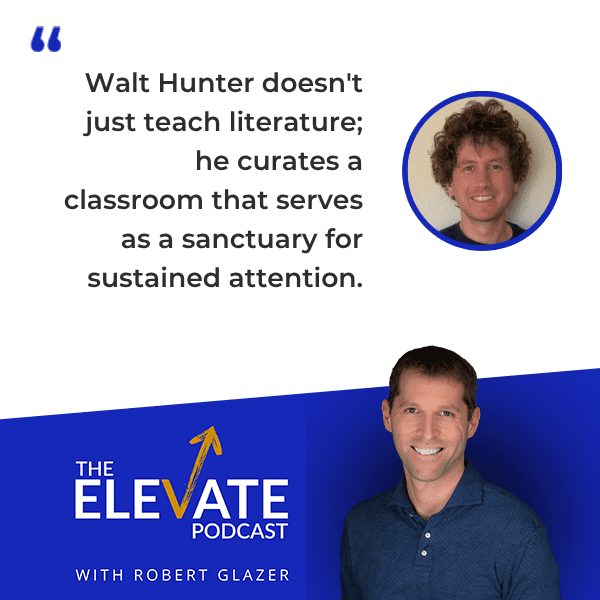
Walt Hunter is a professor of 20th- and 21st-century literature at Case Western Reserve University, where he also serves as Senior Associate Dean for Faculty Academic Affairs. He’s also the fiction and poetry editor at The Atlantic and author of the recent Atlantic essay titled “Stop Meeting Students Where They Are,” where he shared what happened when he stopped buying the story that students can’t read anymore. Walt joined host Robert Glazer on the Elevate Podcast to talk about how he challenges students in class, fighting against shrinking attention spans, and AI in learning.
—
Listen to the podcast here
Walt Hunter On Fighting For Attention Spans And Requiring Students To Read Books
The Transformative Power Of Reading Long-Form Literature
Welcome to the show. Our quote is from Frederick Douglass. “Once you learn to read, you will be forever free.” My guest is Walt Hunter. Walt is a Professor of 20th and 21st century literature at Case Western Reserve University, where he also serves as the Senior Associate Dean for Faculty Academic Affairs. He’s also the fiction and poetry editor at The Atlantic and we’ll talk about that. In this episode, we’re going to focus particularly on a recent Atlantic essay. He wrote titled, Stop Meetings Students Where They Are. That caught my attention and Walt shared what happened when he stopped buying the story the students can’t read anymore.
Walt, welcome. It’s great to have you on the show.
It’s great to be here. Thanks for inviting me.
I always start with the beginning childhood probably relevant in this conversation. You talked about being handed a Tolstoy book at age thirteen years old and how that shaped you. Tell me what was that story. Was that the trigger for becoming a veracious reader?
It was. First of all, I have to say that my diet as a reader extended beyond Tolstoy to such glorious 1990s reader’s choices like Star Trek novelizations and comic books. I was a huge comic book fan. What happened was, I wandered into a classroom in my high school for a teacher who I didn’t even have. We started chatting about books and reading. He had these quotes up on his wall and he shelves the classics. When he asked me what I was reading and I told him. At that point, it was probably something that didn’t inspired to such high literary aspirations. He said, “Why don’t you check out the Death of Ivan Ilyich?” The Tolstoy.
He graduated me on to some harder and longer novels. We developed a nice relationship, but also, I started experiencing that wonderful thrill of immersing yourself in a long novel. Not even being able to follow all of it. I was enjoying the experience of the difficulty of it, and that was where I caught fire as a reader.
That’s not something that has become a mantra these days. I will admit I love reading. I remember reading Atlas Shrugged in college. It’s one of my favorite books. It’s long and fountainhead, but I have also had a Guns, Germs and Steel on my bedside and I’ve been intimidated by it. also, Team of Rivals. Those are the two that are just sitting there unstarted that I need to start that everyone has told me are unbelievable books.
I have sitting right next to me this book Empire of AI that my partner has told me I need to read. It’s live history. I feel like I must read it and yet, it is staring me down since the fall. I know what you mean. My to read bookshelf is formidable as well.
I know you’ve said that the massive books like Warren Peace didn’t always interests you, but you push through bought them and read them anyway. Why was that important to you? What did you get out of those big books? We are all daydreaming through a few pages, but in our societal EDD, what have we lost by moving away from these books?
One thing that we’ve lost is the challenge of trying to understand other people’s lives. Something that could be reduced to a word like empathy, which I never thought would be a term that would be under fire. It is. There is no form of travel that is ever equivalent to reading a book. There are experiences that when one travels that they can’t replicate in reading. Reading Warren Peace’s and Les Misérables, which was my favorite novel for a long time. Maybe still is.
This immersive experience of other people’s lives is critical to being a human being. As much as I sound like I’m reciting something of a cliché. Things are cliché for a reason. Long novels give you that sustained experience of exploring other people’s lives as well as recognizing the vicissitudes of your own moods and your emotions. Seeing yourself in the mirror. Sometimes the fun house mirror of other people’s lives. That’s a critical experience of reflecting on yourself, too. The books help me process.
I’m sure you’ve seen this stat that most Ivy league undergraduate at this point haven’t read a full book in the last year or something like that.
This has to do with a couple of things. One thing has to do with is the prevalence of short forms, which is both good and bad. I find it easier these days to teach a short poem than a long novel. I feel that myself. The other thing it has to do with and this is something we can correct is buying into some idea that attention has changed. I don’t believe that attention has changed. The demands on our attention have become monetized and represented to us.
In ten years, it probably hasn’t changed. It might if it keeps going in this direction.
Good point. It’s a matter of our own agency to resist some of the ways in which our attention is being captured. Books are a way of saying, “I’m not going to let my attention be siphoned off to various platforms.”
It’s a matter of our own agency to resist some of the ways in which our attention is being captured.
You’re a literature professor and senior associate dean of Case Western. You’re also the fiction and poetry editor at the Atlantic. How did you end up holding both roles? How do you balance them? Those seem to be different requests and needs of your time.
I wish I could balance. I started writing for the Atlantic in 2017 or 2018. It’s short essays about poetry. Generally speaking, when poetry came into the broader culture for a particular reason. There was an instance of a judge using a bit of Shakespeare and a decision I wrote about that. As time went on, I took a larger role. Now, I work with a great team of editors. Brilliant people. It’s very collaborative. We look at the submissions for fiction and poetry together.
What it does, honestly, it feeds directly into how I teach and how I read student writing. There’s been no better education for me than trying to edit for a magazine. It has helped me think about my audience. It helps me think about my structure. I work with people who I admire so much and have taught me so much at the magazine. I feel like maybe not balanced, but there’s some synthesis on aspiring between the two jobs.
The “Kids Stopped Reading” Crisis: Assessing Comprehension In The Classroom
Let’s take it into the essay. You open with a line that so many people have heard around many years ago, kids stopped reading. Talk a little bit about the metamorphosis and how you experience it as a professor. I have two kids in in college. I’ve been watching with great interest Harvard’s attempts to put some grade discipline back in. The professors basically saying, “We need you to do it.” Otherwise, the kids go online, grade shopping and they won’t take our class. They won’t learn from me. It’s interesting. I’ve read around all sides of this argument. Have you experienced it as a professor?
Let me take both of the things that you said and pull them apart a little bit. I’ve been teaching in college classrooms since around 2006 to 2007. Over that period of time, I’ve been relatively consistent what I’ve assigned but I have noticed a decline in reading comprehension that I feel is pretty severe. I just mean reading something and being able to talk about what’s happening in it. I don’t mean a more robust form of whatever we might call close reading or analysis. I mean it’s description of what you’re reading. Critical thinking and the ability to represent in your own words if you just read on the page.
I feel it’s never been more important for that reason, for faculty to use the classroom as a vehicle for helping students stress test their own abilities. In fact, they are the support staff for students. When students go out there into their job and they have to read and digestive information. Which whatever AI prognosis we make, they will still have to do. They need to have trained to do that in a setting where they have support from adults.
That’s what college can be and that’s what it should be. When we test students to read difficult work, to comprehend it and to represent it in their own words. What we’re doing is giving them a safe place to do that. If we don’t do that, if we’re living in fear of how they’ll respond to that, we’re giving up on what our job is. We’re abdicating.
Since we have a college professor on, we’ll crap on the high school teachers and administrators a little bit. The average kid comes to you with a 3.8 or 3.9 GPA. There was an upward that a California school was adding remedial math to honors students who all were accepted with a 3.9 GPA. Everyone’s like, “Something about this sentence doesn’t make sense.” How much is great inflation starting at the high school level and younger impacting people’s awareness of what they’re learning or they’re knowledge? How much harm do you think it’s doing?
One thing that I was grateful for after I wrote this article was all the feedback from high school teachers. They’re in such trenches now with the incursions of tech and everything. Both high school teachers and college teachers are facing potentially a contingent of students who are approaching the educational process as something that’s different from an intellectual process. Something that’s closer to a credentialing process or a networking.
If we train our students to expect the college classroom to function in a certain way, then they’ll understand why they got a bad grade if we train them instead to think that. If the colleges decide simply to give them a credential to join a tech firm, then obviously if they get a bad grade, they’re going to wonder where that grave came from. To some degree, we need to frame the college classroom as a place where you are encountering, at least for English, a work that’s written in a difficult way.
You are coming up with an ability to parse the language and communicate your thoughts and feelings about it clearly. That’s going to be something that nobody starts off being good at doing. You will get a bad grade initially and if you work at it, you will get better at it. The way that I’m just trying to frame it here, is not always the way that college is being thought of now and I do worry about that.
The conventional response as things have gotten harder or people had more struggle with attention amongst the high school teachers. Let’s be honest, a lot of its the parents and the administrators. I blame the parents more than the administrators.
You and I are both parents. so we can blame ourselves.
I had a guest on who was pretty interesting. She’s an expert on the science of bravery. I was very vulnerable about how she completely interceded with her child and school around something that she was nervous about doing. It was losing sleeping and realized it was the complete wrong thing to do. It helps that day but it wasn’t the right choice for life. As a result, people keep lowering the bar and lowering the standard so people can get over them. You took the opposite approach. What pushed you to run that experiment last fall and signed full books? I assume there’s an eight outrage.

I looked at the group of students when I walked into the classroom and I thought there is nothing I can lose by giving these students a taste of the things that I found most exciting, pleasurable and thrilling when I was a college student which was reading it a beautiful but classic of American literature. That was Incidents in the Life of a Slave Girl. It was Thoreau’s Walden and it was Toni Morrison’s Song of Solomon and a bunch in between. My criterion was stuff that I thought they would be excited by. I always say to them you come out of this question and you’re going to find at least one book that you think, “That was like the best book I ever read. This transformed my life.”
It’s okay to not like this or I did was hard. I argue with my daughter about this because her she’s very apt oriented with her eating. Let’s curate the restaurant and look at the meals, I was like, “You’re manufacturing out disappointment,” which is a problem. Some things don’t hit. They just don’t.
You need to be able to talk about the things that don’t hit and listen to other people’s perspectives on the things that you’re not as interested in, too.
Beyond “Meeting Students Where They Are”: The Case For High Expectations
Why shouldn’t we meet you? I’d been countering this phrase, we should not meet students where they are with Walt Whitman. Stop somewhere ahead and wait for them to catch up. Talk about the limits of meeting people where they are in education? Where is that getting us?
I never had a teacher who came to me and said, “You’re only capable of doing X, Y and Z. I’m only going to give you this diet of reading to do X, Y, and Z.” I always say to teachers, “This is where you can grow. Here’s how you’re going to do it. I’m going to help you and support you.” That’s key, too. The phrase, meet students where they are, can be understood in a very laudable context as addressing different learning abilities as students have.
I don’t dispute that in any way. In general, as faculty and as teachers at a variety of K-12 school settings, private and public. We don’t do students a favor if we pre-set our expectations based on what we assume about where they’re coming from or where they can go. I like the Whitman quote, it’s this optimistic idea of, “I’m at this point. I want you to come walk along with me up here. I know you’re not there yet but try this. Experiment a little. Take some risks. Challenge yourself.” All these clichés.

As a teacher, we need to bring those into our philosophy of education squarely to replace any idea of condescending to students or assuming that they can only do a certain level of work. They’ve only had a certain amount of preparation. I don’t want to cut off the possibility for any student. I want to see anybody as having a potential for growth. Both the high performing students and the lower performing students.
I’ve done some research on this and the most effective form of parenting matches the most effective form of leadership. There was study almost 70 or 80 years ago. It went and studied and looked at kids. It said, we came from an era where we had high standards and low support. That’s a lot of Gen X kids, but they these were times where you had to work on the family farm and this was necessity. Those people grew up and they said they’re very capable adults, “Maybe I didn’t have the warmth and support. I’m going to swing all the way to high support but I’m going to let go of all the standards.”
In doing that, we swung right past high support and high standards. Which to what you’re saying is, “This is pretty hard. This text is hard. It’s complicated, but I’m your teacher. I’m here to discuss it with you. Let’s talk about it. You can do it. I’m not saying it’s easy, but I’m here as a resource.” I don’t see a lot of that these days but that seems, to me, this winning duality of, “I want to stretch what you think you can do but you’re going to have to do the work. I’m here to help and let me know how I can help.”
That’s right. That’s exactly my philosophy, too. I’ve learned some of it from teaching. I was lucky to teach in a program called the Emerging Scholars Program. It draws in students from the Cleveland Metro School District before college. The summer before, you give them a little bit of taste of what the college experience is going to be like with maximum support and maximum challenge. We read works in canonical liberal philosophy, Hobbes and Locke.
We read all the way up through some contemporary philosophy as well and some journalism and literature, too. These students who might have had meager preparation in some of these authors or traditions. It was thrilling to see them succeed in that class and provide the help with writing about the work that they needed and I needed as a teacher to see how I could do it.
There are a lot of school boards in high schools in towns now in the name of empathy are eliminating honors classes. They are eliminating these classes and saying, “If everyone can’t do it then it shouldn’t be available.” It seems like a generally bad idea. My counter is, we don’t eliminate varsity basketball because not everyone’s good at basketball. It would be the exact same argument. We understand that people are good at different things. Some things are hard and some people qualify for them. What’s your thought? The example you just gave bringing those kids in and upping their expectations a little bit.
It’s a tragedy. I don’t have the research here. I understand that there are lengthy debates around safety tracking in math. That’s something that I don’t want to pretend I can speak to it in an informed way. On the literature side, as a relatively well performing students has been forced to perform even better, my life would have been impoverished.
I’m always conscious of that we don’t want to ignore the students who are getting the As. We want to push them to be even better. The honors class seem to be a way of saying, “You’re good at this. Let’s make you even more proficient thinker, writer, communicator or reader.” I’m in agreement with you there, for sure.
I’d love to talk about the other big thing hanging over your classroom and everyone else is. I have debates going on with my teachers and my kids and that is AI. I’m not sure the education system has a cohesive or clairvoyant response. You rightly predicted it was inevitable. The students would use AI generated essays. My son and his AI classes is writing. I saw some chart on our kitchen counter on poster board on how much cheating is going on in the system.
What is your thoughts and approach? I was talking with a teacher and I said, “One of the things I tell my kids to use it is upload your paper and say, ‘You’re a college English literary teacher. Tell me what grade would you give me? How do I make it better?’ It’s like getting a TA review.” It seems like we’re trying to avoid this or not deal with the reality or not change our policies to understand the reality. There are ways that this can help and there are a lot of ways that this can hurt. It’s a giant mess now particularly at the collegiate level.
Navigating The Impact Of AI In Humanities Education
The tech, in general, doesn’t belong in a Humanities classroom, first of all. I don’t think that it does us any good to have Chromebooks in high school classrooms or AI and college classrooms for the humanities when students are trying to learn how to read in a way that helps them communicate their jobs. It would be almost in equal disaster if we didn’t train students how to think about AI. Here’s where I think we’re not doing enough.
We may be doing too much and trying to bring the AI into humanities classrooms. We’re not doing enough and getting students to think about the history of technology. Also, getting students to think about previous moments in time when people had to engage technology in ways that they felt was depleting or helping them as a society. We’re not thinking enough about earlier forms of resistance movements to technology and early reforms of embraces of technology.
History departments are key role, so do literature departments and sociology departments. Collaborations across the science are critical there too because you need your scientists and your computer science to tell you how this works. Colleges should absolutely require some AI literacy for their students. At the same time, there should be far more skepticism about the ability for AI to help the humanists to do their work.
That’s my position on those two things. I want the presence of AI to be there conceptually so that students can talk about it intelligently. When a student goes into their first job and they have nothing to say about technology, that’s a disaster. I also don’t think that we need to send students into a first job having learned how to fed their essays into ChatGPT.
Technology in classrooms has been a net negative. I think all the data shows. When I did college tours with my kids. Typically, we go see a business school at a school and that tends to be the newer building with glass walls and classrooms. Everyone’s on their laptop not doing anything related to the class from what I can see. Jonathan Hiatus and a lot of other people are basically proving that this is a net negative.
We’re going to look at this as being one of the worst things we did in education. What would the policies that you’d set this? Are you going back to in-class, oral exams and blue books? Are you telling kids, “Don’t have AI write your paper but AI can be good TA?” What would be your ideal state of AI in the classroom or not in the classroom?
In this case, literature is a little bit different than other classrooms. Probably the literature classroom is different than other classrooms. There’s a loss here. I want to say this ahead of time. As I’ve been doing, exclude out of class writing and make all the in-class writing happen during the class period. I understand that is a loss to some students who can benefit from the college education over a few weeks of writing an essay.
There are classes that absolutely should do that. For my class, in this particular class we’re talking about. The policy that I found most helpful is basically no technology at all. They have a book. They come into class having read the book. Sometimes, for accessibility reasons, the Kindle works. I’m pure about things but ideally, it would be a Kindle that you could mark up with some electronic pen. I always read with that. To answer your question directly, my policy is zero tech at all. I allow computers for taking notes because I understand that some students need that, but I may even move away from that in the future, too.
The way you’ve counted this, you assume your kids are going to cheat, and I don’t mean trust them. You’ve gone to basically old-school like in class oral and handwriting down. No technology to prove that they comprehend and read the book.
I want to push back on the first thing you said. I never assumed anybody’s going to cheat. I taught at UVA as a graduate student. There’s an honor code there that’s robust. If a student’s going to cheat, my philosophy is, down the line that’s going to injure you. That’s a matter of character and not a policy. I’m not interested in even in the conversation around cheating. What I’m interested in is just eliminating the distraction and the claims on your attention that technology like AI like these various platforms command. I wanted to focus on the book and the ideas and the conversations that were having.
I’m curious. Is that from peers or students? Is there agitos that you’re doing this? Do they like it? Are they annoyed? Are people going online and they don’t take this class? You’ve got a fill out blue books in class. What’s the market reacting? The blue book is because my kids wouldn’t even know what a blue book is.
None of mine did either. I bought them all for them because it was unclear if people wouldn’t know what I was talking about. I also got them journals to keep their thoughts on a weekly basis and to practice doing that writing. The market reaction is generally been good. I teach in a school where there are a lot of brilliant scientists as students. It comes as a relief that there’s an alternative for an hour or two doing some of the work that they’re doing as part of their major. It’s not an alternative, but rather a companion for doing that other work.
It’s a matter of mental health and wellness, too. I got to say sitting in that classroom and taking time away feels like you’re seizing back your time in some sense that students respond very positively to that. As far as peers go, as I said, there’s a bit of a loss to cutting the out of class writing. Anastasia Berg had a pretty good essay about that. It was in the point and I hear that. I do admit that is a loss that I’ve incurred in a way. For the time being, I want to continue to explore the tightly pressurized environment of writing an essay in twenty minutes in class on a prompt that I give the students that moment. I believe that there’s some benefit in that forming stress with the support.
There was a capstone third grade project in our school, a state diorama for years. My first kid did it and my second kid did it. By the second kid, these things looked like professionally produced. The school put out things like, “Please let your kids do it.” The ones whose engineering parents didn’t do it look whatever. By the third kid, the school was like, “It’s an in-school assignment. We can’t even trust you not to get involved.” Is there a little bit of this or no?
It comes down to something that’s going to sound almost boringly practical or pragmatic. Which is that, given that it’s an American literature survey that starts in the 17th century. I need them to be spending that time outside of class doing the reading. It’s because of how much reading I’m assigning and how much I want to assign.
I want to say that reading time is something that should be taking up about as much time as they would be spending. It’s the nature of this particular survey class. I would call it a reading intensive class. If I was teaching a writing intensive class, they’d be doing out of class writing. I teach those as well but for this particular class, I’ve had to make that choice.
Strategies For Academic Accountability And Ensuring Deep Learning
How do you know that they’re reading the book and not saying, “ChatGPT summarize the book for me?”
Good point. The more confident answer that I can give you is that I did do passage identifications from fairly obscure moments in these texts at the end. I did that at the end as a final exam and I was happy to see so many students nailed that. These students are extremely good here. I love the Case Western Reserve students. They’re terrific students. I wasn’t necessarily this surprised but I was happy to see that be the case.
Obviously, you’re doing literature. Again, it occurs to me that how many kids have gotten a 5 on the AP Lit exam and an A and literature but haven’t finished a book in a few years. Your elevated to head of the department all of a sudden. What would you say is the general guidelines? People seem afraid to put a stake in the ground. How would you set guidelines or other classes in terms of the honor code or the rules about AI can help get?
My friend was saying to me like, “It’s under talked about to say, ‘Put your draft in.’” I loved when people marked up my copies or my dad did it or an editor. It’s great at that, but I don’t hear anyone talking about how to do that. What do you think is a policy that could be more universal that would be healthy within a department overall? If someone said to you, “You’ve got a craft.” Case Western needs a, how we use AI and how we don’t. What’s the strategy here?
The first thing is faculty do have academic freedom to approach, the use of it in the way that they want to. Where I would make a policy would be at a level up from like, you should require students to do the draft here and entered into Gemini. What I would say is, as a department chair these days, I would probably ask faculty to devote time in a class period throughout the semester to having conversations with their students or putting their students in conversation around artificial intelligence and its benefits and costs for them and for society.
I’m looking at students who are going to enter into a world where there are a wide variety of expectations and feelings about AI. They need to be able to communicate their own thoughts clearly about that. I’m less concerned about an individual factory member crafting the right kinds of assignments. I’m more concerned about a department producing students who are articulate and eloquent about AI. I would make that the cornerstone of the policy.
Being articulate without AI doing that. Generally, do you think students, teachers are going to have to? This is the reality. You look at the data. We can say that we trust the students but all the articles say that cheating is rampant. Behavior falls incentives. Do you think people need to get a little more old-school with the, “Sarah, stand up.” An oral exam and blue books.
They’re just going to have to probe a little more to understand what students know, versus what they summarize. There’s a great meme. In the workplace, there’s a lot of AI work slop. There’s a guy who takes four bullets and he says, “ChatGPT, turn this into seven-page memo,” and he sends it to the team. The teams is like, “Give me the four bullets from the seven-page memo.” There’s a lot of that going on.
I might just exploit you a little here. Our response to cheating, to AI needs to remind students that their moral and ethical character matters. The reason why we’re they’re here in the classroom is because a key component of a healthy society is people of moral character. You’re not going to create that society if you’re cheating on your paper. I know that there could be ways in which I’m being overly optimistic here, but I don’t hear these conversations.
Our response to cheating, to AI, is to remind students that their moral and ethical character matters. They’re in the classroom because a key component of a healthy society is people of moral character.
We’ve given up on talking about character. We don’t talk about ethics or morals. I’m saying, we in a way that’s inappropriately universal. I’m listening these conversations around cheating and thinking, the first thing I say to a class of students is, “I trust you.” Again, my colleague, Rose Heart with The Atlantic has this wonderful essay about Princeton in the honor code.
They just had the first proctors ever because people are cheating.
I recognized that there are ways in which what I’m saying is not being backed up by the reality on the ground. The people I admire most as faculty and as teachers in my life, I wouldn’t be able to sleep at night if I cheated in their classrooms. I hope that students would feel the same way about us in this generation.
In the same way that you’re talking about the standards and upping the standards. Do we need to up the standards for accountability? One of the examples I give it a lot. The kids at Columbia University who were taking over buildings, barricading things and causing physical damage seem generally surprised when they were finally held accountable for their behavior. They’re used to no repercussions. That seems like something that has to change. I agree with, first we trust or we set the standard that of, I trust you and whatever. We’re going to have to enforce that on the back end a little bit.
That’s a fair point. Actions have consequences. There have been instances in my life where I had to fail students or have students be dismissed because of their academic integrity issues. If we’re going to say these things, we have to enforce them as well. I have a toddler and I am starting to learn how the right and the wrong ways to try to suggest these things to him.
Parenting In The Digital Age: Screen Time, Boredom, And Attention
Fifty percent of 4- or 5-year-olds have iPads at this point. When will your toddler have technology?
I feel like I don’t want to be a complete casual here because I spent a good amount of time watching cartoons. We’ve never given our child a screen. We take our child on long trips. His attention span, whether that’s a result of innate temperament or screenless, I can’t say. I do attribute some of his patients and some of his general sanguine nature. He’s got an easygoing personality. He’s adept at talking to people and looking them in the eyes. Some of this I do think is a result of not ever having seen the screen at this point. It horrifies me when I see children with screens. I don’t think that we will ever be comfortable giving him a phone or an iPad.
The restaurant thing really bothers me.
The restaurant thing is terrible.
We deserve to have a say into what kinds of devices, platforms and materials are presented as necessary for our classrooms.
It’s one thing even maybe to have it out or whatever. To me, the stand and the headphones. Sometimes, I see it a lot at a nice restaurant. I’m like, “Why didn’t you get a babysitter?” I’m not clear on the point of bringing out your kids to a nice restaurant and putting a movie screen and headphones on in front of them. Are we pretending it’s a family dinner? The worst thing in the world is to have to sit at the table and behave for 30 minutes. I know there’s some exceptions and kids with new neurodivergent issues, but I have a hard time not being judgmental in those scenarios. I’ve read the studies. I’ve read Jonathan Haidt’s work and I know how dangerous it is.
How many times were you bored as a kid? Boredom is a key part. Half the time, I was daydreaming. The other half, I was born out of my mind. It’s not that there’s something valuable necessarily in being bored but you learn how to you learn how to deal with it. You also are not immediately fed some titillating excitement as a response to that fear of boring your child.
They’re social more than, play with your brother or sister. Having done this experiment. If you had to leave parents and teachers and maybe some of the high school teachers who are training your future students with one or two practical things to take from your experiment. What would they be?
The first thing is, there’s no better way of addressing our reading problem if it’s a reading problem in the US than addressing it transparently with the students themselves. Even when they’re young and saying, “This is what I love to do. This is how I learned. This is how I think you should learn. This is what I feel enthusiastic about. This is what I find. difficult. You’re not going to be immediately good at this. Reading is something that like exercise. You need to train at it over time.” It is a primary activity and a skill that you can build up.
Using ourselves as models, even if we have our own shortcomings when it comes to reading, thinking and talking, even if it’s a learning process for all of us. Using ourselves as models is critical as teachers. That is to restore a vision of the classroom with somebody who is in-charge in a ethical, moral and character-driven way at the top of that classroom. I do think if we completely flip the classroom, we lose some of that sense of, “Who is this person? Who’s our teacher? Who’s our professor? How did they learn? How can I learn from them?”
We need to keep that front and center in education. Even if that means retaining a bit of the hierarchy of the classroom, which is probably essential. That’s one thing. The second thing is, teachers are feeling depressed across the country because of the incursion of tech into the classroom. This is something we should resist and we have strength in numbers. There’s no reason why because a particular form of technology is positioned to us as helping with us. We are the experts in that. We deserve to have a say into what kinds of devices, platforms and materials are presented as necessary for our classrooms. We must retain that ability to say that.
Not at your level. Maybe for some parents. I saw a study the number one thing that teachers were asking was for parents to not interfere with their consequences and accountability.
That’s interesting. I don’t have much exposure to that. It’s pretty rare.
Many years ago, it’s unheard of but it is far more frequent now. I always said that college was this barrier. If your parents did not involve with college, but I’m hearing more stories. I’m glad to hear that you haven’t heard from any of the parents.
I certainly trust the parents’ intentions and desires to have a robust education for their children. Being a parent, I understand that impulse. I hope that we can restore some of the trust between institutions and parents. One way in which we can do that is by restoring trust and teachers as the authorities for how things should be taught and not outsourcing that to various third parties.
The last question I always ask and I always say it’s multivariant. You can singular, repeated, personal or professional but what’s a mistake that you’ve made that you’ve learned the most from?
Career Reflections: Learning From Past Mistakes And Staying Committed
A lot of mistakes come to mind. A mistake I made was the first thing that I decided to do out of college was not pursue a degree in writing poetry. It was something that I didn’t have the confidence that I would succeed in that. I have plenty of people who were supportive and detractors of that route, but I made that choice for myself. In some sense, it was a mistake. What I learned from it is that, if you do make that mistake and yet you’re committed to the thing that you have decided was impractical or not feasible at the time. It will somehow find a way.
Using ourselves as models is critical as teachers.
You will find a way of still making it central to your life. Ultimately, it took me a while. It took me many years to write a book of poetry, but it is never vanished from my life. In some deep way, I’m still committed the mistake. I regret it for a long time because I thought maybe I should have done that. It turned out to teach me something about what my own commitments and values were in that case. That was a part of my career path that I’ve often reflected.
There’s some good wisdom in there. Where can people learn more about your writing or class?
I’m constantly on my email. You’re welcome to get in touch with me. It’s Walt.Hunter@Gmail.com. Also, my website. I try to write whenever I have something. I’m always interested in hearing from other teachers and other people who are interested in these ideas. Like everybody else now, I’m trying to be a good listener to everybody who’s facing the headwinds of dramatic change in the job market and technology and in education. It’s always a pleasure to be able to think about these types of things with others.
Thank you for joining us. I hope every parent and teacher reads your essay that wrote for the Atlantic. Not listen to the audio version and follows your lead.
Thanks, Rob. It’s a pleasure to talk to you. Thanks again for this great conversation.
You can learn more about Walt and his work on the episode page at RobertGlazer.com. If you enjoyed this episode or the show in general, the biggest compliment you could bate us is to share this episode with someone who you think could benefit from it or learn from it. Whether that’s via email or text or however else you share things. Thank you again for your support. Until next time, keep elevating.
Important Links
- Walt Hunter
- Walt Hunter on LinkedIn
- Walt.Hunter@Gmail.com
- Case Western Reserve University
- The Atlantic
- Stop Meetings Students Where They Are
- Star Trek
- Atlas Shrugged
- Guns, Germs and Steel
- Team of Rivals
- Empire of AI
- Les Misérables
- Incidents in the Life of a Slave Girl
- Walden
- Song of Solomon
- Hobbes and Locke
- Anastasia Berg


