


Molly Tschang helps senior executives and leadership teams build chemistry, clarity, and trust. She’s the founder of Abella Consulting and the creator of Say It Skillfully®, an acclaimed video series, podcast, and bestselling book focused on making what’s hard to say easier. Molly also created LinkedIn Learning’s first leadership communication course, Leadership Communication in the Flow of Work. Earlier in her career, she spent more than two decades at Cisco and U.S. Filter, integrating over 80 acquisitions globally.
Molly joined host Robert Glazer on the Elevate Podcast to talk about how leaders can build world-class communication skills.
—
Listen to the podcast here
Molly Tschang On Building World-Class Communication Skills
Our quote for this episode is from Margaret Mead. “Never doubt that a small group of thoughtful committed citizens can change the world. Indeed, it’s the only thing that ever has.” Our guest is Molly Tschang. Molly helps senior executives and leadership teams build chemistry, clarity, and trust. She’s the Founder of Abella Consulting and the creator of Say It Skillfully, an acclaimed video series, podcast, and bestselling book focused on making what’s hard to say easier.
Molly also created linkedin Learning’s first leadership communication course called Leadership Communications in the Flow of Work. Earlier in her career, she spent more than two decades at Cisco and US Filter, integrating over 80 acquisitions globally. Molly, welcome. It’s great to have you on the show.
Bob, it’s a pleasure. Great to see you.
I like to start with childhood. Get right in there. I’m always curious if you had any particular experiences that cultivated your interests in leadership and communication.
Absolutely. It was only decades later that I put it all together.

It’s like Steve Jobs always says. The blueprints are there, but you don’t put it together.
Childhood Influences On Communication And Diversity
Exactly. My parents, and they’re alive and they’re my idols, were immigrants from China and from Hong Kong. They came over really not knowing a lot. My sister, two sisters and I, grew up in Upstate New York in Rochester. Beloved Upstate. You know, and it was a great community. We had 1 Black, 1 Korean, and 1 Chinese family in our elementary schools. Not a huge amount of diversity at the time. I wouldn’t say that people were out there to get us, but I remember feeling very judged.
When you feel very judged, you just constantly try to outdo, and I realized that just like being smart, doing gymnastics, playing violin, doing things that other people couldn’t do, was just a way to just create safety, if you will. I said this once to Sandy Agat. He was like, “Being good was a way to just keep yourself safe.”
This whole full circle when people talk about diversity, and I think of it in the broadest sense of people, places, ideas, experiences, that I feel that. You know, I remember what it felt like to not be able to feel like I could say things, to feel out of sorts. My parents my teacher was like, “Chinese is great. Your parents can come in.” they wanted to teach kids how to use chopsticks, which is so amazing for other kids. I was so mortified.
Your parents, could they speak English at that point or not?
My parents’ English is both really great. My only regret in life, really truly, is my dad spoke fluent Mandarin and Cantonese. My mom grew up speaking Cantonese. Now, you would say the dad would speak Mandarin to the kids, the mom would speak Cantonese, and you’d have a trilingual kid. End of story. Back then, because everyone was trying to fit in, we were just like working on English only. We went to Mandarin school, but it never really took for me. That really seriously my only big regret, which they tried. It’s just I think as at that point, as kids, you just you want to fit in.
I think that experience really, again, decades later, informed my sense of that everyone really has value to add. You know, we may have different levels of experience and skills and all that, but we’re all a bit more similar as human beings than not. I think that really helped me be this whole Say It Skillfully thing decades later.
We’re all a bit more similar as human beings than we are different.
You spent twenty years in complex, high-change environments. I’m curious. What did you specifically learn in terms of leadership under pressure and leadership under change? Eighty acquisitions, that’s a lot of change. I do like the phrase that “Everyone loves progress, no one loves change.” i’ve found that to be true.
Leadership Under Change And The Power Of Trust
I think I feel very blessed to have been on a number of truly high-performing teams. Bob, it took me years to realize that a lot of folks just haven’t had that experience. Here we’re talking about it and I’m like, “These people just never felt it.” I would say when you’re among folks who are great at what they do, if not the best at what they do, they do what they say they’re going to do and the trust is just implicit.
When you have that dynamic, you can fly. That alignment of mission and things that are classic leadership. We have a sense of common direction and we’re aligned on what we’re doing. They have that term in the corporate thing, the RACI chart, the roles and accountability. Whenever that comes up, I’m like, “We have a problem.” It’s like, “NASA, we have a problem,” because in the high-performing teams, you’re just there to do whatever it takes.
Yes, you have a sweet spot. People know your sweet spot. We know our strengths. We know our weaknesses. I think that level of vulnerability and openness, vulnerability is a must for trust, folks, that’s the thing that I think lets it rip. People aren’t worried about how they look. They’re not worried about outranking another person because we’re all there for what I’d just affectionately call the greater good. We’re very aligned on whatever that simple vision is.
To me, that is what really was the most fun. That’s when it got less fun, when you miss those kinds of pieces. This is where the communication piece comes in because our ability to know where we’re at- I mean, effective communication 80% I think starts within. “Where am I at? What do I really think? Is this about me or am I really here to communicate something that’s going to serve the other person or the greater good?”
Once one can deconstruct it, and I think your whole life is like, “How do we do the work to get to know who we really are?” we’re work in progress our whole lives. Doing the work, it’s not always pretty. We see things in ourselves, we’ve done things. The mortification factor of things that i’ve done, we could go on and on. You can either let that be a boat anchor for you or you can let that be a learning opportunity to say, “I got it. I’m human and i’ll be better tomorrow.” I don’t want to make it necessarily easy, but it’s sometimes it’s quite simple.
You’ve really made your expertise in leadership around communication and the whole Say It Skillfully brand. I’ve watched you say a lot of things skillfully. I think what you said there, obviously, we’re going to spend a lot of time talking about that, but I think the internal piece is interesting. Let’s start there. I recycle the Gandhi quote around happiness in a lot of different ways, his, “Happiness is when what you think, say, and do are all aligned.” It would seem like this is where a lot of communication things would start. It starts with that first thing of like, “Am I saying what I actually think or believe?” Is that out of because I don’t know for a lot of people or is it because I have concerns about what I think? I don’t want to be clear about what I think, and I’m trying to think about like what might come off the best, but is then really inauthentic? Let’s talk about this inner piece first because I’m sure we’ll be knee-deep in the tactics on the outer piece.
The Me Part Of The Say It Skillfully Framework
This Say It Skillfully framework is Me, You, We. That’s these three parts. The “Me” part is just understanding. Before you say anything, like, “Where am I at on this?” you want to go in and we talked about a personal situation. You want to go talk to your in-laws about X. The first thing is like. “How do I feel about that?” “I’m annoyed,” or “I’m scared.” All those are valid.
I want people to feel comfortable about feeling what they feel. “Why do I feel that?” “I’m afraid, I don’t want to offend.” You don’t want to offend. If you share something that could help someone be better, that could help someone see something differently, is that more important or are you worried about you offending? I think when people deconstruct it, it’s easy to say, “Well, no, I really want to help.” Okay, you want to help that person.
Let me stop you because I have some questions on that because we were joking a little bit about this before. There seems to be a cobbler’s kids’ problem. If I’m trying to be clear on what I think and I’m having this circular discussion with me in my own head, does that work or do I need to ping it off someone else? If I have a therapist, can I talk about it with them? It would occur to me that we’re not the best judges of clarifying what’s in our own head due to some cognitive dissonance. I don’t know. What’s your thought on that?
You’re getting at a very advanced level. I think some people can really churn in their heads. Super-numerate. It is what it is. I think in the moment of a conversation, the ability to get whole with myself and not necessarily have to go through 50 years of what happened to me. I think there’s a balance there. This gets in the line of do the work, Bob. If there’s something that’s going on in your life, people have gone through a lot of stuff. There’s been trauma. Some people genuinely have PTSD from things that have gone on for them. Hopefully, they will get someone to support them and help them so that doesn’t become a boat anchor.
Let’s take a common one. Again, a non-work one because I hear people say this a lot. A kid who thinks that parents are playing favorites and is frustrated by it. It’s usually the older kid who thinks held to different standards. Are you the oldest?
I am the oldest.
I could see by the look on your face that there was something. I’ve heard this come up a lot with people. If I want to say something, right, I guess I have to be clear about am I frustrated? Am I jealous? What is my motivation in this? Am I driven by fairness? What’s my motivation in the first place?
Absolutely. You have to understand what what’s going on for you and then, “Why do I want to bring it up? What’s your intention? Are you trying to make your parents look bad? Are you trying to make them feel bad?” it’s saying. “If there’s something that you just think could help the family dynamic be better, what serves the whole?”
Yeah, what’s the impact?
Yeah, what’s the impact? You want to share your experience in a way because it’s going to help you be a better member of the family and help you feel better about you. That’s legit. Say, “I’m noticing something and I want to bring it up. I know that you value all of us and you love us all equally in our different ways. There’s something that’s been going on and it gets under my skin. Can I bring it up?”
You want to share your experience in a way that helps you become a better member of your family and feel better about yourself.
Do you have a lot of other prompts like, “I’m noticing something.” That’s a good prompt.
“I’m noticing,” “my experience is.”
That’s the CEO, YPO. I will say having learned how to do that in EO and YPO over the years, I have brought that to all other conversations. It is a really good rubric of, “My experience in this is,” yeah.
As a to play on that, what happens is a lot of times our reaction is “You,” which of course puts the person on their heels. If we can own, “I’m feeling,” That just says, “I’m fully owning my fair share and you’re not at the outset putting somebody on their heels,” which you can see how even you’re not trying to put make them feel defensive, that can be a natural reaction.
Let’s flip to work on this. I’ve done some difficult conversation training and scripts and I find that people are just absolutely terrible at this. One of the scripts that we have in a role play thing is, and you would probably find this fascinating, I don’t know if I have any videos of it is we have a group of leaders sit down. This came up because over the years, people would have to have a conversation about someone leaving or otherwise and the person was totally surprised.
I would be like, “I thought you sat down with them like 30 days ago and went over them.” I’m like, “I did.” I’m looking at the form review forms in the last year, and I’m like, “They shouldn’t be surprised. What are we missing here?” We sat down and we came up with a bunch of role plays and situations on this. My favorite was the what we called the New Employee Check-in.
The audience of leaders watching this has both cue cards and they see both sides, but the person who’s acting this out only has one cue card. We’ll call it Molly on the left. It’s her first 90 days and her cue card says, “You’re Molly and you’ve made some mistakes in your first 90 days but you think it’s going really well and you like the company and you want to know what’s next? How do you get promoted?”
Bob’s the manager and Bob says. “ Molly’s on your team and she’s started off and made a lot of mistakes and is losing the trust of her team and like, you’re not sure if this is going to work out and you need to like really let her know that these are like potentially fatal flaw issues.” we let them go and Bob starts with a “Molly, how are you?” “Good.”
After having done this with over 100 people, after about 10 minutes, and this is like fake, I hit timeout and I ask the other leaders in the audience, “How many people here think that Molly knows after 10 minutes of this conversation that her job is on the line?” We haven’t had anyone raise their hand. I’m like, “No wonder we’re having a problem.” this is fake. They give Bob feedback and then usually the next time, Bob, because he’s defaulted to the crap sandwich and I can see why it’s confusing. The next time, usually the starter really matters. It’s like, “Molly, we’re going to have a difficult conversation and I want to make sure you hear me and we can talk about it.” i’ve just been shocked at how many people think they’re getting something through and it’s not even close.
Yeah, so you get to the point, to the heart of it, which is people feel bad. They just feel bad. I think this is very easy to rectify because you want to help people realize that we want to have the best folks in the right seats on the bus. Our responsibility is to ensure that that’s the case. This isn’t an optional thing, you do your job. If you don’t do your job, you are part of the problem. This is the big thing that I realized in communication. People have to have a driver for change. Why would I communicate differently? If you don’t, you, my friend, are part of the problem.
By the way, you’re highlighting on something here in this form but I have brought it up, I have written on it. Many people don’t judge or evaluate their leaders for- for their leadership capabilities. The things that they needed to do, like, “Did you have the hard conversations and you deal with the underperformers?” They evaluate them on their production, which is not the primary aspect of their role. It’s like. “Are you doing your job as a leader?”
This is a really great point. Everyone can complain, “Can’t believe that person is there.” I say, “Well, did people bring up the fact that I’m noticing that our leaders are people who have produced a lot? If I sit back and think about some of these characteristics, we don’t seem to have an opportunity to input on that. I’m wondering how that is, why that is, is there a possibility?”
This is what I really want to empower every single person reading. This is not everyone else’s problem. We all have agency and we can put out there what we think could best serve the whole. In a way that really is about “I want to be part of something amazing. You want to be part of something amazing. Let’s make it more amazing.”
To this performance situation, labeling it “hard” or “not hard,” I mean, you can do that. I might go in and owning it as a manager. “My job is to make sure that all folks, all of our talent, are in the right spots, doing the right things, and working to their best capability for the organization to thrive. Part of my job, this is early on before you have the hard conversation, early on, so my job is to help you be amazing. That means I’m going to try to give you very direct, timely input in the spirit of helping you be your best. Are you good with that?”
You create a contract. “And if it’s ever unclear to you what great looks like because I haven’t been clear,” now notice how I’m owning that. “You didn’t get it, but I wasn’t clear. Your responsibility is to come back to me. It will not be okay for you to say, ‘Well, I wasn’t really clear.’ I’m counting on you. This is our relationship. Does that make sense?” There’s a little bit of a contract between manager and person. This is all cheerful because you’re here before anyone screwed up, okay?
Giving Direct And Timely Input Using A Number Scale
As we go through that ability to do the check-ins, I like to use numbers. I did a video on my site specifically for this because millions of people have had this situation. “While I understand you went through this project, let’s do a debrief.” Notice I haven’t said anything negative. “How do you think it went? On a scale of 1 to 10, 10 being like flawless, how would you rate your execution?” “I think it’s an eight.” You’re in your mind you’re going, “It’s not an eight.” you show curiosity, “An eight. Say more. Why is that?” Less talking, more listening. The person and you’re listening, you’re understanding. “What is their experience of it?” they feel heard.
You’re like, “Okay, I really appreciate that. I’m going to be upfront. In my view, it was a four, and here is why.” Not “You were bad,” but “These were the things, these were the behaviors that I expected, so that.” Now, having said that, “What do you think?” They can disagree. “Okay, I can see that.” “Great. What I’d like to focus on for the next period of time are these two things. Are we game? Great.” You’re giving them a chance to succeed. This is Ken Blanchard’s “How to give them an A,” we’ve heard that before. Not “How do I pummel you and show you how bad you are.”
The only goal of feedback is so that the person can try to improve. It’s not like for us to point out all your flaws. That’s not the goal.
That is not the energy. “I got to tell them this bad thing.” Okay, well, you can go in there and of course if your manager came to you with that death and destruction face, you would feel horrible. That’s your job as a manager, as a leader, unleashing your talent. You and I would agree on this. I think some people would not agree. How do you unleash the human potential collectively? Working well with each other.
That’s your job as a manager and a leader: unleashing talent. How do you unlock human potential collectively and help people work well together?
That’s a curious conversation. I do think your openers and we could talk about the Win As One framework, but openers are important. When you have to have a real serious conversation and they need to accept that it’s grave. This is where people get in trouble with the deep platitude. How important of it to clarify that right up front?
Presuming we’ve had these series of conversations and you can say, “This is our fifth conversation.”
Right, then it shouldn’t be a surprise, yeah.
It’s not a surprise. The problem is when it’s a surprise because the person is like, “What?” I think, “This is our fifth conversation. I really can see how much you’ve been trying. We need to be upfront.” I’m going to tell you that the people know, they know it’s not working.
They just don’t know if you know.
You’re not doing you or them any favors. It’s a relief because they’re in the wrong job. They’re good people. We have them with the- in the wrong job with the wrong skills. There’s something wrong about it. They’re not a bad person. Say, “Okay, this is we’ve tried really hard. I think we really need to be upfront about this. I think it’s time to move on or help you exit,” whatever, but not in a shirking back way, but in a way that, “We did our best and we want to create a space for you that’s going to be awesome. It’s just not this place.”
We were talking about this before. There’s a mantra I found myself using in some situations, which is just like, “Clarity is kindness.” When people are confused about what to communicate or whatever and when there’s been unclarity, there’s frustration. I think there’s some desire to soften the blow. Interestingly, in this training, which at some point I should have you look at, when they got the feedback, and the second time around, you could actually see the discomfort in the new employee in the conversation because it was super messy the first time around.
In the second time, they would start off much more directly. “We got to have this conversation. I got to talk about,” then we’d ask the person, the employee how they felt. They were like, “Actually, it felt better even though the news was bad because it was super clear and there was a lot of awkwardness in the first one and dancing around.” They preferred being told they were losing their job, like, essentially when they had more clarity about what the person was saying.
Clarity is respect. One phrase I will give folks is, “i’ve said a lot. Share with me what are you hearing.” Pause. You let them just say, “Well, I’m hearing.” If they parrot it back exactly what you said the way then great. If not, it is not, “You didn’t get it.” It is, “Thanks for sharing that. I wasn’t as clear as I needed to be on X, Y, and Z. Let me try again.” You have to hear from that person what you want to hear.
Communication is your most important skill in life. How you communicate is part of how people experience you.
This seems to be a key thing. Cognitive dissonance is the most powerful force in the universe. We will do anything to protect ourselves from ourselves. You can be as clear as possible. Do you prefer it’s auditory, written, does it matter? I’ve heard people say the same thing. “If I ask for feedback and you give me the feedback, even a managing up, I might have heard a totally different thing. Replaying what your concern was and making sure I understood that is important.” Does the method of replay matter? Does every conversation that’s complicated need a like rewind at the end of it?
I think you know the person and you know the history of whether we tend to leave and not be on the same page. This is accurate shared reality. You want to ensure we have an accurate shared reality because that’s how we’re going to make the best decisions, execute at speed, and do our greatest output. That shared reality is not just the hard facts, it’s also the human experience. That ability to tease out where people are at, how are they feeling and ensure that we’re on the same page about it. Not to judge it, but you have to have the same understanding.
If it’s serious, though, do you think that the written follow-up is important? Just so there’s no interpretation issues.
It can be written. It can go to HR and we have all our lawyers. This is way over my pay grade. I just think it helps say, “I really appreciate our conversation. 1, 2, and 3, here are the things that we covered. I really appreciate.” It doesn’t have to be an annoying, “I’m documenting this to hold you account.” Say, “I want to make sure that I’m understanding that we’re on the same page. Are you good with this?”
We used to say this for the acquisitions, Bob, for press releases because it’s very easy. “We have synergy and we’re coming together.” when you write the press release is when you know, “Are we actually aligned on why we’re doing this deal? Why we’re buying this company?” etc. You put it in words. Putting it in words is very powerful and everybody knows it takes way more time, less is more, to get it really concise and very sharp takes work.
Talk a little bit about the Win As One framework because I know we’ve danced around it, but let’s nail that for people.
The Win Is One Framework For Leadership Teams
There are two frameworks. One is the Say It Skillfully one, which is the Me and the You and the We. I just really want to encourage folks to lean on it because communicating is your most important skill in life, much less work. We are never taught how to do it. That’s the paradox.
Particularly the tricky ones, yeah.
Negotiation training. It’s a very individual and personalized skill. Individual in that you have a unique voice and only you can find it. Molly can’t find your voice for you. People have to do their own work. Personalized because how you use your voice is not a one-size-fits-all. That’s why I think a lot of training fails because they want to be able to say, “Did you get 100?” you can get away saying things that I can’t get away with and vice versa. I want to encourage folks to realize You have to do the work and you’re a unique special gem and how you communicate is part of how people experience you. It’s just so game-changing to get that.
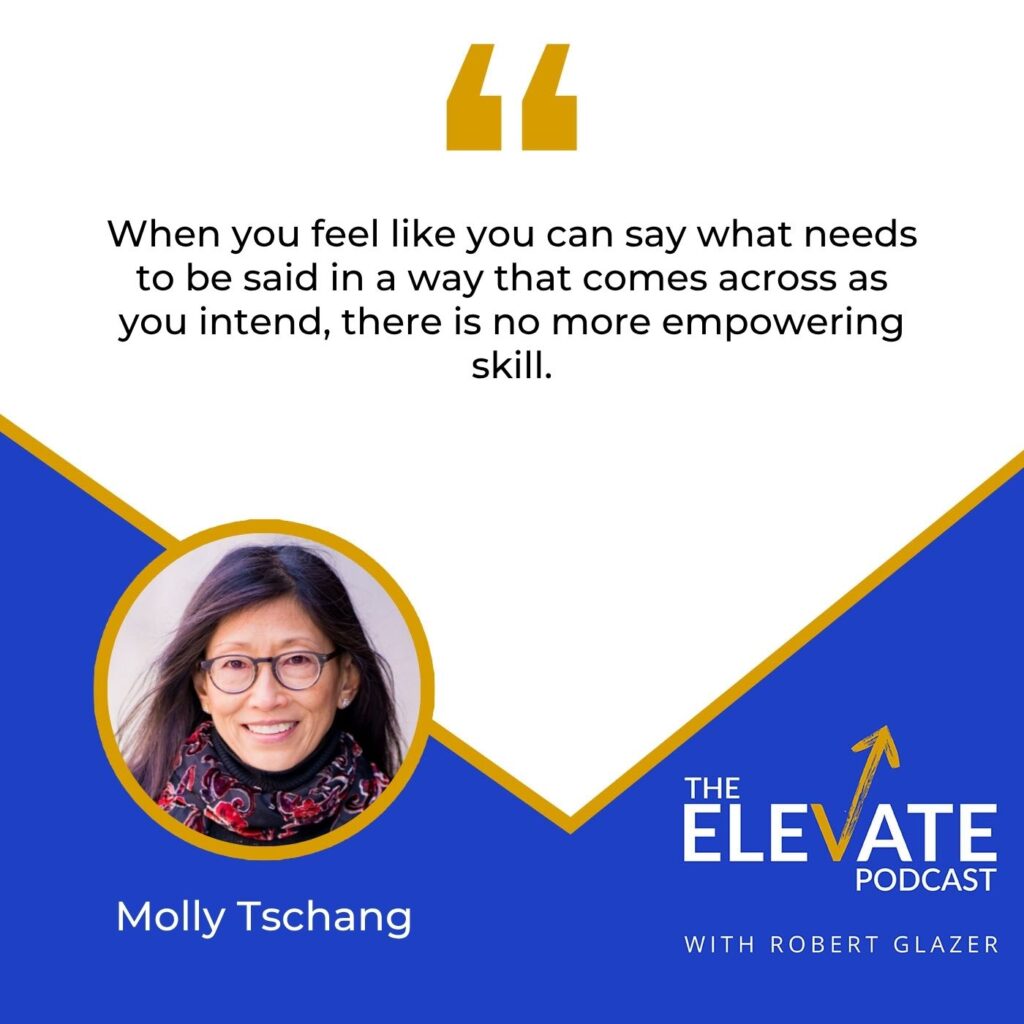
I can tell folks, when you feel like you can say what needs to be said in a way that you come across the way you intend, there is no more empowering skill. It is the best thing ever because you can do what you think is right to the best of your ability and sleep well at night. You have peace of mind. Peace of mind is huge. I just really want to encourage folks to lean into this and to realize how much of it is within really our control. I just want to say, you can do a perfect job but we don’t control how people respond to it. You have to feel good about doing what you could do with compassion, with care.
You control what you can control.
Exactly. The Win As One, getting to that, to me it is about committing to each other’s success and leadership teams leading powerfully together as one because culture starts at the top, Bob, as you know. Oftentimes, when I was coming up the ranks I would see very smart, very experienced people, lots of expertise. They wanted everyone else to work like a team, the leaders did, but the leaders were doing a not-great job of it.
For example, this person really hates this person. Now their teams know that they hate each other. They’re running around pretending that they also hate the person. Down here they’re trying to figure out, “Well, let’s make it all work together because we know that we really need to work together.” I’m just like, “This is not really happening. Really? You’re trying to sabotage each other?”
I also get that this can be the experience in a bit of a corporate rat race where, “How do we make Bob look fabulous so they pick Bob?” Bob is like Bob at all costs. I can throw anyone under the bus that I want to throw under so I get promoted. I’m being extreme, a little cheeky here, but we get the drift. If we’re here to really commit to each other’s success so that we win together and create that environment where we are all part of something that’s far greater than any one of us can be, that’s what we want. That starts at the top. That ability to have to create the trust, which means vulnerability. When I use the word vulnerability, especially with leaders people would rather clean toilets. No one wants to be vulnerable and it’s also a judgment.
It’s so funny, it’s never bothered me. I don’t know why.
That’s a good thing to realize because I think it helps you model for others. You know Brene Brown. We love Brene Brown. She’s like, “It’s something you have to do.” It’s also you have to figure out the way to do it so that you’re real. At the end of the day, people want to work for people that are real. Plus, you don’t have to bleed to them. You’re not trying to like be a bleeding heart and share everything. That is not the point.
A friend told me on this. This gets really confused. People want actually vulnerability with confidence. Again, you want to see your leader cry every once in a while or show some emotion or whatever. You don’t want your leader crying every day and being an emotional mess and there’s some real research on people want vulnerability but they want confidence. They want confidence in the people that they’re following and so that’s really important like there was someone joking with me they’re like, “We just know they’re going to cry.” that’s not the reaction you necessarily want.
No, I totally agree with you. Again, it depends on the leader, but I think this is where you cultivate the folks who are close to you to tell you what you need to hear. Stop being surrounded by yes people. We’ve all seen this happen. You’re like, “This is not helping the leader, it’s not helping the organization. It’s a bummer.” When you get into that environment, it can be doing good work. It’s never going to be great.
In your mind, what percentage of leadership problems are fundamentally communication problems?
Leadership Problems Are Mostly Communication Problems
It’s way North of 80%.
I was going to say maybe 90%.
I would go 90%. I use this model, the direction, the alignment, and the commitment. The block and tackle. Do you have a vision? If you don’t have a vision, it’s a problem. How do we communicate the vision in a way where people feel like they understand it and they know their role in making the vision happen? It all gets down to people appreciating what it’s like for other people. It’s hard. I’m having my experience, you’re having yours. That’s where we’re at. To be able to say. “Okay, I know mine but, what’s really going on over there?”
I will use the performance reviews as a great example. The managers are always so happy. We’re having a survey, people are giving performance reviews. They think it’s fabulous. The people here are like, “We have another review. We’ll give input. We never hear what’s happening or what’s changed or what not. I’ll do it but, and I’m not really sure if it’s anonymous or not.” there’s this huge gap. People ask me like, “What do you think about the 360?” I can think there’s a lot of value. I’m not saying it’s a poo-poo, but wouldn’t it be better if people felt comfortable to tell you what they really thought instead of having to be anonymized?
The how on that matters. 360, again, if we’re doing them once a year and it’s all new material versus it’s a recap and people are getting this feedback on an ongoing basis. You just said something I’m curious. I have a strong opinion on this. Obviously, there’s some legal protections and stuff where you want channels for anonymous feedback in companies. In general, how do you feel about anonymous versus open feedback channels?
I think it’s really great to provide all. I think some people say, “Some people are uncomfortable.” I understand that. I think that what we want to say is we really want people to be comfortable to share what you really think because we value you and we want to hear it. Nothing signals safety more than hearing what you might not want to hear. Taking it with grace and you may not agree. You help people understand why we’re not acting on that because people realize the leaders are the leaders and the leaders make the decisions.
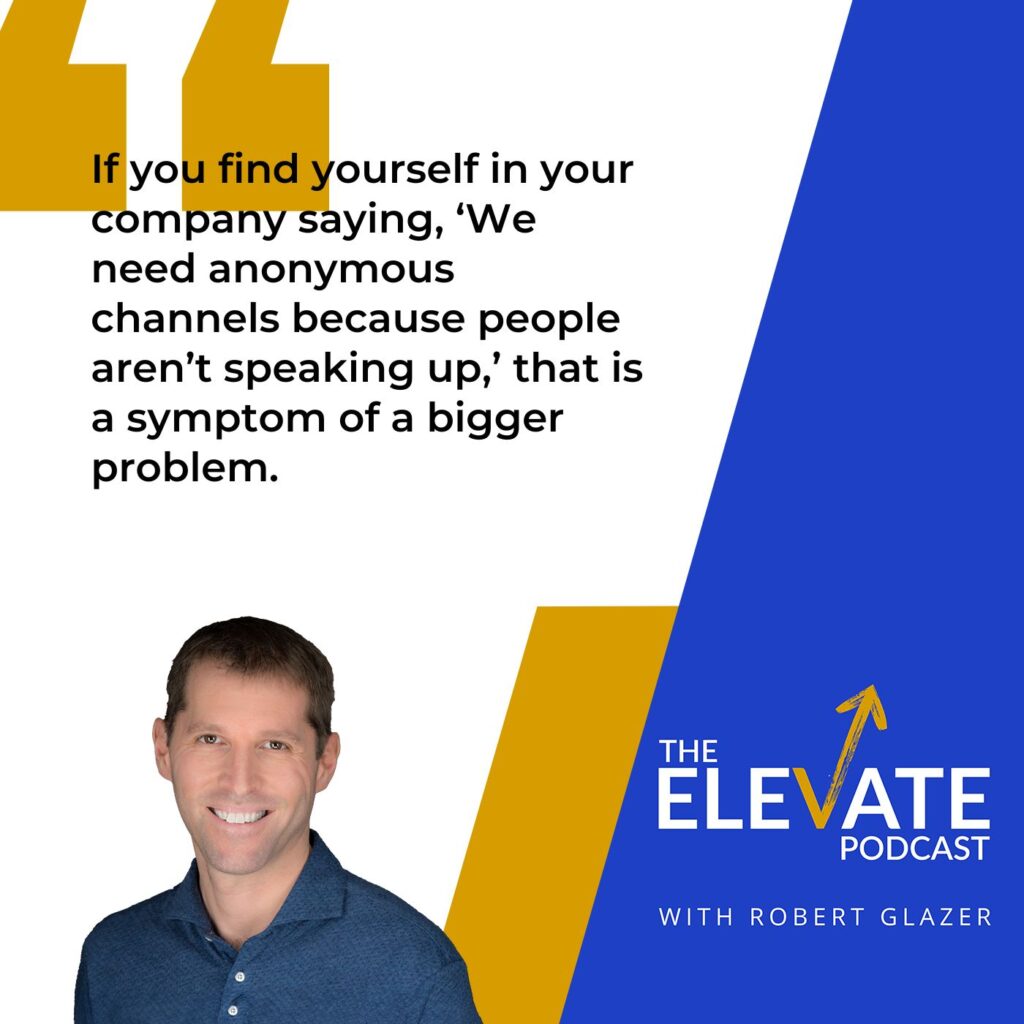
It’s a symptom. If you find yourselves in your company saying, “We need these anonymous channels because people aren’t speaking up,” that is a symptom of a bigger problem.
“We love that.” I just this is where the big mantra of Say It Skillfully is. We’re all part of the problem and we’re all part of the solution. For sure. All of us. We’re overreacting, we’re not patient enough, we’re not listening, we say something too soon. Every one of us is at some point part of the problem. The beauty is when we realize that or when someone cares enough to tell us that we can shift and be part of the solution. I want to normalize that for everyone wherever one is in an organization we’re on both sides of that coin and the opportunity is to help people get onto the be part of the solution part of it more often than not.
Yeah, we had a lot of anonymous feedback mechanisms early on and we used this tool. Eventually we tried to abolish most of that because we felt like the anonymous feedback A, isn’t helpful. “My boss is terrible and I’m thinking about leaving.” Okay, I can’t solve that. It matters which boss, which group, and all of this stuff. Again, I- I want to know this and I want you to see I’m doing something.
You also can’t tell if one really loud person is sounding like ten people. Everyone’s got like little bees in their bonnet but we want to solve problems that were problems for more than one person. We couldn’t tell whether is this 10 different people complaining about this or is this 1 person that has submitted this ten times to anonymous channels?
Here’s what I would say. When we’re getting that, you’re like, “Do we have a mechanism to truly understand how our managers, our leaders are showing up for their people?” Managing up is a skill. Lots of times we’ll have and I’m not saying they’re bad people, but they’re exceptional at managing up. They are not necessarily that same person when they manage their teams. It’s really important to be able to suss out, to have the conversations and the comfort to say, “No one’s rave reviewing about whoever. I don’t get any rave reviews about that. What’s going on there,” and digging deep.
It doesn’t take a lot, I think, to just see the dynamic of how people interact, how safe they seem to feel or not. You can tell when people feel that they are open with their team and you can see some conflict, you can see people going into it, you can still see compassion and caring for each other. I don’t know, I can see it. I think you can see it. Maybe some people are blind to it.
To me, cultivating this communication capability is an essential part of being a leader. It’s not an optional. If you can’t, to me, if you don’t have it, sorry, we’ll find you in some technical advisor role, but we can’t put you in charge of a bunch of people. It doesn’t work. Some people, it’s not the right thing and so now we’re torturing everyone. We’re torturing the leader. We’re torturing the people. That’s a bummer. Everyone has seen something like that. These are senior kinds of decisions. When they’re not being made, it does put the base at a little bit of in between a rock and a hard spot. What are they going to do? They can only do so much.
That takes real genuine humility, I would say, Bob, to be able to go out and say it. This is the thing I want to say for leaders. Confusing approachability and accessibility with the fact that people are telling you what you need to hear. Those are not the same thing. “People love going to drinks with Bob. He’s so amazing.” You think everyone thinks you’re fabulous. Are they telling you the stuff that you need to hear?
Don’t Confuse Approachability And Accessibility With Hearing What You Need To Hear
Wait, that’s approachability, not accessibility. Which way is it?
I think of approachability as people can come up to you. That’s great. They can, “How’s the picnic? How’s your daughter?” accessible, that you are available. Those are great. Don’t confuse either of those with the fact that people are telling you, “No, this leader over here is bumming out their entire team and they all want to quit.”
They’re together. Let’s talk about the other side. How you communicate upwards and give feedback and do it in a way. I remember we had a member of our leadership team years ago and she was eviscerated by the facilitator, this was a very long time ago, because she would constantly say things like, “Well, I keep hearing,” or “Everyone’s saying.” He was like, “Look, you’re in a leadership team meeting. Don’t do that. Either be like. ‘I have concerns about this,’ or don’t hide behind it.”
Obviously, that was at a leadership level. We see this when people are giving feedback and if it’s anonymous or hiding behind it. Talk about this, when I want to strengthen my opinion by saying, “We have a problem. I used to do very open town halls. We had anonymous questions. I had a problem and people gave feedback that we were defensive about this. I know that we were, but I don’t like these types of questions. The question would have unfounded statements in it.
I felt like it was hard to not address that. For example, if they said question, “Why is everyone leaving because of a failure of us to do the pay increases?” or something like that. I’m looking at the exit data and like it’s just not true. Something else where they are, again, taking something that they believe in, generalizing it, and forcing that into the issue. I understand the natural inclination to do this. It’s a little more scarier. It’s more covered to say, “Everyone.” talk about like what- that approach and how it can hurt the person who I think they’re trying to get some air cover with.
I had a conversation with someone, actually, a friend, this came up. I think there’s a lot of opportunity in this. Someone’s saying this loaded statement. First of all, you thank the person for speaking up. You love that they feel comfortable doing it and this is how we’re all going to get better together. I just want to lean in a little bit to the statement because I’m not sure I’m tracking with it. When you say this, when you say that, in a way that’s like, “Am I okay with that? I don’t really know that it’s everyone.” Helping people realize you will be held to account for what you say. You’re being nice, you’re not this person’s not losing their job, but you’re helping educate people to say it’s not okay to say “everyone.”
It’s how you do it. I probably didn’t do it skillfully, and they were anonymous. I would say something like, “I’m happy to answer this question but I also have a little issue with how this question is worded because it makes a lot of assumptions.”
Now you’re giving the answer in the Bob world, according to Bob. You could say, say, “The anonymous is being used. That’s awesome. I want to unpack this one a little bit because I want to help everyone realize that when you use your voice, we’re listening. I want to be able to have questions that we’re going to be able to be better for them. I get that there’s venting folks, so in this case, I’m just going to point out a few things that make this hard for me to really address.”
I struggled with that. That was the hardest ones for me when the question stated a false premise in it. It was hard.
I think you say it’s a little bit hard for me. I don’t want to come across defensive. You guys can imagine if you were in my shoes, you’d feel a little defensive. I think this is the thing for leaders is that it’s scary for the rank and file, even if you say you’re approachable and even if they know they’re not losing their job.
Yeah, they say, “They think everyone is cover.”
You have to say like, “I love this question.” Own it. Own something. Own whatever you can own so people realize it’s safe. Also realize when you bring stuff up, we’re going to take it seriously. Don’t be like you want to immediately get rid of those venting kinds of things. People will get that. I like the idea that people can use their voices in a lot of ways. I think we want to create, to me, the understanding that it’s everyone’s job in a place where you truly put people first, speaking up is not an option. It is a shared responsibility in service to better decisions, to stronger cultures and to the greater good.
You are responsible to speak up. Now, maybe you can’t speak up in the full group. You come one-on-one to a leader. I’ll give you that. It is not okay to vent with your- your colleagues at the cooler. We’re not doing our job. I think when people appreciate the communication is a team sport we’re in it together, that’s when you have a chance to really spread your wings and fly and create that environment where you can really help people be who they are, be respected, but do collectively your best work because that’s what we want to do. We want to crush it.
When people understand that communication is a team sport—that we’re in it together—that’s when you can truly spread your wings. You create an environment where people can be themselves, feel respected, and do their best collective work.
The Simplest Playbook For Preparing For A Tough Conversation
We talked about leaders having these tough conversations. I know you coach a lot of people around that. People lose sleep for nights or weeks or whatever. What is your simplest playbook for helping prepare someone for a tough conversation?
Me, You, We. The simplest way. I say to folks, “If you want to consider it a tough conversation, I’m you’re happy to label it.” I would just say, and I asked this to my nephew who shot a three-pointer, I say, “When you’re shooting all those three-pointers, what are you thinking?” He goes, “I’m thinking this is easy.” I can’t even get the ball to hit the basket thing, much less get the three-pointer in. I just would be aware I’m making this hard like “Is it really hard?” I’m here to serve the greater good. I’m helping. I just think that’s part of the “Me” part. If you use the framework, which I do all day long, sometimes it’s microseconds. It might be I’m going to spend 30 minutes and sit back because this is a big topic.
I also want to tell people, sometimes you’re trying to solve this, you want to get everything that you want to get out in the first ten minutes, which is like a firehose for the for person. Put yourself in their shoes. Maybe it’s a series of chats. Do they even see a problem? Do they understand X, Y, or Z? Bring the person along. We all know that we want to enroll people into.
In terms of the tactical, i’ve heard people say recording yourself, talking to the mirror, practicing on Zoom. What are some mechanical?
I tell people in my course, Say It Skillfully 101, you take your voice memo and you record it. You say, “Would I want to hear that from me?” was I racing so fast that the person couldn’t even breathe? We get a little nervous, totally understandable. Having a bit of a dry run on it is great. The most important part, when people work with me, after all is said and done, they’re like, “The words, exactly how I say them.
What’s really most important is am I showing up with this energy of kindness, of compassion, of caring, of helping, of partnership, of being on your team?” When people feel your good intention, even if you botch it up a little bit in the words, they realize that you’re there to help and you want to do the right thing even though it might not be easy.
All right, here’s the hot question of the day. AI is everywhere now. Everyone is using it as their coach, therapist, business partner. I’m sure they use it to draft, refine, or rehearse communication. How do people use AI as an asset without it becoming a crutch or losing authenticity or outsourcing their thinking? I’m sure you’ve seen good and bad here.
I’m hardly the AI expert, but i’ve used it and I love it. I’m learning it to learn how it can be a partner for me. We all know when you put stuff in there and stuff comes back, it may not be true, so you have to corroborate the actual factual part of it. Especially when it comes to communication, it can be such a helpful guide.
“I have this conversation I want to have with someone and there’s this, this, and this, give me an opener.” You can use it as you would use like Molly or a friend. I have a Molly-Bot. I haven’t put it out, but I have a Molly-Bot. It’s fantastic. I understand it’s a big unknown. I think there’s a lot of things about it that people are very gung-ho without really actually knowing. I just think when that happens, you get a little bit over your skis, which is natural.
For the folks who are saying, “I want to explore it, I want to get to know it,” we want to grow together with it because it is here to stay. If there are folks out there who are like, “I’m not going to do AI,” I would just say, “Do you use a credit card?” we only used to pay in cash before.
A cell phone.
Some people don’t use cell phones, which is totally fine. I think the attitude of embracing it with some curiosity, with the fact that there’s good and there’s bad. It’s not going to be universally great, folks, we all know that. It’s up to the human. People solve problems, not technology. How do we use it in a way that works? I think some people really are fearful for jobs and what have you, and I think there’s a lot of grounding there.
For companies, I think being upfront with your folks, showing support, how are we helping people understand this? How are we ensuring that our people are making the decisions we need them to make? We’re downgrading the decisions that AI can make, so I think there’s a lot of process it’s not about add-ons for how can AI do this. It’s really how do we fundamentally think about the different responsibilities and decision-making and processes. That’s big change.
The Biggest Communication Mistake Is Not Pausing
All right, Molly. I’m going to modify the last question for you. I usually ask about a personal or professional mistake that you learned the most from. What’s a communication mistake that you’ve learned the most from?
There are so many communication mistakes. I would say the universally the biggest one is not pausing because something’s tough, point of view, I’m right, because I’m always right. There’s these just jump in. That ability to just pause. This framework has really helped me. “What do I really want to happen here? Is this about me? Am I worried about the fact that I was wrong or I’m worried about looking bad because I’m over that.” It’s like, “Okay, if I have something to say in service to the person or the group, then I can say it.” the reacting thing, the answering too quickly thing is where I would say I would have had regret.
There are many communication mistakes. The most universal one is not pausing.
All right, Molly. Where can people learn more about you and your work?
I would love people to check out SayItSkillfully.com. We’ve got the book. Marshall and I wrote an Amazon number one bestselling book, which I think is a great intro to it. You can get that on the site. Follow me on LinkedIn and join in the conversations. I really am here to help people be who they are and say what needs to be said. I know what a game changer it is for people and their lives and I just want to help people do just that.
All right, well thank you for joining us. There are not many people who interview where they’re showing their actual discipline in the discussions. They get a sense of how you could help them. Molly has incredible videos, training. If you have something you need to say, reach out and she’ll help you do that. Thank you, Molly.
Thank you very much, Bob. You take care.
As always, if you enjoyed this episode or you’re a follower of the show in general, I have a small favor to ask and that is would you just take a minute to share this conversation with someone who you think would appreciate it or learn from it? That is how most new users discover our show. Thank you again for your support. Until next time, keep elevating.
Important Links


