
Mark Matson is an American entrepreneur, financial educator and the founder & CEO of Matson Money, an investment advisory firm managing over $11 billion in assets for more than 35,000 families across the country. Mark is known for making Nobel Prize-winning investing research accessible to everyday investors. He is the author of several books, including the new Experiencing the American Dream: How to Invest Your Time, Energy, and Money to Create an Extraordinary Life. He’s also an innovator in financial education – the creator of the “American Dream Experience” workshop – and even a producer of award-winning financial documentaries.
Mark joined host Robert Glazer on the Elevate Podcast to talk share his extraordinary story, talk about how he transformed his money mindset, and leadership lessons from building a top financial business.
—
Listen to the podcast here
Mark Matson On Finding Abundance And Changing Your Relationship With Money
Welcome to the show. Our quote for this episode is from Benjamin Franklin, “Money never made a man happy yet nor will it.” Our guest is Mark Matson, an American Entrepreneur, Financial Educator, and the Founder and CEO of Matson Money, an investment advisory firm managing over $11 billion in assets for more than 35,000 families across the country. Mark is known for making Nobel prize winning investing research accessible to everyday investors.
He’s the author of books, including the new Experiencing The American Dream: How to Invest Your Time, Energy, and Money to Create an Extraordinary Life. He’s also an innovator and financial education, the creator of the American dream experience workshop and even a producer of an award-winning financial documentary. Mark, we’re excited to have you join the show. Welcome.
It’s great to be with you, Robert.
Mark Matson’s Upbringing And Career Journey
I always like starting with the beginning in childhood and I know you grew up in humble circumstances in West Virginia. I read that at age eleven, you picked up Napoleon Hill’s, Think and Grow Rich, which has got to be one of the more polarizing books in society. Not that polarizing. People who like you and me read it and believe in it deeply. Others think it’s like a gobbly guck. Tell me about your upbringing in that book and how it shaped your view of money in financial security.
I was born in Charleston, West Virginia. West Virginia can be a very beautiful place, but it also can be a very ugly, nasty, and depressed place. After my dad got us out of there, I was about five years old. We go back to visit every year for a vacation. My grandfather, when talking about the American dream, didn’t believe in the American dream. As a matter of fact, I’m pretty sure he detested it. He was a coal miner. My dad grew up in the little house by the railroad tracks. They had one pair of shoes per year. That was right before school started and they went barefoot.
They had meat one day a week. They had potatoes and beans other than that. On Sundays, they would have some chicken. They had rat slurry coming into their house and they would have to take the tops of instant Carnation milk cans and hammer it to the baseboard to keep the rats from coming in. This was destitute poverty and I wasn’t much better when I came along and was born in 1963. When we went back to visit, I noticed there was a major difference between the way my dad saw the world and my grandfather saw the world.
My grandfather saw the world as him being a victim that he was entitled to things that he didn’t create. That money was evil and entrepreneurs were helping anybody. They were just stealing money and that’s the only way you got rich. My dad, on the other hand, saw personal responsibility, the freedom and free markets. If you serve enough people, you can create wealth and prosperity for yourself by helping others. I had this stark reality between these two models. My father who was deeply rooted in the American dream and my grandfather who pretty much detested it.
It’s not like your dad, it sounds like was doing incredibly well. It’s not like he was rolling in it but he just had a different view. Your grandfather’s view sounds like what we’re teaching in Ivy League education. We’ll come back to that at some point.
For sure. When my dad was teaching me these things, we probably lived in a 1,800 square foot home. It wasn’t a mansion. We weren’t super wealthy but it was a long way from the railroad tracks in West Virginia but he taught love, serving others, and creating prosperity for other people. He always said, “If you can help enough other people achieve their American dream then your American dream will be automatically insured. It’s about other people and about hard work.”
He looked at work as hard work as an actual positive trade itself, regardless of whether you got rich. He also helped us look at gratitude as a tool that we lived in. No country is perfect but we live in the greatest country on the face of the planet. We were grateful to be there and you could create your own business and create miracles in the world by helping other people. He taught these things. When I was ten years old, he gave me, as you said, a copy of Think and Grow Rich.
He said, “You can learn anything in life from reading a book.” I looked at the title. I’m like, “I can just think and use my mind and get rich? That doesn’t seem right. Why doesn’t everybody read the book and get rich?” He said, “Two reasons. Number one, most people are lazy. They won’t read it. Number two, the people that do read it will just read it and go, ‘That won’t work for me or that’s too hard or but that’s just nonsense.’” I took it on as a sacrosanct, the ideas, the concepts and beliefs. From the very first moment I cracked that book open at ten years old, I knew that ideas were things that could create amazing value for other people in the world. It’s one of the greatest self-help books ever written.
You read this book and then what did you end up doing for work or school? What did you study as you thought about what you wanted to do?
A lot of kids wanted to be football players or baseball players. My dad saw life insurance. I was a weird kid and I wanted to be like him. I got a degree in Finance and Accounting from Miami University in Oxford, Ohio. I went straight to work for him at 21 right after college. I wanted to be a financial planner and help people with their investments and their financial planning. I thought that would be just a wonderful thing to be in life but after that, I found out pretty early that what happens in most people is they end up speculating and gambling with their money instead of prudently investing it. I learned the dirty underside of the investing world.
Getting Into The Stock Market
In 1991, you started your own firm with very little money. How did you get off the ground? Who are your clients? When you started, did you start doing what everyone else did?
From 1986 to 1991, I did what everybody else did. I had a large brokerage firm.
Pushing people to high commissions.
High commission products, that was the ‘80s. You had a lot of partnerships and real estate deals. A lot of partnerships paid 10% commission, the liquid then active mutual funds. Those were paying 8% or 9% commissions back in the day.
A regular mutual fund was paying?
Eight percent up front. It was a huge load up front and then you would sell these people these five star mutual funds that beat the market for maybe 10, 15, and 20 years with the assertion or the inference that they were going to continue to do it in the future. I would have to meet with my clients 2 or 3 years later telling or showing them these money managers weren’t performing. They were underperforming the market. I went back to the broker dealer and I’m like, “We’re hurting clients. We’re telling them we’re going to beat the market and we’re underperforming.”
The president of the broker dealer said, “What’s your problem? Get them out of it, sell them another thing and get a new commission.” In that moment, I knew I couldn’t do this with my life. I can’t do this to people. It turned out that when I learned the academic stock picking, market timing and track record investing, which are all things that people say they can do is basically just gambling with your money. I had to find a way out of that.
The market timing, I’ve written some articles not about this in the stock context but almost the most dangerous thing you can do. I’m sure you’ve read this book given your interest, but Nassim Taleb’s Fooled by Randomness. Where almost the worst thing you can do is have amazing luck in timing and make a ton of money. He talks about these kids, who the ones who survived the option traders are older and not risky. Inevitably, some young person gets a trade right then they get a right the second time in a row. They lever it to the hill and then move against them and they bring down the whole place and bankrupt it.
Interestingly, they thought they had bad timing on the last one and then they were attribution errors I’ve seen constantly, which is you get one of these trades. I have done this and then I lost. The problem is, if you get a right, you’re almost going to lose more money than you made because you just start to think that you’re smart.
You start doubling down. The reality is for everybody, when it comes to stocks, options, commodities and all this stuff. All of the noble and predictable information about the future is already in the price. There are literally hundreds of millions of people trading on stock. All of that information is already in there. There are people that have committed their whole life to studying one stock that work for these large broker dealers. You’re never going to outwork them and at best, you’re probably going to underperform by 2% to 5% a year.
Now, at worst, you’re going to get destroyed. From 1995 to 2000, which is a good time for people to think about. Tech stocks made 45% per year for five years running. Large stocks made 22% per year for five years running. If you got a year or two that maybe you didn’t get any of it. You just got to the very end. I was always telling everybody, “The last 3 or 4 or 5 years is meaningless when it comes to building a portfolio.” What happened was the tech crash. Not similar to 2008 and 2009, but the tech crash hit and large stocks lost 50% and tech stocks lost 75%.
The way math works, if everyone forgets this in the context is that the 50% down and 50% up are not the same thing. When it get 50% down, you need to be 100% up.
If you have $100,000 you make 100%, now you’re at $200,000. It only takes a 50% loss to get you back to your $100,000. If you’re 30, you might overcome it, but a lot of my clients are 60s, 70s, and 50s. They don’t have another 5 centuries or 5 decades to work their portfolio. If a person can understand that markets are efficient, that means that all the predictable information is already in the price but it’s not just the predictable information. It’s also unpredictable information. What do I mean by that? Human beings have instincts and emotions.
Human beings have instincts and emotions. And most of the time, they are almost certainly never right.
That isn’t right most of the time.
Almost certainly never right when it comes to investing and those things are factored in the price, too. Not only do you have to know what’s going to happen to the future. You have to know how people’s instincts and emotions will work, which you don’t have any access to. The other thing is, people have plans.
Someone plans on selling $2 million of AT&T to go buy a house in Boca. That’s going to also factor in the price, too. You don’t know what the new news is going to be. You don’t know what markets are going to do in the short term. All of this stock picking, market timing, and track record investing is all gambling with money and most people have no idea that they’re gambling. They think they’re being prudent.
That’s because they are being sold stuff by people who make money on it. What did you fundamentally change about your model? I don’t think most people realize as you said, “I’m supposed to be a good fiduciary. I’m managing the money but I don’t make much on this one and this guy’s offering me a 7% commission on his product.”
The first thing is to first see what gambling is. Gambling is making a prediction about the future and putting your money in different asset categories. For example, the Magnificent Seven is a real good example going on. Everybody was dumping their money in Microsoft, Apple, Amazon, NVIDIA and Tesla. People dump all their money in that thinking it’s going to go forever. These things are down 20% to 30% over the last 4 or 5 months. They had no idea that they could lose that much money investing in these things.
They thought they were ten feet tall and bulletproof investing in these things. First of all, you have to understand that it is gambling then you have to understand where the returns come from. The returns don’t come from a brilliant manager picking up the best stocks. That’s random. There’s zero correlation of a manager’s ability to beat the market in the past and going forward.
There’s zero correlation.
If you have some manager that beat the market by 5% per year for 20 years, There’s zero correlation about them making that additional return in the future. The reason is, if you have a big enough, for example, fidelity has thousands of funds. If they knew which manager was the best manager, they would have one fund. They wouldn’t need a thousand funds.
How does that explain like Warren Buffett?
Number one, someone’s always going to be lucky. Over a 30 or 40 year period, some were going to get lucky. The myth is that you know in advance who the person is that’s going to be the one that gets lucky.
This is what Taleb shows. You could throw darts or just mail letters and the law of numbers will.
That’s right. The law of large numbers says that someone’s going to get lucky but 95% of the managers fail to give even a market rate of return. The idea that you’re going to know what the 5% that are going to win is ridiculous. The mutual fund companies themselves don’t know and are not a hedge fund guy. Hedge funds are worse because it’s active management with leverages you pointed out earlier. What a hedge fund manager will do is, if they knew how to get 20% per year, they could go out and borrow the money at 5%. Invest the money at 20% and pocket the 15%.
This is like a guy who sells and can’t lose the real estate system. I’m like, “Why is he selling books and not hiring 500 people?”
Why wouldn’t they make pockets of 15%? Why would they give it to you for 2% and 20%? It’s a 2% fee per year, and then they want 20% of all the gains. If they knew how to make 20%, 30%, or 40% per year, they wouldn’t tell you. They borrow the money from the bank. They’d keep all the money to themselves. The premium for intellectual capital goes to the person that has the intellectual capital, not to the outside investor. It’s absolutely absurd. That leaves investors thinking if the returns don’t come from a brilliant manager and if there was a brilliant manager, they keep all the money for themselves. Where do returns come from? It’s a great question.
I was about to ask you but you asked it. Now you should answer it because you led me to that logical conclusion. It sounds like I shouldn’t invest in anything.
That’s because most people throughout the baby have bathwater. They say, “If an active manager can’t beat the market, then maybe I shouldn’t invest at all.” A lot of people get that feeling but when you come to understand that the returns come from the market, not the manager and there’s a cost of capital. You start a company and you raise, let’s say $500 million or $5 billion to build factories. You issue stock. When you issue stock, your company has a certain risk return scenario. The riskier the company, the higher the long-term expected return of the buying that stock
The return comes from the cost of capital or the riskiness of the company. Not from a brilliant manager being able to pick all the best stocks at any one time. Not keep a list every year of the number one stocks for the year. Most of them are 500%. Some of them are 1,000,000,000% in one year. It’s impossible for someone to pick out the best stocks in advance.
That’s why I like the dog strategy. That regression to the mean. If it’s been that bad for so long, then maybe it’ll get better.
The dimensions are large stocks historically about 10%, small stocks 12% and small value stocks could be referred to as dogs. They’re distressed companies. Everyone thinks that you buy strong growth companies to get higher returns. Wrong. Strong growth companies have the lowest expected return. Small depressed companies have the long term highest expected return in the ballpark of 14%. Nobody wants to buy them because they’re distressed. That’s because they have a higher cost of capital. The investor’s job is to allocate a portfolio with an amount of risk that’s suitable for them to get the highest expected return for whatever mix of assets that they develop and then to stay diversified and disciplined over 30 to 40 years.
This is the Buffet in psychology. It’s just time in the market.
The hardest thing for investors that do, though. Even if they start off with a prudent portfolio, the hardest thing is to remain disciplined. Let’s say just simply 50% equities is 50% fixed income and 2008 and 2009 come along. Your stocks and your portfolio get hammered. You just lost 50%. You turn on the news and every single talking head, “Get out. It’s the great depression. Peter Schiff and all these morons out there. We know what’s going to happen. It’s going to get worse.” You have somebody like me come along and say, “Stop. You don’t know what’s going to happen. It’s unpredictable.”
We know long term, the next 100% is up and not down. You take your 50/50 mix, which is now 70%, they’ll say fixed income and 30% equities. You sell the fixed income and put it back to 50/50. When the market comes back, you make these massive gains. It’s like a diet, Robert. Everybody knows the rules, eat less and move more. Yet we have 40% of Americans who are obese even though the rules are simple. They’re hard to follow.
Relying More On Facts And Less On Emotions
This is because of emotion. One of the things that stands out in your company is, humans are not rational. I loved Morgan Housel ‘s new book which was just focused on what stays the same as things change over time the same as always and it’s always the irrational human behavior. Whether it’s blockchain or tulips or whatever. Humans behave the same way. I know you talked about changing people’s psychological relationship with money. It aligns a lot with what Morgan Housel wrote but I’m sure you’ve read that book.
How do you do that? How do you try to educate people? I’ve learned in the past similar to what you said and I had one of these days a few weeks ago. I felt like I was going to vomit. I looked at my notes and I’m like, “That’s the day you should go in.” The day that it feels like you’re incinerating money and you’re going to throw up is probably the day to invest. We know it. You know it on paper but then you can’t do it at the moment. Similarly, everyone’s magazine cover says Mag 7. You know historically that’s probably the time to sell.
There’s two parts to it. Early on in my career I thought it would be much better if people would look at themselves in their career and what they’re doing in life and identify where they were wrong. If you can identify where you were wrong, then it’s instructive for the future. When I was 27 years old, I started my firm. I thought when everyone knew the science and the math, and this science now is 30 years old.
If people would look at themselves and their careers to identify where they were wrong, they could offer something instructive for future generations.
If you could read a book, here’s the right thing you should do. You’ll do that.
It’s been out there.
Benjamin Goossen is Benjamin Graham stuff.
You’ll think and grow rich. Even Benjamin Graham on his deathbed recanted that he thought now that markets were so efficient that he doubted you could be the market by stock picking and very few people know that. What you do is you say, “I need to start with the academics to build the portfolio.” What I underestimated was the emotional, psychological and the biases that people have when they go to build their portfolio.
That’s why we have people like Dr. David Eagleman on our academic board. You got the math of building at the science of building it but then you got the science of the human brain. How does the human brain and the mind function such that you make bad mistakes? Emotions are bad. It’s only half of the story if you can harness your emotions.
Emotions aren’t bad. Emotions cause us to make bad choices.
Investing what I’ve discovered is if you can, it’s easier said than done. Harness your emotions that motivate you to stop gambling, then they become positive. If I look at my relationship with my family and say, “We’re going to retire in ten years. I love my wife. I love my family. I love my kids. I don’t want to speculate with my money.”
I can use those emotions and those feelings to motivate me to get help. It’s very unlikely that by myself most investors are going to be able to stay disciplined because your instincts always force you the wrong way. You’re looking at your portfolio. You see something down 40%. That’s fear, pain and suffering. You’re going to run from that every time you turn on TV. You’re a clicker. Now I have this 24/7 cable in my face and they’re telling me to get out.
Now I have confirmation bias and hurting bias. I want to do what everybody else is doing because that makes me feel safe. I’ve got confirmation bias. There are 180 biases that you can have investing in money and those things in addition to the instincts and emotions, always push you in the wrong direction and that’s what makes it so hard.
The psychological piece, there’s no knowing what you should do and do it. Let’s go back to psychology but I want to go back to the gambling because you said the gambling. You’re trying to beat the market gambling and trying to allocate yourself appropriately with the market’s overall return, not gambling. Is that the distinction?
Let’s say I want to have 10% of my money in small US stocks. I’m going to go out and own all 2,000, market weighted as the market will weigh them. I’m not going to go out and then try to pick out 30.
Stock picking is your definition of gambling and this gets in the psychology, the barbell thing. Where the returns are driven by these outliers every year, and the chance of picking that it’s Nvidia this year and these guys that year is the fool’s game. That’s what you’re saying.
It’s a fool’s game. If you say, “I don’t know what the best stocks in any asset category are in advance.” No one that knew would be willing to tell me, so then it’s a fool’s game. It’s a fool’s air to try to do it, but I could build my portfolio with asset categories that are historically over 80 years or even 60 years of performance of an active manager trying to be the market. It’s not enough to discern whether it’s random luck or skill. It takes like 70 years.
You’re not ready to tell whether Buffer is skilled or lucky yet.
He hasn’t had very good skill or look over the last fifteen years, let’s say that.
I thought he still beat all these active managers that he bet against, though.
He has barely kept up with the S&P over the years. He’s coasting on his reputation, his earlier reputation, but he has not done very well against the S&P long-term.
He’s just been in the market so long and that is compounding returns.
You want to own the market and don’t time the market. The other thing is trying to decide when to get in and out of various asset categories equally as destructive because no one can tell you in advance. I do this thing in our class. I take US large stocks, US small stocks, international large stocks and T-bills, and I give fifteen years of record. I asked the people in the class including “financial professionals” to stand up.
I said, “Pick which asset categories are going to do the best in 1971.” Three quarters of the people sit down and then do it again, “In 1972, what’s the best asset category?” Robert, people can’t even predict the past. How the heck are they going to predict the future? They have no idea which sectors are going to be the hottest.
You’re saying whether you have $100,000 or $100 million, you should be in the lowest cost index funds allocated to your strategy and risk weighting. Is that the summary of what you’re saying?
That’s headed in the right direction.
Why not put it all in the S&P if that’s been the best performer over 50? Is it just from a risk perspective?
The S&P has been one of the worst over the last 80 years. It’s avidly clocked in about 10% which still beats most investors. Compared to microcaps, there’s an extra 2% small value. That’s an extra 4% on top.
You had to own the whole thing.
You have to own the whole asset category. You can’t try to time it or pick it but then you should also own international. From 2000 to 2010, the dead decade for large US stocks, small value stocks did 8% per year. The S&P lost money for ten years and did so at the same time. International stocks made a lot of money over that ten-year period. Emerging market stocks made a lot of money during that ten year period.
Back to your thesis, we know that everything doesn’t work at the same time but you can’t predict which things.
That’s right. You can’t predict, but what you can do is, once you build it then you can rebalance it every quarter forcing yourself to buy more of the thing that’s down. I was like, this is common knowledge. It’s been common knowledge for 30 years. Especially for money managers, this is the way to do it. Dr. Harry Markowitz who is now deceased, but was on my academic board and also Nobel Prize winner for efficient market theory. He showed you how you could build different assets into your portfolio with this similar price movement that increases the rate of return while reducing the risk.
This is like the belief in gravity. It’s there, but people can’t employ it because it’s too difficult to employ. It’s hard to force yourself. If the US stocks made 22% for five years running and you had international stocks down 10%. It’s almost impossible to force yourself to sell the S&P and buy international shares while it’s down.
Regression to the mean is going to happen.
That’s a whole other concept. Regression to the mean only over very long periods of time. It would be easy to say, “You had three years where the S&P made 22, so now it’s going to regress to the mean.” It could still have another great two years after that. There’s no way to predict when it regresses to the mean but we know that stocks are chaotic systems. That chaotic system eventually will average out but it can go long periods of time before it goes back.
Staying On The Lookout For Bad Advice
You mentioned a lot of cognitive biases and there’s some people reading this and might be like, “My brother bought Pfizer, and he retired on it.” It’s one of my favorites. People have to understand survivorship bias. For every one of your brothers who bought Pfizer or your cousin that bought Tesla, there’s ten other people who did that and lost everything. They just don’t brag about it.
Tony Robbins just wrote a book of The Holy Grail of Investing, which is hyperbole. I think it’s a disgusting name for a book.
Did it get to the right conclusion?
No, it doesn’t because his conclusion is just what you said, Robert. It’s, if you want to be a billionaire, invest like a billionaire. Invest in hedge funds, private equity, real estate, private credit, or baseball teams. As you said, for every billionaire, for every Mark Cuban, you have 10,000, or 100,000 people that tried the exact same thing that lost everything. It’s just a terrible thing to tell people to do and it’s very self-interested because then he recommends you use his guy that he’s in cahoots with.
For every billionaire in the world, you have hundreds and thousands of people who have tried the exact same thing and lost everything.
I love the book The Millionaire Next Door. I read it and it inspired me then I read Taleb’s books and he just tore it apart. Basically, it was like, you’re going about a bunch of people who are successful and you’re measuring all of their traits. That only works if you measure the traits of similar people who weren’t successful and see that there’s some fundamental different set of traits.
I’m still amazed by the people who fall for Ponzi schemes and causation versus correlation, the news reporter screws up every day. This is one that’s a little deeper but is everywhere. Smart people fall for this survivorship but let’s just measure all the winners. There’s a famous story about the planes in Japan where they were going to reinforce. The planes that came back with all these bullet holes and they were going to reinforce where it had the most holes.
Someone’s like, “We should reinforce where they weren’t hit because clearly the ones that were hit crashed. It’s okay if you hit here.” This survivorship buyers is a harder one that doesn’t get as much awareness but it’s the summary of every article about success and successful people. It’s just very flawed unless you happen to look at people who did the scene thing and then say, “This group did a whole different set of things and this group,” but everything else was the same and with luck and timing. It’s hard to separate.
It is. None of these biases live alone. It’s like octopus, the tentacles.
They metastasize around each other.
You take survivorship bias and mutual funds are famous for this. You come up with 100 different mutual funds. Ten of them beat the market. You close the other 90% and it looks like they were so brilliant that all their phones beat the market, but they’ve hidden and killed off the other mutual funds that failed. They look like they’re brilliant in Morningstar but they killed off all the ones that didn’t work. Now, you can only see the people that got lucky.
Those people, if you played this out, you could have had a bunch of them who threw darts for five years and someone’s going to get it right five years in a row. What happens is all the money goes to those people, whether there was luck. The one that kills me, we haven’t talked about this but Cathie Wood just kills me. She in one year with one strategy had 100% market returns and for the next five years did nothing but lose money for all her clients because the strategy didn’t work anymore. The market changed. Every newsletter in CMC, they just love Cathie. Why are we listening to Cathie Wood? I don’t get it.
That’s a great example. Here’s what these money managers do and this is what she did. When you have a fund that was your flagship fund and it gets lucky and it makes a lot of money then you run out of luck then you open another fund. This is our biotech fund or this is our health fund or this is our new AI fund. If you open enough funds up, whether you’re a hedge fund manager or mutual fund company, something is going to get lucky.
That’s the one that will get five stars on the Morningstar and that’s the one you promote. If you go on Fox Business or CNBC, you talk about this brilliant fund that you’ve started and how it makes 20% a year or 50% or 100% and it’s all a scam. They know they don’t know. Either they’re blissfully ignorant or they know they don’t know and they don’t care. They’re going to push it down your throat anyway.
Here’s the thing with luck. If you have bad luck early one or two years in a row, no one will listen to you or give you money or whatever. If you have good luck early, you can trade on that for the next five years. Think about all these and this is an important thing for people to understand. If we go back to the housing crisis, the big short, or the tech bubble. There was a different guru who called each one. The right place and right time, that was their call.
I don’t think anyone can point out to subsequent calls that they made that were right. What was her name? Who was the tech woman? She was famous for the tech boom and we know the big short guy in the housing. What happens is the perpetual bull guy is always right sometimes when there’s a bull market and then there’s a perpetual bear who’s said the market’s going to be down 90% every year for the last twenty years. The one time it goes down, they’re all on TV but they almost never have a right call again.
That is brilliant because the stats are simple. The market is measured by just the S&P and there’s a lot of ways to measure the markets. The S&P on average goes up three out of every four years. It goes up an average of 20% in the years where it’s down. It’s down an average of 11% and historically, the next 100% as always up. No one can tell you where the next 20% is. If they did, they wouldn’t tell you anyway. They keep it all to themselves. What you need to do is you need to be long-term and stay rebalanced in the Cathie Woods of the world.
Cathie Wood hasn’t made money for five years and everyone still quotes her. I just don’t get it. If you wanted to lose a ton of money, you would invest it with Cathie Wood over the last five years.
Even fidelity can’t find the next Peter Lynch. That tells you how hard this is to do.
That’s why it was just ETFs now. You can just own the whole market cheaper and don’t even need any of it.
You hit on earlier, too. The problem is that there are tens of thousands globally of ETFs available. Not all of them are the S&P or on the US market or an all-international market. There are Bitcoin, real estate, and active managed ETFs now. What’s happened is they took a good idea and this goes back to my thing about what I was wrong about.
I thought it would get easier to stay disciplined and it’s more difficult now than ever before for two reasons. When I started in 1991, you didn’t have 24/7 cable. You didn’t have a computer in your pocket. You did not have Robinhood right next to your DraftKings app. Now, you have all these exotic ETFs and index funds.
It’s a game. Robinhood is turning your investing into a game.
It’s been gamified and they’re taking advantage. You even hear about these things like, “Schwab has a zero fee S&P 500 fund.” They do it because they want you to dump some money in there and then they’re going to start hitting you with ads for buying options, commodities and trading. That’s a gateway drug. They get you in there. They suck you in with something that sounds okay, but then they suck you in and then they promote all these other forms of speculating that destroy your dreams.
Achieving Happiness Through Purpose Instead Of Money
I know a big theme of one of your books and people hear this and they don’t believe it. It’s that money doesn’t buy happiness. A fair amount of studies showed that the lack of money can cause unhappiness but it’s something like $70,000 or something like that. Above that, it doesn’t show deviation. My favorite is these studies where they asked people like, how much is enough? They asked them for $1 million to $100 million. How much is enough?
The answer is 40% more than whatever they had at any stage. You quote Ben Franklin often about the destructive cycle of chasing more wealth without fulfillment. Why do you think that people confuse money with happiness? You’ve seen and I’ve been in rooms with tons of people who have exited their business and sold in life-changing money and they’re not that happy. I know people don’t believe that or want to hear it but there’s clearly something more to this.
That’s one of my key dissertations in the book. That money doesn’t make you happy but purpose does. When I was very young, like 26 years old. I had two clients. One, I had $5 million in invested assets and $500,000. Now if money made you happy, I was thinking, “If I help this woman grow her money and the more inner portfolio, she should be happy or at least have more peace of mind because she has more money and more safety.”
It didn’t work that way at all. In fact, the more money she had, she was always worried she was going to lose it. She couldn’t turn off the TV. She was worried her kids were going to steal it from her. She was afraid her lawyers were going to steal it. She constantly lived in fear of being a bag lady. The other lady with $500,000 was out there in the world, having great relationships with their family and giving money to charity. She’s very happy and fulfilled. I was like, “If I spend the next 30 years of my life just trying to help people to get more money, it’s not going to make them happier.” The reason it doesn’t is because we all have survivorship bias. We know we need things in life.
Back-to-back to this again.
We know we need to survive. We need at least food, clothing, shelter, etc. Some of us work for 35 to 40 years, we end up getting way more than we need to survive but you buy that new car or that boat or that new house and you get in the house and you say, “I don’t like the cabinets. We got a rip from those out or I don’t like the kitchen.”
The hedonic treadmill.
You rip out the kitchen or you buy that beautiful new cell phone and all of a sudden, it’s outdated and you have to buy another one, a new smartphone. You get on this treadmill of getting more and more, better and better and faster and faster, technology. It doesn’t deal with the very hard things that make you unhappy. It’s not the fact that I don’t have more things.
History is rife with people, whether it’s Elvis Presley, Marilyn Monroe, Howard Hughes, John Belushi, or Prince. All these people had money, power, fame and seduction. They had it all and it not only did not make him happy. It killed him. It doesn’t make you happy after as you said, she wouldn’t have the basics in life but for $70,000 a year, you can get the basics in life and have a fairly secure life. What makes people happy is purpose.
You can get all the basics in life, but what makes people happy is purpose.
Also, relationships. That seems to be the two things over the long term.
A lot of study in science and purpose. People that have a clear purpose and what they’re about in life. They live longer. They are in better physical shape. They have better relationships as you just mentioned. They make more money. They report a high level of happiness. They have a better immune system. It’s this powerful thing and a lot of people think it’s just froufrou or has a purpose. That’s silly. No, it’s not. It’s very scientific.
If I have a purpose for my life and for my money, any amount. If I have $100 million, I can put it to good use. If I only have $10, I can buy a card. I can go visit a person in the hospital that I love, hold their hand, be with them and I can express my love. I don’t need money other than the basic necessities if I have a purpose. If I don’t have a purpose, no amount of money will ever fulfill me or anybody else.
I know people hear that and they don’t believe it. The only way to do this is to be around people who have a lot of money and see that they’re miserable. A lot of times, I’ve been around. You see these CEOs grow. So and so sold this business. I was in a group and made $100 million, self-funded and comes back the next year divorced because she was like, “He’s been miserable for twenty years. I finally just got my payout and now I’m out. I’m not sure that that felt great.” Now he’s down to 50.
People look at entrepreneurs, whether they’re actively managing the company or they sold it. They think that they got this beautiful life where they call all the shots. Not true.
They also don’t know the toll that takes.
The stress and anxiety. I worked most of the weekend getting ready for a big conference I’m doing. The weekends, the long hours, the stress, the anxiety and the payroll. I was joking with my guys. I did a class. I’d say about probably 85% of my job is putting out fires and dealing with stuff because I’m the CEO that I would prefer not to have to deal with. Maybe only 15% of my time I spend on it because if you get to dress the problems, you’re the only one that can solve them a lot of times. You see somebody with money. There’s a saying, “Heavy is the head that wears the crown.” Whether you own it or you sold it, now, you got this cash. A lot of people die when they retire.
In the first couple years, it’s huge. Similarly, the entrepreneurs I know who are most depressed are the ones that sold their business. At the time, they were emulation because they were the ones that sold and left right away. I just think like they went from 500 to miles an hour to zero and they just weren’t ready for that.
A lot of people, especially high-powered CEOs will get their sense of self-worth and value from the company. If they’re not connected to that anymore, their sense of purpose arises. Their power and ego takes a hit and bad things can happen.
A lot of high-powered CEOs get their sense of self-worth and value from their companies. If they are connected to it anymore, their sense of purpose erodes and their ego takes a hit.
Experiencing The American Dream
Let’s talk about your book, Experiencing the American Dream because we share some similar perspectives on this and you argue that it is still alive but we need to read to redefine it. I’d like to know how you define it in modern times. Also, my perception or maybe I’ll make a statement. To me, it’s a little bit misunderstood.
In this world of entitlement, it’s an opportunity. Often, it was a multi-generational opportunity and now I see people expect it to come to them quickly then they declare it’s dead when that doesn’t happen. I look around to people I know who are pretty fine. You trace back three generations and they’re the immigrants working in factories. There are these overnight one generation successes but that’s far the exception of the rule.
Dr. Arthur Laffer who is the chief economist that helped Reagan recover. He’s also on my academic board and a good buddy of mine, the Laffer Curve. He says, “People always mistake your 30-year overnight success.” They see after 30 years of hard work to create something and think it was overnight. For the American dream, it gets a bad rap because some people think it’s about materialism. “I got this house. I get this car, I get this whatever. I got this money. I got this portfolio. I got these fancy trips.”
The American dream is not about money and materialism. The American dream is based on, first of all, the foundation of freedom. Freedom of self-expression, freedom of creativity, freedom to pursue happiness and the way that you view it. Freedom of religion and freedom of owning property. These are the basic foundational principles of the American dream free markets.
We wouldn’t be having this conversation without this great thing called the American Dream. People are coming to America. They love America not because we’re racist and not because they think we’re terrible people. They come to this country because they love it. Nobody’s getting on a boat in Key West to go to Cuba. Nobody’s trying to get into Mexico or to Canada to freeze their butt off.
That’s a great point that people forgot. As I talk about how horrible it is, they’re coming in droves here.
Neil Diamond wrote a song Coming to America and they are. It’s a great place to live. It’s not perfect because no place is. America has this thing. We also are very entrepreneurial and very optimistic overall but, for me, the American dream isn’t just the idea. If you pull people and say, “What’s in the American dream?” Most people say, “I like to have homeownership. I like to have a family. I like to have a nice retirement. I like to have that vacation.” It’s like the standard things. There’s nothing wrong with that. That’s great. That can be achieved in America for sure.
For me, the American dream is a screen by which you see the world and that screen by which you see the world allows you to accomplish things and take actions that people that don’t have a screen would never dream of taking. My grandfather didn’t have that screen. He would have never dreamed of being an entrepreneur and trying to create a money management company. Not in a billion years. He believed and a lot of the American dream haters believe that you’re entitled to something. You can never build the American dream from a sense of entitlement.
He also believed that he was a victim. That he lived his whole life. When I was writing the book, I isolated myself from an airstream. I went out to the desert. I’m writing about this American dream and I’m thinking about victimhood. It’s easy to catch it in other people, but then I had to take a look at myself and say, “Do I play a victim?” I do. Anytime I’m complaining, I’m playing the victim. “Why don’t employees work better? Why do I have to pay so much in taxes? Why don’t people understand my value creation? Why did this happen to me in my life?”
When I had my hips replaced at a very young age, I was in my 30s. I had a disease called osteonecrosis. What I kept thinking in my head is, “Why me?” I went to a doctor’s office. He had a bunch of little kids who were on chemotherapy. They’re playing with their cars, coloring and talking and I’m thinking, “Mark, you were so selfish. Why not you? Pain and suffering is part of life. You get off your ass. Get the surgery. Get it done and get on with your life. Stop feeling sorry for yourself.”
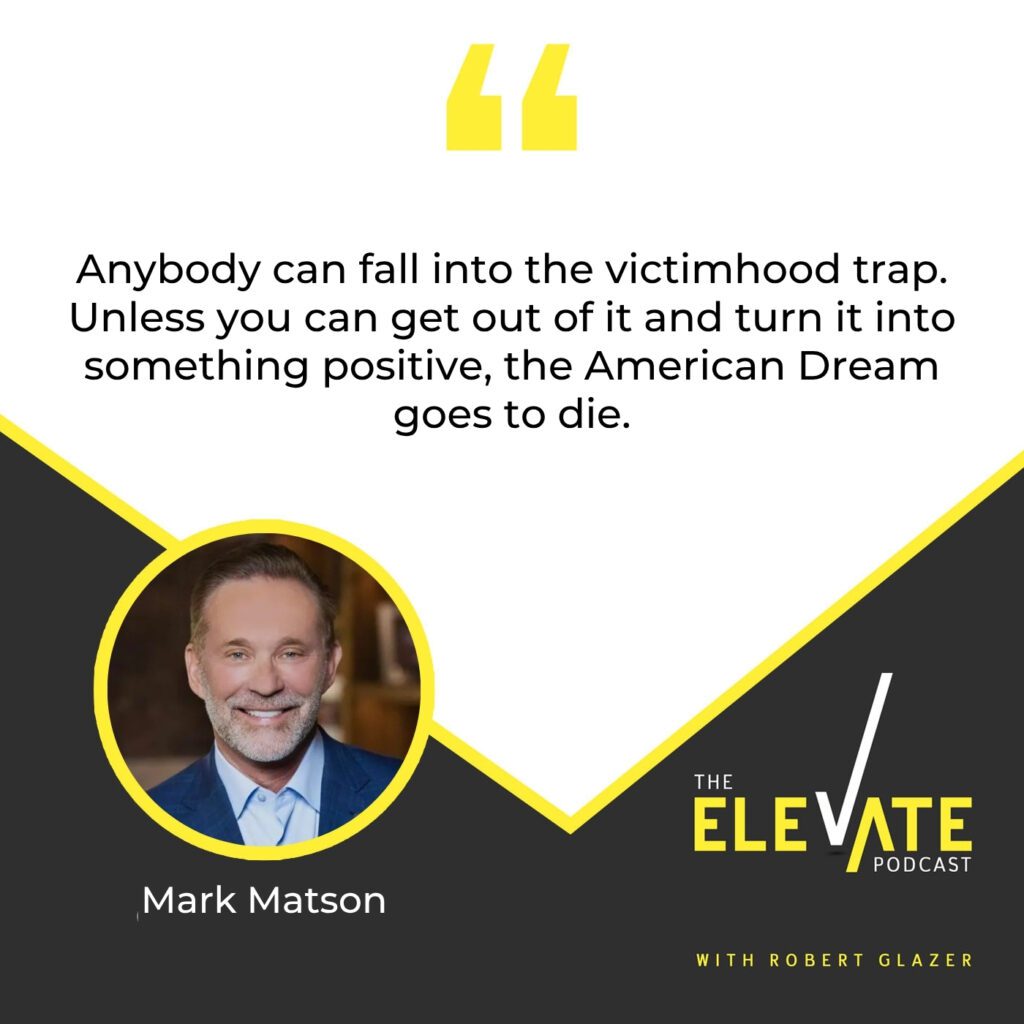
Anybody can fall into this victimhood trap and when we’re in it, it’s definitely a trap. Unless you can get out of it and turn that around to something positive. The American dream goes to die. To me, in the book, it’s a screen where you see the world where you can take massive action to create power in your life. That’s why I say in the book, it’s how to invest your time, energy and money. Time and energy is even more important than money.
I am deeply worried from our college education systems below that we’ve taken this concept of empathy and are trying to understand empathy. We don’t start on the same page in different things and we have turned it into this culture of victimhood and scarcity. They’re scarce resources, versus abundance and this victimization. I keep trying to have someone bring me an example of a historical figure or a movement.
Even when you think about people like Gandhi who had little or Martin Luther King around what he was doing, where the message of victimhood delivered an outcome or success. I’m trying to think of any celebrity or well-known person who’s brand was victimhood. I’m sure someone will come but I can’t come up with it. In fact, they tend to be more humble and lucky. This happened and I had to do this. Empathy is fine and we should have people understand empathy but now this hardwired victimhood. It’s not producing anything and I don’t know why people can’t see the outcome of that.
Psychologically, kids can be victims. They often are abused of all kinds. As an adult, if I sign up for being mistreated in any way, shape, or form. I’m the one that’s creating the victimhood. I’m creating it as an adult. Whether it’s a bad marriage or a bad relationship or bad business or whatever. I’m the one signing up for the mistreatment to be a victim. Now, the victim mentality is juicy because there’s a secondary benefit from it where I can get people to feel sorry for me.
What they do is they lower expectations.
“You poor thing. You’re being so much treated. It’s terrible. It’s awful.”
Abigail Shrier in her book called Bad Therapy, which I thought was incredible. It talks about her grandmother. Her grandmother’s mother died and then she was left with a friend and whatever. They put her in school and no one treated her any differently. She went on to become a top student and it went on. I think about that in my grandmother. They would have put her in something and labeled her. Objectively, she was a victim. There’s a difference but they would have labeled her for her whole life.You got a C on that test but you had a hard time. She never would have built the life that she had if people didn’t hold her.
I look at my dad. He was five years old. His mother was an alcoholic and she left the family. He would walk home from school and she’d be in the bars dancing with men that weren’t his dad. He didn’t have a mom and his dad worked in coal mines in the chemical factories. His dad was MIA. They had no money. They had nothing. It’s not that we only have two cars or three TVs. No, they have no cars and no TVs. They have rats coming into the house, but he refuses to be a victim.
He always told me. He said, “Nobody owes you ****.” Your mind, however, you view the world is how the world is going to turn out for you. All of us at times can play the victim role. When we are in that victim role, me included. I have no power. I give away all my power when I am on the victim road. I can’t accomplish anything staying in that role. I try to notice as fast as I can and try to get out of that thing because if I don’t get out of that, I’m doomed to stay there and it’s a bad place to be.
Nobody owes you anything. How you view the world is how the world will turn out for you.
Focusing On Abundance Instead Of Scarcity
Speaking of that, there are a lot of people feeling pessimistic and scared particularly around the economy. What advice do you give people in general or your clients? How do you stay balanced in these tumultuous times? You can see that even business leaders, psychology. If people feel bad about stuff then they stop buying and warehouses are empty. It turns into reality pretty quickly.
My dad always said that you can measure a person or a company not by what they do when times are great but what they do when times are bad. When things are bad, the economy, we have two wars, talk about recession and potential tariffs. There are a lot of people that are afraid but as an entrepreneur and as a human being, when there are bad times, that’s our opportunity to step up. That’s your opportunity to get your business helping more people, to be more help with your charity and your faith. It’s a time to expand while others are being weak and look at history.
History is instructive to people who refuse to back down. I just finished watching the documentary on Winston Churchill. I also read greatly about him. He never backed down. Talk about disasters and bad times. This is truly hundreds of millions of people dying and he’s still out there pulling for everybody and getting Americans involved.
It’s a warrior’s mentality. When things are bad, you look at the American dream and say, “It’s still achievable. I’m going to live it. It’s the screen. I’m going to see the world. I’m going to fight for it. I’m willing to go out there and fight. I’m not going to lay down and I’m not going to be a victim.” Get up every day and go crush it. It’s easier said than done.
It is, but part of it is to control things. There’s so much we don’t control that you might as well control the things that you can control. That seems to be a good orientation.
Even if you can’t control it, do it anyway. I was trying to work out before I went to work in the morning. I worked out and I wasn’t feeling good. I didn’t sleep very well. I wasn’t feeling great. I’m like, “Get your butt to the gym. Go get your workout in. I don’t care how you feel. Do it anyway.” If you don’t feel like it, do it anyway. This is another reason people get stuck because they’ll make a commitment on January 1.
Do it anyway because you know it’s good for you.
You got January 1. Everybody comes up with all these New Year’s resolutions. It’s not who’s in the gym on January 2. It’s who’s in the gym on December 31st. You got to be in there all year to see a real change, but here’s what people do. They set a goal or something they want to achieve in life then they start seeing the actions they need to take to achieve it. When they see the actions they need to achieve it, they then become a victim of their own commitment and go, “I didn’t want to do it. I didn’t want to get up at 5:00 anyway. I didn’t want to lose that 30 pounds.”
It turns out hard things are hard.
We do them because they’re hard. Not because they’re easy. That’s a completely different mindset for most people. As soon as they see it’s hard, they’re like, “That’s it. I didn’t want it. I didn’t want that.” You’re either going to have results in life or you’re going to have excuses. You get to choose which one.
Prize of regret or the prize of discipline.
That victim mentality. “I’m going to be a victim of my own commitments.”
Finding Meaning With God
Mark, last question for you. What’s a personal or professional mistake that you’ve made on your journey that you learn the most from?
For me, my biggest mistake in life was being an atheist. I lived my whole life up until my mid-30s being an atheist. When I went to college, I even studied classes in Freud and Jung and people that had all these Huber and Holly, people that talked about how God’s not real and so forth. I always felt empty in life. Not settled and very unhappy. My goal in life to try to feel better about myself was to win and to win at all cost. You got to make the most money. You got to get the best grade. You got to be the best in sports and that never worked.
There’s always the next thing.
It was like building a castle on sand. It just never worked. In my 30s, I was going through divorce and had a buddy of mine. I had moved out of the house. I was living out of the house and was only getting to see my kids half the time. I was worried about the company and everything. I was upset. I was probably crying. My buddy was talking to me on the phone. I was in Cincinnati and he was in Tennessee. He says, “Are you ready?” I said, “Ready for what?” He said, “Are you ready to stop trying to control your own life? See those four walls around you? That’s where it got you.”
Without a moment of hesitation, I’m like, “I’m beat down, bro. I got it. I’m not God. If I’m God and there’s nothing bigger than me then I’m seriously screwed here. I need it.” He said, “Get on your knees.” He prayed with me and I went from those screens. The screen of no God to a screen of God in my life. That has made all the difference because I was in a terrible situation. Talk about a victim going through divorce and worried about all that stuff in my mid-30s. That was my biggest mistake, turning my back on God all those years. Also, one of my biggest wins in life was finally bending a knee and bowing and praying.
Get In Touch Mark And Get His Books
Mark, where can people learn more about you, your company and your books?
You can grab my book on Amazon. It’s Experiencing the American Dream. Also, if you’re not a big reader, you can get it on Audible. My buddy Rob Lowe wrote the introduction to the book and we were talking about the audio version. They wanted an actor to do the audio version. They’re like, “You don’t want to do this. It’s like 50-hours of reading.” To get 11 hours of audio, you get to do it for like 40 hours but I did the owner of my own audio. I’m proud about that and they were right, it did take 40-hours but 11 hours to listen to it.
I did that in my own book. That’s a lot. It’s a long day. You need a lot of tea while you’re doing it.
You do. That’s where you can grab a copy.
Mark, thanks for sharing your story and your insights with us. I appreciate the passion and the clarity you brought, particularly to redefining what the American dream means.
Thanks, Robert. I appreciate it. It was fun talking about the investment stuff. I can tell you’re well read on that.
I probably well-read but fall to all of the same biases and have this little account that I try to trade in and lose a lot of money in. I’m just going to stop. I’ll leave it at that. To our readers, thanks for tuning in. We’ll include links to Mark’s work Matson Money and his book on the detailed episode page at RobertGlazer.com. If you enjoyed this episode or the show in general, I hope you’ll sign up for Friday Forward.
If you haven’t already, it’s a weekly newsletter with over 125,000 subscribers that shares a little inspirational article every Friday morning. Friday Forward is free. There’s also a premium version that includes a second newsletter called the Leadership Minute, which provides best practices to become the leader that you want to be. Join now at RobertGlazer.com and you can look for the Friday Forward tab or just go to Substack.com and look for Friday Forward. Thank you again for your support. Until next time. Keep elevating.


