

Jenna Free is a therapist for ADHD, with ADHD. Through hundreds of hours working with ADHD clients, and through her own lived experience, she has developed a practical, compassionate framework for understanding ADHD as a dysregulation cycle—not a character flaw. She is the author of the new book The Simple Guide to ADHD Regulation that releases the date this episode publishes.
—
Listen to the podcast here
Jenna Free On ADHD, Self-Regulation And Resilience
Welcome to the show. Our quote for this episode is from Ned Hallowell. “ADHD is a trait, not a deficit.” Our guest, Jenna Free, is a therapist for ADHD with ADHD. Through hundreds of hours of working with clients and through her own lived experiences, she has developed a practical, compassionate framework for understanding ADHD as a dysregulation cycle, not a character flaw. She is the author of the new book, The Simple Guide to ADHD Regulation, which I am excited to discuss.
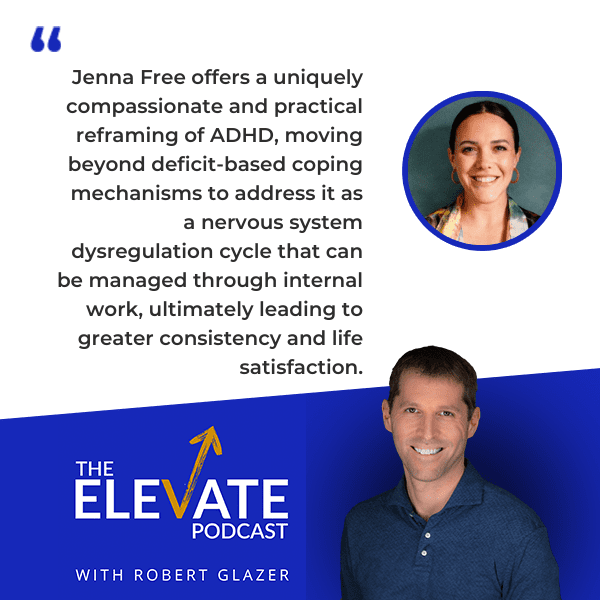
Jenna, welcome. It is great to have you on the show.
Thank you so much for having me.
I will preface this by saying, I mentioned this before, so it is not a secret, I was diagnosed with ADD. My understanding is that the diagnosis has changed, where now there is not a separate ADD diagnosis, in my 30s. I have some kids who are involved as well. This comes up a lot, particularly, I know we have a lot of entrepreneurial audience as well. By my estimates of the entrepreneurial communities I have been in, the market share is drastic.
There is a lot of misperception. I think there is all kinds of stuff going on. There are now people who say, “Look, anyone can get a diagnosis, and we have societal ADD.” I am very curious to have this conversation and curious to see where it will go. I am sure there will be some distractions in it, one way or another. I always like to start with childhood. When you look back, what were some of the early signs of ADHD that you recognized but did not have the language for at the time? When were you diagnosed?
Childhood, honestly, it is hard to see it because as a girl, I was raised differently, and I was very much the goody-goody front of the class, smiling, nodding, smart enough to get through. There were no huge red flags. As I got older, as I had more responsibilities, and then it really hit when I had kids, where my coping mechanisms, even though I was not aware of them, were not covering up everything I had going on.
It put me into the worst dysregulation, which we will talk a lot about, which is a part of my perspective. That is when I started going, “I have always thought, I think of it differently. Am I not unique?” When I started struggling, I was like, “This is not normal. It is not normal for showering to be hard. It is not normal for sweeping the floor to be, like I have to take two hours to get myself up to do that.” That is when I started going, “I think I have ADHD,” and was diagnosed at 32.
Gender Differences In ADHD Diagnosis & Experience
That is almost probably identical for me. It was an interesting, I always say it felt like this stencil that I was like, “Looking back, that makes sense.” You brought up an interesting point there, and I have seen this firsthand and through friends and family. I do not know that the market shares are different, but the diagnosis is very different for boys and girls.
Boys are more classically disruptive when they are younger with ADHD, or maybe on the balls or bouncing around, or cannot sit still in class. Girls are not as much. I have read a lot that there is a lot of misdiagnosis of girls, which may be related to anxiety, whether it is the chicken or the egg. Is that something that is being addressed? I think, because normally it is, boys are either disruptive or not paying attention, and there are a lot of girls who are high functioning in school, but it shows itself in other ways.
What is sad is that it shows us as people who only care if it is bothering them. If you are suffering, but you are not bothering me, you are fine. That is depressing. Yes, it is very different, and the diagnosis is very skewed. We think it is more of a boy thing. For many years, people thought you outgrow it. You do not outgrow it. Your brain is your brain. You are going to have your brain for your whole life. I really see that in adulthood is when women start struggling, especially with parenthood, jobs, getting out of the scaffolding of school, where you now have to make your own decisions and run your own life. A lot is going on, and this is when it starts to unfold.
For many years, people believed you outgrow ADHD. But you don’t. Your brain is your brain, and you’ll have it for your entire life.
Looking back, what messages did you internalize growing up about focus, effort, productivity? Was school hard? Did you feel misunderstood or alienated in certain things? Did you have a hard time with subjects that you just cannot get engaged in?
I was very privileged to, I do not know whether it be brain function, IQ, whatever, but I was good enough to skate by, do things the night before, do the bare minimum, and I was all right. I had enough coping, and I had enough support. I had great parents. I was an only child. I had all the attention and support, so there were a lot of factors that helped me get through. University was definitely more taxing.
When I would get stressed, it was like all self-care went out the window. I was the notorious person who probably did not shower enough. That felt too hard. I have a paper due, so I cannot possibly eat a full meal and have a shower. I’m so overwhelmed. I still got through, still passed, got good enough marks. It is this tricky thing of whether we are only caring about productivity and success. Are we also caring about the quality of life and how it is playing out?
It is just more of, and again, this is a bias from a diagnostic standpoint, but I think it is more of a, people tend to intervene when they can see that it is causing a problem. Versus, there is some internal struggle. The other thing is, people with ADD are very good at using deadlines as motivators, but it is not like that is healthy.
The dopamine kicks in, and all that stuff lights up, but that is like revving the engine really high and then almost burning it out and then turning it off again. It seems like that is, I have seen that, like they are really good around it, but then they start struggling with these mid-range things that do not have deadlines or that need to get started until it is like Eisenhower’s matrix, everything ends up in the urgent and important bucket.
Challenging The Traditional View Of ADHD Symptoms
This might be our first turn into my whole approach, which is, is it inherent for the ADHD brain, or is it because we are in fight or flight? As neurodivergent people, we live in a neurotypical world. The world is not made for us. We do things differently. We have a different brain. When you are different in your whole life, you have been butting up against, “That is not quite right. You are not quite doing it right. That is not how I would do it. You are wrong.”
That puts our system into fight or flight. We are then stuck in that state. That is exactly what the fight or flight state causes. Frantic crash cycle. I need intensity, or my other option is absolutely nothing. We get stuck in that. You fling back and forth from the extremes. What I have seen in the work that I do is that we can actually back out of those extremes and find more stability. The big thing there is this belief that that is just ADHD. That is just how it is. Too bad society has to work with it. I have not seen that to be the case.
There are so many questions about that. Talk a little bit about it, we will get into the more specific, but I want to do the setup for a little more people who are tuning in. Obviously, there is a lot of things, and maybe not ADHD as much because if you do go through a neuropsych exam, and I am sure there is always someone that will give you the diagnosis that you want, but a lot of terms like anxious and depressed and triggered, these have lost a lot of their meaning because they have been watered down.
There is also a real distraction problem in society. Cell phones, social media, these things that for the average person have gotten our attention and focus down to less than a goldfish or whatever people cannot focus on. How do people think about alpha versus beta? It seems like everyone has ADHD. What is the difference between the societal deterioration of focus and the actual ADHD brain diagnosis?
As you said, it is like, let us think about childhood. It is lifelong. If you have ADHD, you have had it your whole life. Even though I was masking and I looked really happy from the outside, I could see that I had always been. I have always had that thought, “I think differently than my friends.” I always had this feeling of being different. There was something innate in me that showed a lifelong trait.
My question also goes, because I do get that comment sometimes on my posts and stuff, “Everyone has ADHD.” My approach is to let us get out of fight or flight. I quite frankly do not care if you have ADHD or not. We should all get out of fight or flight. If you are struggling so badly that you are relating to the struggle of ADHD, let us get you regulated. Once you are regulated, you can go, “What is really going on here?”
We should all get out of fight or flight. If you’re struggling so much that you relate to ADHD, focus on getting regulated.
This is my bread and butter. This is what I do personally. This is my career. It is talking about this regulation work for ADHD. I can still tell I have ADHD. I am horrible with attention to detail, no matter how regulated I am. I have a memory. My memory is still a real struggle. I have a calendar system that has a lot of detail to support me, but my other symptoms have gone down so much with the regulation work. It is irrelevant if you have it or not. If you think you do, get support.
There are best practices, environmental best practices. It is interesting, you mentioned memory. I have so many compensation systems now that I do not need them. They are just a need to me, and I do not forget anything. I built systems. If I think of it, it goes in an email, the email goes to my inbox, it goes either on a to-do list, or I email myself 100 times a day, because I know that it is gone.
I do see that if you get into a discussion with a topic with me, and if we are in a specific thing, a rabbit hole, stories come out, memories come out, jokes come out of time. When someone asks me to pull something from cold storage, like “Tell me a time when you did that,” it is really a struggle. It is a hard thing for people to understand. My brain is engaged, and when it is focused on something, it unlocks the locker. But I really struggle with these high, low, best of, name of time, when did you do this? I draw a blank. It is like I am not warmed up for it.
I will say that it does get better with regulation as well, because when we are in fight or flight, we are not focused on the present, absorbing memories. A lot of ADHDers I talk to are like, “I do not have any long-term memories. I do not remember my childhood. I do not remember a lot of things.”
What year was something? It is just not how it is filed for me. I am like, “I do not know, it could have been 2012, 2018.”
Which can be, some of that is just the way it is. I have noticed that since I have been more regulated, my general memory is better. I am not as afraid of forgetting everything. I do have supports, but it is dialed down because when you are more regulated, you are more present, you are more mindful. You are absorbing things more. You are actually creating the memory. I am in such a rush that I forget what I have done today because I was not even present. That can add to it.
I know you have said much of the traditional in your mind, but ADHD training for therapists misses the mark. What do most people misunderstand about what ADHD actually is?
It is not even what ADHD is. So far, studies have shown that the narrative of ADHD is the symptoms we have. It is inevitable. That is how you are. Cope. You just need some water. Just as long as you are not drowning, you are fine. Get those calendars out, get those timers out, get those tools, get those reminders. That is what I was taught in school.
Take the medicine, and it gets better.
Medication, which can be great for some people. I am not anti-medication. I do not personally take it, because regulatory work has been enough for me, but it is not enough. Medication is not enough, in my opinion. That is the problem, we are contributing every symptom we have to the brain we have. If we believe that, there is nothing we can do about it.
What I have seen is the ADHD brain is one thing, but I have not met an ADHDer yet, and I have talked to thousands and thousands of them, and they are in fight or flight. Go look at the symptoms of being in fight or flight. It is almost the same as ADHD. You have now compounded your symptoms. We are so debilitated. We are in paralysis for days. We are overwhelmed by showers. The brain is on the fritz. That is not just because we have a brain difference. That is because we have a different brain in a society that has pushed us a bit into a corner.
The societal push towards faster fight or flight causes it is negative for everyone, but particularly harmful for people with the predisposition.
Exactly, because now we have two things going against us. My mission is to get this understanding out as far and wide as possible so that when everyone gets diagnosed with ADHD, our first instinct is okay, let us get you out of fight or flight. I promise you, you are in it. Dare I say, clients have said this, 75% of symptoms go down. Now it is manageable. Now the calendar actually works. I have enough mindfulness to remember I am using a calendar. I have the mindfulness to use the tools, and I do not need that many. For me, I have a paper calendar and a wristwatch with the time. Those are my tools.
The problem is that everyone wants the quick fix these days. If you told a lot of people and are having this discussion with someone, I said, “You could do the assessment, you get diagnosed. Here are the first five things you should change either way. Are you willing to do those? Are you willing to do these things that are probably causing problems either way?” There have been a lot of studies coming out. Mark Hyman, whom I follow, has some of his stuff about sugar and just changing the diet, and with kids, and how it makes a huge difference.
Most parents are probably not willing to do that. I just found it, and obviously, it probably goes, crash, and then it’s all over, like none of that stuff is helpful. Some of the people are not willing to do the hard work. The dysregulation, can you explain what you mean by that? What is happening to the nervous system during these honor roll highs? We were, as you said, just getting up or putting on the socks, which feels like it’s really hard.
The Dysregulation Cycle & Nervous System
When we are in fight or flight, we get pushed into a state where our nervous system thinks, “I am getting chased by a bear. I am about to die. I need to be on alert. I need to be hyper vigilant. We need to literally fight, flee, freeze, or fawn so I can survive.” It is 2026, and I am making an assumption that the people listening right now are physically safe. We are reacting that way to a long to-do list and emails that we do not want to write.
We are bringing thousand-year-old biology to first-world problems.
That causes a lot of problems, because being a fight or flight is not a problem in and of itself.
It was designed for a bear in the woods. It was not designed for “I am really stressed because the house cleaner is not coming to my vacation home today, and we have guests coming.” It is a real physiological reaction. Your body was not designed to be in that state for white-collar stress.
That is where we get the problems, because now my blood flow has left my prefrontal cortex, the part of our brain responsible for prioritization, planning, logical thinking, all the things that we think ADHDers are bad at. It goes to our limbs so we can literally run. I am sitting here trying to write an email. I am not going to do well. We are going to go into flight avoidance. Are we not good at that until the last minute? We are going to go into freeze ADHD paralysis. This might be controversial, but I have not been in paralysis for almost two years now doing this work.
I used to be stuck on the couch for weeks. That is a symptom, I believe, that is almost solely fight-or-flight related. If we get the blood flow back into the brain, obviously, our brain is going to work better. We are going to have better executive functioning is going to go up. It has been proven that when you are in fight or flight, your executive function goes down. You are going to have fewer ADHD symptoms. You are going to have less stress. Be more productive while being less stressed and enjoy your life. You cannot enjoy your life in a fight or flight state. There are so many positives.
If we get the blood flowing back into the brain, our brain will work better. We’ll have better executive functioning.
Comment and then a question, because I think a lot of people do not understand this. I want to know how you get the blood back, but I want to just give the audience a quick overview because I was really surprised by this. Basically, the prefrontal cortex is like the coach, and the coach is doing the team. I always assumed that medicine for ADHD was like a downer.
People seem to be hyper. It was Ned Hallowell’s book, or something explained. It is actually, no, what happens is the team is all running around, and there is no coach, and what it does is it does the same thing you are describing. It gets blood flow and neurotransmitters and wakes up the precuneal cortex so it can coach the team, and now everyone is like in order. It is a stimulant.
Kids have problems falling asleep and stuff, but it would seem so counterintuitive to someone to give someone a stimulant who cannot sit down all day. It took me a while to understand that. As you describe it, that is what the drug does, or the medicine does. It helps the neurotransmitter get delivered to the prefrontal cortex. How do you do that naturally, because that seems to core a lot about what you are talking about?
In-The-Moment Nervous System Regulation Techniques
There are three layers. One is the nervous system. That is what we hear about a lot. Meditation, yoga, that is not what I teach. I teach in-the-moment nervous system regulation. First is being aware when I am dysregulated. My shoulders are tense. I have anxiety, which is dysregulation. My stomach is in knots. I am not breathing. I am ruminating. There are a lot of mental signs of dysregulation. Once you get familiar with it, the clients I work with are like, “I am dysregulated 24/7.”
Is this the parasympathetic or sympathetic nervous system?
Yes. We are in that state, so we need to be aware of it. In-the-moment regulation is how I can communicate to my nervous system that there is no bear. There is no need to be in this physical state, and it is so simple. Drop those shoulders, take a breath. Honestly, the biggest one is that we have to slow down one thing at a time. Walk, do not run. We are not rushing anymore.
We are really working on breaking that habit. The only way we can speak to our nervous system is through action. You cannot talk to it. You have to show it through behaving differently, “There is no bear here. Eventually, that will sink in. It takes time.” It will sink in, and your nervous system goes, “Maybe there is no bear. Maybe I do not have to wake up like this every single day.”
It is an interesting point because one of the misconceptions around ADD is that people cannot focus. Actually, ADDs can hyper-focus. It is actually a problem for me, because I hate being disrupted, and the switching cost is so high that I hate being disrupted. When I am editing my writing, I am so into it that the cost of someone getting me out of it is very high, and I get frustrated, like, “No, just go away, do not interrupt me.” It occurs to me as you are saying this, that that is a little bit of using that mechanism. When the bear thing, your vision changes, and it all focuses on the problem.
Suddenly, this cleaning person who is late becomes this existential crisis rather than stepping back and being like, “Look, in the grand scheme of things,” but your system starts, your pupils dilate, cortisol floods your system, and everything runs back in. It is very hard because of that hyper-focus element. It is hard for people to step back and be like, “I know I am really like diving into this thing right now, but it is not life or death.” Very few things are.
That is a part of dysregulation. We see dysregulation in extremes. I am either hyper-focused or I cannot even start. That is not normal, isn’t the word, but that is not the inherent state of the ADHD brain. That is dysregulation. All or nothing thinking, that is dysregulation. To be regulated means I have found the rate and speed at which I function best, which for everyone is always going to be some balance. Slow and steady wins the race, all these things. Consistency, slow consistency, is going to get us so much further. We are going to be so much more productive than intensity and crash, but when we are stuck in that, we feel, “That is just my brain. That is how I have to do it,” but it is not the case.
When you hit beast mode, and it is actually productive, is that a good thing, or are you saying you do not want to rely on that? I have seen some ADHDers who, again, just get there and plow through something in an hour that would take someone a week to do.
If someone is happy and content and they are living their life, I am not here to judge. This is not a moral thing. You are not good or bad for being regulated or dysregulated. We do need to start connecting the dots because a lot of people think, “Look how good I am in beast mode.” You have a week on the couch after. You cannot show up every day. This is the clinical sound for regulation. I just bebop through every day, but I do not have crashes anymore. Over time, if you look at my year compared to my dysregulated year, where I had beast mode, but I also had crash mode, I am actually much more productive in the long run in regulated mode.
More fun to party, but the hangover is bigger. Sounds like the analogy.
Truly, regulation is fun. At first, you are like, “That is so boring.” You know what is fun? Being successful, showing up every day, and getting your shit done, not feeling guilty because you have done the thing. Being able to work out regularly because you’re not so overwhelmed by mere existence, it is fun to have life going well. We do not see that part.
You mentioned this before that many people who are diagnosed are instructed to rely on productivity hacks, planners, timers, and sticky notes. A lot of these things often fall flat. Why is that?
If you are in fight or flight, and you are trying to use sticky notes in a calendar. It is like an umbrella in a hurricane. It is not going to do much for you. Let us get out of the storm. We just keep trying to patch it. That did not work. That only lasted a week. We have a foundation that is not solid. Once we can work on that and get us out of fight or flight, then the umbrella works in a bit of a rain shower.
It is an and, not an or. You are saying that if you are regulated, these are things to help you from getting off track, feel more in control, and not forget things, but they do not work in a crisis. They are not for solving a crisis.
Yes, and you will need less. You will not be so overcompensating. You are just simply supporting, which a lot of our stuff is overcompensating. I know a lot of ADHD tuning in have 30,000 screenshots in their phone, 50 post-it notes everywhere, and four calendars on the go. It is like, “I am just trying to keep myself afloat with this stuff.” Whereas when you are regulated, it is more mindful, it is logical. I have one calendar, because I am one person living one day. I have one watch, because all I want is the time. These simple things work so much better.
The Fawn Response In ADHD & People-Pleasing
In your upcoming book, The Simple Guide to ADHD Regulation, we talked about how you are reframing through the lens of fight and fawn. We understand fight or flight. Freeze, we understand. I am curious more about Fawn.
That is the people-pleasing part that comes out when we are feeling unsafe. We are, like we said, primal people, which is tribal people. If I am rejected by the group, I am going to die. That is not the case anymore. We do not need everyone to like us.
Much of this is biological wiring that we do not need anymore.
It is so biological. That is what is fun when you start seeing yourself, and I encourage everyone to do this. Start realizing you are a primal being, and almost everything you do is animalistic in nature, and you are seeking safety, and then your behavior is going to make so much more sense.
You are a primal being, and almost everything you do is animalistic in nature. You are seeking safety—and when you understand that, your behavior makes much more sense.
I say this all the time, I mean, you see that just the tribalism in society today is because people are being scared of being thrown. If you got thrown out of the group in the old days, you literally died. Now it causes a little psychological shame, but people still have that response. Sorry, but to Fawn. How does this show up?
That can look like putting others’ needs before yours. A lot of ADHDers say, “I cannot do stuff for myself, but I can do it for other people.” That is because the Fawn response is coming up, and there is pressure there. I do not want anyone to be mad at me. That works more than if it is just for yourself. This can look like saying yes to things you do not want to do.
Maybe at work you are doing 30% of your work is not even in your job description because it is just so you do not want anyone to be mad. You want to be a helpful person. That can be very dysregulating when you are overly worried about what people think, spending a lot of your time going over social events. “What did you say? Was that embarrassing? What did they think?” Tiring.
There is a lot of replay of situations.
That is just a safety mechanism. Your brain is trying to keep you safe because it thinks you are in danger. “Let me calculate. What did people think? Am I still part of the group?” When you start realizing what your brain is doing, “Sweet little brain, I am safe, it is okay.”
It seems like not caring is important, as you said. I need to not worry about this, I need to not care, I am responding to all of the stuff around me, and I just need to shut it down. I am walking through the garden here, and it is a nice sunny day.
You cannot just do that. How do we do that? There is the physical nervous system regulation piece I mentioned, thought and belief regulation, which nobody talks about when we talk about regulation, but I believe it is the biggest piece. When our nervous system is dysregulated, our thoughts and beliefs grow from a nervous system that is dysregulated.
The way we think is very rooted in fear. It is rooted in protection. It is rooted in scarcity. And that is going to keep you dysregulated. I can share a few really common beliefs. Number one, “I am behind, I need to catch up.” Every single ADHDer has, how the hell are you going to get regulated if you think you are behind and need to catch up? You are trying to slow down while simultaneously believing “I need to catch up.”
That inherently makes me rush more. It is this cycle. If we sustain these beliefs, and a lot of them are subconscious and underlying, they are not like ticker tape across your forehead all day, so you might not even realize it, but my underlying narrative, my story, is “I am behind, I need to catch up.” “Have we ever caught up?”
No, because there is no amount of catching up that is going to relieve that. It is a feeling of lack, scarcity, and puts us into that dysregulated state. We have to work on shifting these beliefs. “There is not enough time in the day,” any shoulds. There is so much that keeps us dysregulated in our thinking and in the belief systems that we do not talk about, and if we do not work on that. There is just no way the physical is enough.
You said in the book that what won’t be in your book is no shame, no shoulds, and no homework. Why was that so important to you?
Shame and shoulds are dysregulation. That is just you trying to keep yourself safe. “I really should have done that yesterday.” You did not. What are we going to do now? It is really realizing there is no morality in any of this, which, as I said, if you’re dysregulated or regulated, you choose to work on your regulation. If you are happy with how things are going, it is not good or bad.
It is simply what the effects are, and what do I want? Very rooted in dysregulation and homework. People drowning are not going to do worksheets. This is not the way to do it. When we are in fight or flight, our system will do the bare minimum to get by so that we can live another day. I do not give worksheets, I do not give homework. Of course, in my programs, it is “Here is what we are focusing on this week,” but it is more “Carry this awareness with you and observe yourself and see what you can do with it.”
Of course, we do some visual reminders because of the memory piece. Other than that, there is no “Take time out of your day and sit down and do something” because that does not work. Anyone who is giving people in fight or flight homework is setting them up for more failure because you are not going to do the homework. You feel more shame, more dysregulation, and round and round we go.
Because your system is flooded with these things that are designed to run from the bear or punch the bear, I have not heard you mentioned, it seems like exercise. A lot of people are a big part of the physical relief and commitment to an exercise routine. I just saw a graph, I think it was on Instagram, or I have to verify it, but I think it was particularly in relation to anxiety. Now I am suspicious that girls are overdiagnosed with anxiety and underdiagnosed with ADHD, and how much of that may be people who are really in fight or flight.
That was a quote of yours, “If you are depressed, you are thinking about the past. If you are anxious, you are thinking about the future, and if you are calm, you are thinking about the present.” This thing said they did a split trial with people who were told to walk five miles a day and/or take some anti-anxiety medicine. It was almost an exact equal response.
Firstly, exercise. Great in theory. A drowning person cannot exercise every day. This is what we have to look at. I am a big fan of what is possible, not what is good in the lab, because I used to work in the non-diet field and diets, and it is like, “In theory, this diet is great.” No one can adhere to it. It is useless. Do not even bother. Exercise at first when you are at peak fight or flight.
That would not be my first move. Let us exercise every day. By day two, they have not done it. Now they feel shame for not doing it. Back we are. This is why I recommend in-the-moment regulation, things that take no time out of your day. There is no checklist. It is simply, am I building up my awareness and starting to interrupt my dysregulated state daily?
Now that I am more regulated, I do exercise five days a week. I value it. It makes me feel so good. I have quit drinking, and I have taken such good care of myself because I am no longer drowning. To expect a drowning person to go do a bunch of self-care is just not going to happen. It is actually going to make it worse.
I get what you are talking about from a macro perspective, but let us say someone is in a really bad period and they can remember, “If I just go run for ten minutes and I probably could burn some of this off, I will feel better.” Is that a good triage solution?
Add it to the toolbox. It is so easy. A dysregulated brain motivates itself through urgency, guilt, fear, and shame. If that, expecting yourself to work out and then you do not do it is going to create more dysregulation. I just do not know if it is really worth it. If you can be flexible with your thinking and go, “If I can, I am going to do my best to get out there. I know that will make me feel good, but if I do not, that is okay.” Cool. I do not think that is very common when we are in peak fight or flight. That is the goal.
A dysregulated brain motivates itself through urgency, guilt, fear, and shame.
The goal is “Let me get to a more regulated state, so I have the capacity and the desire and that positive motivation.” I work out for positive motivators, not because I feel like shit, not because I hate myself. It is preemptive. It is like, “I feel so good when I go, I love it. It feels so strong and great.” That is awesome, so that is why I go regularly. When I was drowning, I was working out and dieting out of shame and guilt and not being good enough. I binge, and then I would not go.
What got you out of the crisis? Obviously, like you are at this, you can feel the peacefulness around you, but for those who feel like they are in the middle of this, like “Great Jenna, but like you seem in a different place than I am.” If you could take people back, or what was the moment where you are like, “I have to do this differently,” and what work to just start making that shift? Obviously, it does not happen overnight. Was it really those internal conversations and stepping back in the moment?
Yes, definitely internal. How it played out for me was I went and got my diagnosis, and then I was crying to my husband, “I need that medication now, I am drowning.” I was like, “Okay.” I started worrying because I understand that there are always side effects to things. I am a little wary of medication, just that is how I am. I did not go on it right away, because I only had a couple of months left in my practicum. I was seeing clients.
I did not want to be in some weird state. I am like, “When I am done with school, and things have calmed down a bit, I still have two young kids, but I will have less on my plate. I will reassess, see how I am doing, and see if I want to go on the meds.” I started realizing that a lot of my struggle comes from anxiety, rushing, and all of this stuff. I was slowly working away, learning about ADHD, working with clients, seeing that the homework I am giving them, which I was taught to give them, no one is doing.
What is going on? I started to see the theme, “It is not just me in this frantic crash cycle.” All ADHDers are, and this is not a common trait that is talked about.” “Okay.” Slowly learning about it and then doing the work myself, and I teach exactly what I did myself. It was completely. I am adamant about “I do not rush.” I can start rushing sometimes, but I always interrupt it. I am adamant about working on my thoughts and beliefs and observing how those dysregulate me.
I have seen the amazing results in my productivity. I have been an entrepreneur for ten years. I have been more successful in the past two years than I was in the previous eight combined. I am happier. I am enjoying life more. I am working less hard because being in fight or flight is exhausting. To be on the defensive, hypervigilant, and thinking you are about to die all the time takes all your energy. I have more energy. It is like, “Oh,” and then so I was really buying in because I was seeing the results. Now this is how I live my life with these key tools.
Back to the entrepreneurial connections. I told you, I have been in communities where it feels like it is an 80% market share. What is the chicken, and what is the egg there? Someone once joked to me that in my twenties, “If you do not take this job, you are not going to be employable.” They meant that as a compliment. Is it “I cannot follow other people’s rules, so I have to do it myself?” Is it something with our creativity? Do you have a thesis on the dramatic over-representation in the entrepreneurial community?
I do think that because we are different. Neurodivergent person living in a neurotypical world, trying to put that neurodivergent person into a neurotypical business, a neurotypical corporation. I have been a teacher. I have had many degrees. I have been in marketing. I have been a teacher. I was an intuitive eating coach, but I was an entrepreneur. All the jobs I had before I became an entrepreneur, I lasted probably a year and a half max. This square peg does not fit a round hole. It just does not work.
I always knew I was an entrepreneur at heart, and that is where I thrive. When I was dysregulated, the business did not thrive because I was not consistent. I was all or nothing. I was frantic. I was crashed. My blood flow is not in the brain. Now that I am regulated, I am like, “This is the sweet spot.” A regulated ADHD brain is like an entrepreneurial God. I do not know. Entrepreneurial whiz. It really is awesome to have that consistency, the creativity, and the unique thinking together.
Regulation Vs. External Accommodation In Entrepreneurship & Life
There is probably also a factor, and it is a privilege and a blessing, in that when you find yourself moving. I tried medication for a while, and then I just changed my environment. I always told people I ended up running my own business, and I had the ability to design the environment so that it worked really well for me. What I could do, how I had to do it, the times, what I did not want to do, and what I wanted to outsource. Those are not decisions you get to make a lot of times when you are working for other people. I created an environment that was healthy for me. For some people, you just cannot do that in a regular job.
I work with tons of clients in all sorts of jobs. Stay-at-home moms, ER nurses, corporate people, receptionists, everyone. We can get regulated in whatever situation you are currently in. Even if you are thinking, “I probably want to be an entrepreneur at some point, but I currently have this job,” that is fine. Let us get you regulated in the environment you are in, because not everyone can change that, then you are going to be so much more capable of, one, maybe you realize, “This job, it is actually fine when I am more regulated.”
You are going to have the lovely bandwidth and brain capacity to then take the steps you need to make the change. A lot of people think, “My internal experience is how it is going to be, and this is inevitable, so I have to change everything on the outside.” I find that doing the internal work is much more effective, and then you are going to be better at changing stuff on the outside.
I am curious, I wrote an article last week, and I think that what I was saying before, maybe I will contradict myself a little bit too. As you think about this, there was an article that almost 40% of students at Stanford are now registered with some disability. This is ten times more than a community college and more than MIT. There are some questions about the environment and what it is rewarding or otherwise.
Part of getting regulated, I think, there are people with real debilitating needs for whom, if there is no severe intervention, they have no chance of learning or otherwise. There is also something going on, particularly in the much more affluent communities. “We should try to shape environments around me.”
I always say, “That is great in theory. However, how do you deal with 100 concentric bubbles in an organization of people who need different things? While you may need accommodation, you may need changes. We have to learn how to operate inside environments.” I think the problem is that a lot of kids are really struggling outside of college because these accommodations have been so, you missed the test, no worry, we will lower the standards, you need this.
They go to the real world, and it just is not like that. You cannot operate in those bubbles. When I say to people all the time, “Look, I do not love sitting down, I am not good at it. I am restless, but I have to, I have to learn how to sit through a board meeting.” If I am in a board meeting on a bouncing ball with a kazoo in the corner, no one is going to want me on their board. People get married, and there are religious services, and I am not saying it is my favorite place to be or what I should do, but you do have to learn how to survive in some situations and build some muscle.
The environment is just accommodated to you. You do not do that. Eventually, the world does not do that. I am curious about your thoughts on that because I know sometimes when I try to make this argument, it sounds insensitive, and it is really not because I have experience with this, but I think we all need to make sure that we have the tools. The world is not going to customize itself in the matrix perfectly to our needs.
What you are saying is regulation, because it is like, “I do the internal regulation work so I can train my body that I am okay in all of these situations. I do not need to be in fight or flight, I do not need to be rushing and impatient.” Impatience is dysregulation. We think, “That is just how ADHDers are. We hate slow walkers, and we cannot let people finish a sentence.” That is dysregulation, rushing is modern-day because we are dysregulated, and I get it.
Those are very true, though, but fine.
I have worked so hard at not rushing. Now I can still get in there, but am I better at it? It is something we can train our system into, and that is going to help you be able to tackle anything. My goal in life, which is a very lofty goal because this is like my passion, is to really get regulated where I can be regulated in any scenario. That is my goal. I do not care if I am going to be the queen. It is like, “Can I stay present? Can I stay relaxed?”
Whereas before, sweeping the floor was dysregulating. Now I have written a book. Even being on podcasts like this. It is very nerve-wracking to go have an interview with no prep and just get in there and go. That is the power of regulating, like, “I am so empowered. I can handle it. I do not need to change everything around me. I do not need everyone to tiptoe around me because external change is external regulation.” How do you change everything?
If you are speaking to parents, the default thing on parents is how can we augment the environment these days. That is really dangerous because it just does not give you the survival mechanism that you need versus focusing on the kid.
That is having that regulation lens, which I encourage every single human being to come from, is “When I do that, I am externally regulating them, and they are going to need all this to be regulated. Let us teach the internal regulation so that they are good in any situation.” It is really cool to start doing the internal work, because then the external regulation falls away. That is what a lot of us can over-plan. Rewrite lists ten times, sit for three hours with your calendar instead of doing it. That is all external regulation.
“I am doing these things to soothe my dysregulation.” It makes me feel better. Scrolling, addiction to our phones. That is just external regulation. Once you start doing the internal, the external, you do not need it as much. You are freer, you are more able to make conscious choices of what you want to do instead of it all being so compulsive.
Our compulsive technology has become a societal pacifier. I actually was at a restaurant this week that I was at two years ago, which prompted me to write an article. Every kid at this restaurant had an iPad on the table at a family dinner. I had told my kids no phones, and they were teenagers. Actually, we were back at this restaurant two years later, and there were no iPads.
We said something to the waitress, and she said, “We have noticed a change.” I was like, “This is great.” The thing about it, you cannot even make it through a dinner. It is so horrible that you cannot make it through a dinner without this digital pacifier. That is external self-soothing, not, “What can you do to calm yourself down or play a game or something that you control?”
That trains the system. Every time we are soothing dysregulation, we are fueling dysregulation. “If I have to scroll to feel better, that makes me feel better.” Now I need it even more next time. If we have to write list after list after list of feeling control, you are never going to be able to not do that. It is just going to get worse and worse and worse, and you notice you are not executing anything.
Every time we soothe dysregulation with quick fixes, we actually fuel it. If scrolling makes me feel better now, I’ll need it even more next time. The same goes for endless lists—without real regulation, the cycle only grows stronger.
“I am just planning and planning and thinking and thinking to soothe my dysregulation.” What this intentional regulation work does is get us into our bodies and our brains and go, “I can do the work in here to calm that all down, to get my system out of this state where I feel afraid.” Now I can tackle anything, and it really is very empowering stuff.
Parents are constantly these days emailing teachers the excuse, the deadline, another day. I understand the deadline is stressful, but the reaction to a missed deadline cannot be just to keep moving the rope. That is not a viable solution for life. Rather than working on how we think about deadlines or doing some work differently, or you know. Deadlines exist for a reason. I have an offer I made with my last book, and it had a code with it. I was giving people the course.
You just had to register by a certain time. We wanted to shut down the codes and first deadline and second deadline, and then as soon as, three weeks later, four weeks later, I saw it, I ignored it, “I am sorry, can I still get it?” As nicely as we could, we said no. I do not want a reward. If you look at my writing and what I focus on, rewarding you for doing that is the worst possible thing that I could do.
It is so true. Our brains will use the time we give them. A lot of my clients at first will say, “I am really slow. I cannot get it done in that amount of time.” Start giving yourself that amount of time. Some people will stay late at work every single day. Start actually leaving at five, no matter what you have gotten done. Your brain will rewire to go, “She is serious. She should be leaving at five, so I guess we’d better do the work earlier.” Once you start going, “I could stay till six, I could stay till seven.” The subconscious goes, “There is no urgency here, and I only function in urgency.”
Urgent and important. I am all about that with all my kids all the time. “Put it on your thing, make the note. Do not wait for the deadline, do not, that is driving stress.” The same thing, the time when you got the note that said “Just take the two minutes to register for this now, and then it is free forever,” that is the time to do it, not ignore the three notes and then ask for an exception four weeks later.
What we want to do is not just do it. If they could just do it, they would just do it, but it is going, it is always looking underneath. I recommend everyone of my clients, especially for ADHD symptoms, “I just work well under pressure.” Let us look underneath that. What is that about? Why is that? “Why did you not do it when you saw it?” “I did not have time.”
“Why are you in such a rush all the time? Do you have an inherent belief that there is not enough time in the day? Do you believe you are behind? You need to catch up, so you are doing everything in a rush?” If we look under the surface, there is always something more. It is not just even someone in a group, I was running, said, “Yes, I was thinking about what we learned.”
There was a two-week gap between our calls, which is only normally one. The second week, I was like, “The novelty is wearing off.” I am like, “What does that mean? Let us look underneath that. What does novelty mean?” It is impatience. It was not about novelty, new shiny. It was, “It is not working yet, and I am getting impatient. Screw this, it is not worth my time.”
Addressing The Myth Of Working “Well Under Pressure”
That line you said before is a total lie. “I only work well under pressure.” You talk to people who operate that way, and you said they are exhausted. It is not that they only work well under pressure. It is that they get things done just in the nick of time because all their cortisol kicks in. It is not like there is no cost to doing that.
We want to start seeing this cycle, and that is what I teach people because they go, “That is my superpower.” No. We are human beings who live in linear space and time. You’ve got to look at what is happening over time. “Yeah, I did. This is me in university. I did a fifteen-page paper the day before, but now I cannot go to class for three days.” That is not a way to function. That is not a way to live. That is not doing things.
Cannot go to class for three days, and then all of the homework is now pushed to the next deadline.
I have to rush to do it, and then we are stuck in a cycle. Cycles by nature are a trap. How do you get out? What regulation allows us to do is get out of that high, low. It slowly dissipates the borders, and you start just going, “Okay,” and you get that consistency, and you are more, and off you go. It does feel so much better.
Let me ask you the last question. For someone listening to this who feels exhausted by the chaos cycle of fight or flight, they think they may have ADHD, but they are not sure. How would they know in separating alpha from beta? What do they need to do to then focus on regulation and say, “Is there a deeper thing here, and should I follow up, or am I just falling into some of the societal constant dysregulation?”
First of all, either way, the same regulation works. Going to be helpful. Number two, I do recommend checking out my podcast, ADHD with Jenna Free. That first episode, I get so many people going, “I was bawling my eyes out. This makes so much more sense. I understand myself in this context as opposed to just, I just have ADHD, and it is what it is.” That can be a great place to start as well.
Jenna, where do people learn more about you and your work?
You can find me at JennaFree.com. I also have a free ADHD regulation guide, just a little PDF and video that you can grab. Of course, my book, The Simple Guide to ADHD Regulation, is coming out.
What is the date on that?
March 17th, 2026.
Jenna, thank you for joining. I appreciate the way you are reframing ADHD not as something to fix, but as a trait to understand and regulate. I know a lot of people will be helped by this conversation.
Thank you so much.
You can learn more about Jenna and the simple guide to ADHD regulation, and we will link to her podcast as well on the episode page at RobertGlazer.com. If you enjoyed our episode or the show in general, I have a small favor to ask. Would you just take a minute to share this conversation, particularly this one, with someone you think would appreciate it? We have grown entirely through word of mouth, and I know I find new episodes and shows when someone says, “You need to listen to this.” If you text it, email it, or use the share button, we would really appreciate it. Thank you again for your support, and keep elevating.
Important Links
- Jenna Free
- Jenna Free on LinkedIn
- The Simple Guide to ADHD Regulation
- ADHD with Jenna Free on Apple Podcast


