

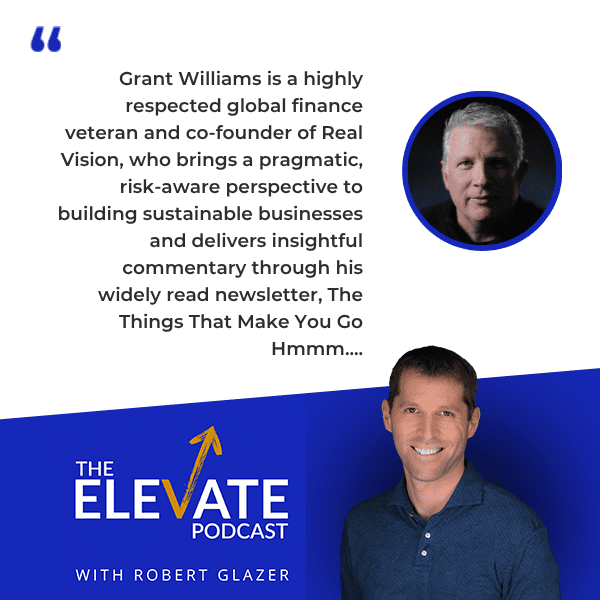
Grant Williams has spent more than 35 years in global finance across seven major financial centers, from London to Sydney. He had a front-row seat to Japan’s late-1980s bubble and its dramatic collapse, and later worked across New York, Hong Kong, Singapore, and beyond. Grant co-founded Real Vision to bring the most thoughtful voices in investing to a broader audience, and he’s also the longtime author of Things That Make You Go Hmmm…, one of the world’s most widely read financial newsletters. Today, he serves as a senior advisor to Von Greyerz and a portfolio and strategy advisor to Vulpes Investment Management.
—
Listen to the podcast here
Grant Williams On Leadership Lessons From High Stakes Finance
Our quote for this episode is from Simon Sinek. “Leadership is not about being in charge. It’s about taking care of those in your charge.” Our guest, Grant Williams, has spent more than 35 years in global finance across seven major financial centers from London to Sydney. He had a front-row seat to Japan’s late 1980s bubble and its dramatic collapse. He later worked across New York, Hong Kong, Singapore, and beyond.
Grant co-founded Real Vision. He’s bringing the most thoughtful voices in investing to a broader audience. He’s also a long-time author of The Things That Make You Go Hmmm…, one of the most widely read financial newsletters. I’m sure there’s a lot of things you can read to make you go hmmm. He serves as a senior advisor to Von Greyerz, and a portfolio and strategy advisor to Vulpes Investment Management. Grant, welcome. It’s great to have you on the show.
Robert, I’m delighted to see you again. Thanks so much for having me. I appreciate it.
It’s been a while, home and away game. Let’s start early with childhood. Tell me a little bit about it. Particularly, people that fell into leadership, my experience is they had a great exposure to leadership or maybe an absence of leadership. What was growing up like? What got you interested in finance and leadership early on?
It’s funny. I don’t think of leadership as a thing to be interested in for me. I didn’t want to be a leader as such. I played a lot.
Early Exposure To Leadership Through Sports & Childhood Experiences
I was just going to ask you. Did you play sports? That does come up sometimes.
I did. I played a lot of football. I played a bit of rugby. I played a lot of basketball. I was captain of the football team and captain of the basketball team.
I do have to laugh because it’s funny as you said it. “I never thought about it except I played all these sports. I was a captain of all of these teams.”
As I hear myself say that, it’s funny. I was thrilled to be given those roles. As a kid, that’s a fantastic thing to have. I honestly think for me, I’ve always managed to rub along well with people. I get on well with people. I’m pretty easy-going. I always just work my butt off in every game I play. The coach saw that I was always going to work hard. I was never going to give anything less than 100%.
I got on well with all my teammates. We were friends. I never felt I was in one click or another click. I was pretty comfortable across the board. As a kid, the thrill of being named the captain is something because every English guy in my era grew up wanting to be the captain of the English soccer team. That was the dream for everybody. I can still harbor that dream.
Is that a winning endeavor? I don’t know. The heartbreak. Even I’m rooting when they’re in the fire. I got a root for them. It’s funny.
It would be nice. We’ll get a chance to see in America this summer. It was never something that I sought out. I was always comfortable in that role because these guys are my friends. It’s easy to motivate your friends because you don’t feel like you’re trying to motivate up or down. It’s like, “Come on, guys. We can do this.”
My first exposure to real leaders came when I first started work. I saw these guys who were in the finance industry. I fell into that. It was something I wanted to do because a friend of my father’s, it was what he did. He was the coolest guy that I knew as an eight-year-old kid. This guy always had a magic trick for me, always a joke for me. I thought he was such a magnetic personality. I just said I want to be whatever Uncle Harry is. It turned out he was a foreign exchange dealer.
As an eighteen-year-old, in the UK, you didn’t need to go to university. I had a job in a university offer. I chose the job because it wasn’t a big decision back then. You didn’t need a degree to have a career. I went into this world as a very young man and felt it on my first day. I saw the guys who were the leaders on those trading desks.
They were big, bold characters who led with sheer force of will rather than anything else. Everybody knew who they were. There was no armband or anything. You knew who the leaders were in that room. When the thing you’re measured by, the yardstick, is money, profit made. It’s a very simple pecking order that develops. Guys that make the money.
A very specific culture leadership means a very specific thing.
I learned good and bad things from them. I didn’t learn the bad things, hopefully. I could discern the good parts. I won’t say there was a culture of bullying. In those financial markets when everything was phone-based and not screen-based. You were talking live to the people you were buying and selling with. Imposing your personality was a key part of being successful in that.
I saw how bullying was used. I saw the people that were bullies. That was who they were. There are other people that they could turn it on and turn it off when they needed to. Those were the guys that I gravitate towards. I could see that this was just a tool in their arsenal to try and be more successful. There were people who were just flat-out bullies. You recognize them pretty quickly and try to stay out of their peripheral vision as best you could most of the time.
I’m guessing you’ve read Michael Lewis. One of the major things, I’m sure a Liar’s Poker has got to be in your top ten books. This will resonate with you based on what you’re saying. I heard Lewis speak years ago. He was like, “When I wrote Liar’s Poker, I thought it would be this expose on the finance world and everyone would be disgusted.” To his disgust, it became a recruiting book and an anthem. Everyone’s like, “I want this.” That was a fascinating analysis to me.
I had a friend that I worked with for many years. We debated this many times over drinks or over dinner. Whether finance attracts that kind of personality or creates that kind of person and people who are susceptible to it. We never came up with an answer.
Is yes the answer?
That probably is the answer because it’s a high-testosterone environment. You can be successful without becoming pure testosterone. You’ve got to be very shrewd. You’ve got to be very confident in who you are to manage to shrug that off and not get sucked into this macho contest. It’s not an easy path to navigate. Some people can manage it. A lot of people can’t.
Obviously, you were in a very specific industry like finance. That has an interesting context with leadership. As I said in the intro, you were all over the world like London, New York, Hong Kong, Sydney, and Singapore. How much cultural difference did you see in leadership? What principles were the same? What was different? What did people have to adapt? What did you have to adapt?
That’s a great question. When you first go to a new country, you have to take your time to fit in and understand how the land lies. Understand the power structures and the management styles. They are very different. In my first exposure to that, I went to Japan when I was 22 years old. Again, I was still a very young man.
Although, the company that I went to work for in Japan, I was on secondment to a branch of this UK investment bank I was working with. It was run by Brits, basically. It was in Tokyo. All the staff were Japanese. The head of the office was Japanese. He was very much a figurehead. The management structure was all British. It was interesting to me to be in a different country, in a different culture, in a room where probably 70% of the staff were Japanese. The power structure was very definitely English.
I sat and observed that. I was very much the youngest guy on the desk. I had that advantage that I could observe it because I didn’t have to push anybody around or make any big decisions. I was learning. I was on my way up the ladder. I sat back and watched it. I like to do that. I like to just sit quietly and observe things until I feel like I understand where things are.
I’ve got a great story about this. This is much later on. I went to a dinner in the South in the US. I was invited to dinner by a friend of a friend. We went to this beautiful old house in a part of the southern states of United States. I love that part of the world. I’ve had a home there for many years. I like it because you’ve got the politeness and the manners of the South. It’s just very genteel. It’s a real throwback to what England used to be like.
My friend, who had invited me, was from Texas. He’s a big brash Texan. We’re in this environment of all these genteel Southerners. We ran and had drinks. It was all very formal, but in a relaxed way. They said it was time for us to eat. We went into the dining room and there was a buffet laid out. The idea was you get a plate. You sit down and eat. I hung back and I watched what’s going on.
People queueing up, getting their food and a plate of food. I make sure I follow along the line to see what to do. I’m trying to figure out, “What are the protocols here?” I take a moment and I’m watching. I noticed that no one’s sitting down yet. Everyone’s going, standing there with a plate in their hand. It suddenly occurred to me that the matriarch of the family, who was a wonderful woman in her probably mid-80s, was at the back of the line. She got her plate of food.
I suddenly realized that the matriarch will sit down. The ladies will sit down. The gentlemen will sit down. I said, “I get this now.” I understand what’s going on. I look over at my friend from Texas. He’s not only sat down. He’s got a mouth full of ribs. Everyone was so polite. They never said anything. You could see that there is a way of doing things here that we just do. We don’t impose it on anybody. It’s just understood.
When I went to Japan, I observed because Japan has already so many customs and rituals and what have you. It’s a very structured, ordered society. There are things you do and things you don’t do. I learned from that very early to just be patient and watch how things work. Try and stay quiet until you’re confident enough that you’re not going to be in the wrong place or do the wrong thing or putting noses out of joint. That’s appreciated. That care is appreciated.
Cultural Differences In Leadership & Navigating Foreign Environments
The culture stuff is real. We had debates on our own company, as we were growing internationally of what tenets of culture were universal and what tenets of culture had to be respected locally. Interestingly, there were some universal principles that even some different cultures felt more strongly drawn to than whatever their cultures had compensated for in that area. They were real areas.
As a leader, if you ask people to ask questions in some of the Asian countries, they wouldn’t. If you called on them to ask a question, they would ask it. That was important feedback. There are the cultures. What about leadership? I remember Gladwell. One of the things in the cultures that people are willing to get in there, more tussle.
You call someone out on a bad idea. One of Gladwell’s conclusions about why there were so many more plane crashes in some of these countries. The co-pilot was not allowed to challenge the authority of the pilot, which is a major check-and-balance in there. In terms of the real leadership stuff, how did you see that play out?
It was a unique time because Japan was the hottest market in the world at that time. The stock market was going crazy. The real estate market was going crazy. Japan was going to overtake the US. It was where all the money was. They were buying up assets all over the world. The Japanese were very confident and rightly so. The Japanese miracle was a real thing. I watched their confidence grow. I watched the confidence in Japan.
The Japanese are a very patriotic nation, deeply so. They do have this culture of deference. You watched at that time that that patriotism mushroom into something. I don’t want to call it arrogance because I think that’s a little too strong. You could see that the things that the Japanese were used to feeling, they were struggling with that. They were being told how great the country was and how wonderful it was doing. We all know what happened next.
Leading in a foreign country, the English leaders of our business out there were very adept at navigating the cultural differences. They were foreigners in a strongly rising power, but they had the command. To watch them work with the figurehead of the Japanese side of the organization, be very deferent to him, and be very aware of his place, totemically, amongst the Japanese staff was very interesting.
It was a uniquely British approach. The Brits are very good at that. I think if we’d had American management, and this is not stoutly Americans. They would have been a lot more forceful in imposing their own ideas without being perhaps as sensitive to the Japanese. We saw that some of our competitors, Morgan Stanley, Merrill Lynch, and Goldman Sachs, were American-run companies. You felt the difference.
Anytime you’re in different culture and leadership, there’s an instant barrier there because you’re not one of us. Why should you be in charge? That’s very real. That’s the same in the West. You had a Japanese leader at an English bank, they would have exactly the same problem. It’d be slightly different in nature. It’s something you have to be conscious of and be very aware of. You can turn an entire office against you if you handle things in one way.
Anytime you’re in a different culture or leadership context, there’s an instant barrier—you’re not one of us. Why should you be in charge? That’s very real.
You said something in there earlier that’s interesting. That everyone was telling them they were great. It does seem that across all culture, all leadership styles, going back to emperors. That hubris seems to come right before the fall. As you said, you could do no wrong and then the massive bubble. This is a pattern that’s repeated itself in history and finance. How have you seen that and navigated through? When it seems like, whether it’s Bitcoin or anything, you can’t lose. It usually is right before it does.
That’s the phrase right there. If anyone tells you something you can’t lose that then your radar needs to be up. Instantly, because the phrase, “There’s no such thing as a free lunch,” is so true. There’s no such thing as a sure thing in finance, let alone the world, is also true. The problem with the finance industry, in particular, is that money is ultimately what you’re chasing and how you’re rewarded.
It’s very easy to think that money equates to control. “If you get a lot of money, I’ve got more control now. If you get a lot of money, I’ve done extremely well. I’m smart. Otherwise, I wouldn’t be getting all this money.” I’ve seen an awful lot of people earn an awful lot of money. Many of them who shouldn’t have. They just happened to be in the right place at the right time. They weren’t particularly skillful. They were very good politicians. That I will say the finance industry is something.
I had a friend years ago in Hong Kong. We were young men at the time. We were probably in our early 30s. We went out for dinner one time. He said to me, “I figured this business out. I’m going to play the game. This is all about politics. It’s nothing to do with money. It’s nothing to do with skill. It’s all about politics. I’m going to play that game. I’m going to play the politics and you watch. I’m going to work my way up the ladder because I know exactly what to do.”
I said, “Come on, you can’t be serious.” He said, “I’m very serious.” I said, “I couldn’t do that.” He said, “It’s not my preferred choice, but you watch me.” Sure enough, this guy, his ascent was stratospheric. He was superb at managing the game. He took credit for things that had nothing to do with him in the meetings where the people who were responsible for the successes didn’t have a voice. He became remarkably wealthy, became remarkably powerful. Unfortunately, along the way, he changed. It wasn’t a game anymore. It became who he was.
A lot of his friends from back in the day before he decided to get on that ladder lost contact with him. Worse, he fired some of them. The persona he vowed to adopt to become successful became who he was. That is a real danger in an industry where there is so much money floating around. We’ve come to equate money with all kinds of things that we shouldn’t.
For me, as I went through that process, I never ever made money the thing that I was chasing. I worked out very early that the industry I’d accidentally found my way into was an industry where I was going to be getting paid a lot more than just about any other industry that I was qualified to work in. If you do a good job, the money takes care of itself. You can try and maximize that by being noisy at bonus time and doing all that complaining.
You’re going to be okay.
Your worst case is you’re going to be doing just fine. I prioritized my family. I prioritized being home with my kids. I did just fine. I never had the stress of trying to climb that ladder and trying to do the things you needed to do to play the political side of the game. For my banking career, I had particular leadership roles. I shied away from actively putting myself into a management position. I didn’t want to manage people because I could see the structure.
You felt like the whole game was like a bunch of first round draft picks who aren’t going to listen to anyone, who are all waiting for their next contract.
It’s so true. It’s a great analogy. I hadn’t thought of it, which is crazy given how much I love sport. That’s a perfect analogy.
Which makes what Mike Krzyzewski did at Duke in this era all the more impressive. That he had all these kids that were going to go first round and leave. He ran a program that was about character first. It was sort of a John Wooden program that you can go for after a year. You’re going to play the play. You’re not going to come in here and tell me you’ve got your own style and your own way of doing it.
Before him, Dean Smith at North Carolina, what he did with the James Worthys and the Michael Jordans of the world and how he managed to do that. Again, that’s culture. There’s a culture in banking that is not personality-based. It’s money-based. That makes it much harder because the guys come and the guys go. Occasionally, you’ll see real leaders.
Jamie Dimon, for all his faults, is a real leader of men. How many others like Jamie Dimon are there? There aren’t that many around. 2008 was the perfect example of this. We saw the “leadership” in 2008. We saw what the princes of the world at Merrill Lynch and the guys at Goldman at the time. We saw what they all did, how they underperformed, and when they had to lead. What we found out in 2008 was they hadn’t been leaders at any point in time. They’ve been figureheads, getting paid extraordinary amounts of money.
Transition To Intentional Leadership At Real Vision
They’ll have enough money and they’ll be gone. You have to care about whatever it is to go through the morass, to come out the other side. You’ve even seen in financial. Your hedge fund has two bad years. You get underwater and you close it down. You go start a new one and start over. There’s no need to even carry it through. It’s interesting. As you said, there’s not a lot of reason that people are in it in some of these extremes other than the money. The money becomes the culture.
For me, I didn’t have to think about being a leader of any sort until 2014 when myself and a few friends started Real Vision. At that point, I had to be part of a leadership team. I had to lead my part of the business. That was the first time I had to do it. I walked towards it. I didn’t fall into this one. I knew this was something I was going to have to do. It was a challenge I embraced and I enjoyed. Parts of it I didn’t. Parts of the leadership role I definitely struggled with. Parts of it I enjoyed and thrived with.
It was new experience for me. I was glad that I hadn’t had that role younger. I felt like I was much more prepared for it at the age of whatever I was, 47, than I had been at any point in my career. It opened a whole new world to me. Not only leadership amongst the people that work for you, but leadership amongst a leadership group. Which is a very different sort of challenge, but definitely a challenge all the same.
The Origin & Purpose Of Real Vision
What was the raison d’etre for Real Vision? I was going to ask you that.
It was a simple idea that we had over dinner. Raoul, Remi, and I met for dinner in Spain. We were just talking about the world. We didn’t go there to come up with a business. We went there to meet and have dinner and chat. I’d been writing my letter for a number of years and Raoul had been publishing his research. We had been on the fringes of the financial media world. Written media rather than anything else.
I’d done a lot of public speaking. I’d done probably more bits than he had. He was quite reclusive at the time. We just talked about the world. We hit upon this understanding that over the years, he and I, having been in finance and worked in different parts of the world. We’d had thousands of meetings, dinners, drinks, lunches, whatever with peers in the industry and always come away with something to think about. You walk away and what he said was interesting. I need to think more about that. Why that challenges something I thought was true. I need to think about this.
There’s always something when peers talk to each other. The idea was that “Why don’t we try and recreate those conversations, but just film them? No agenda, no particular thread. Let’s talk to fellow people in the industry, smart guys, and just talk to them. Have a conversation rather than interview them. Put a camera there and see if other people will take away from it what we have.”
It felt like a good idea. We spent a weekend in Hong Kong with a whiteboard and a closed room and sat in there figuring it all out. We came out and said, “This might not be the stupidest thing we’ve ever tried to do. Why don’t we give it a go?” Really, it was simply “Let’s find smart people and talk with them rather than talk to them. See what happens.”
We believe there would be an audience for that because no one else was doing it. It was all much shorter. What’s the word? Snackable, I think, is the word. There’s the trendy word for short content. Our conversations were going to be half an hour to an hour long. They were going to be conversations between peers. We would not try and find a level. We would have the conversations at the level they naturally wanted to be at. Let the audience either decide they were too high brow for them to low brow for them. Let’s just see.
We were talking to experienced smart people. They were genuine conversations. We weren’t trying to sell anything. We didn’t have people on who were plugging anything. It was just a conversation. The audience grew pretty quickly because it was different. The conversations were substantial. There was real meat on the bones of these conversations. They were practitioners in the industry talking to other practitioners. They didn’t feel they had to dumb it down for a journalist who might not have the same level of understanding. We weren’t afraid to ask questions because we had tenure in the business. It worked well.
Approach To Conversations & Content Creation
We built a good audience quite quickly. At that point, for me, I loved the interview side of things. I loved the conversations. I love having my curiosity satisfied with all these brilliantly smart people who were willing to give their time and their input. I found that just so captivating to travel around the world. Sitting down with people and being able to ask them any question I wanted. Have the freedom to explore anything that came up.
I found it incredibly captivating to travel around the world, sit down with people, and ask any question I wanted, with the freedom to explore whatever came up.
I didn’t have a list of questions. I found out pretty early just through observation that if I had a set of questions written down. As soon as the conversation started, we were dead in the water because I’d asked my first question. The person answering it would begin their answer. There was a little voice in the back of the head saying, “He’s got more questions. You better wrap this up so he can get to his next question.” I’m focusing on, “How do I shift from this topic to my next question, which is about something completely different?” You’re not engaged in the conversation.
Whereas if I know what I want to talk about roughly, but leave myself the freedom to pick up on anything the other person says that I find interesting. “Tell it. Let’s go down this road because I’m interested in that.” A) You have a conversation that’s based on a natural curiosity rather than trying to get something out of someone. B) You hope that the audience that has come to you has come to you because they have a connection with you.
If you’re curious about it, you can be pretty confident they would be too. You’re asking the questions they wanted to. I talk about leadership. At that point in the business, the business was growing. I was living in Singapore. The business was based in Cayman. I was living in Singapore because my daughter was finishing school. I had to get through that with her. I was traveling all over doing the interviews. I wasn’t at HQ. It became obvious I would have to move to Cayman to be part of the management team. When I got there, I found that the business had grown at the management level, not without my input.
My input had been from a distance. I hadn’t been present in the room. The rooms would be conversations about leadership and what we’re going to do. It would be presented to me as a set of options because these things were held at 2:00 AM. I was on the road interviewing someone. He said, “Listen, we’ve had this meeting and we’re either going to do A or B.” I realized that my role had been more of a sounding board than a decision-maker. I would always take the other side of every situation because I’ve been a trader. Risk was my lens. I look everything through risk.
The world would be better off if we brought kids back to a debate, argue-for-the-other-side mindset.
When the four of us were in a room, it was fantastic. We just found so many great ideas. We would build on them and they go. It was all hugely positive. We’d all come out of there giddy with these new ideas. Having the distance that I had from a lot of that process. Not the ideas, but the process of getting wrapped up in this giddy spiral of, “What if we did that and then we could add that?” It allowed me to be the handbrake and say, “This is a great idea, but what if this happens?”
For a while, that worked well is having someone removed from the process who could be a natural sounding board. For me, as I said, because I’ve been a trader for my financial career, I looked through everything through the prism of risk. My business partner had been a salesman his entire financial career. He looked through the prism of opportunity.
Leadership, Risk, & Business Decision-Making
It worked brilliantly for a while because he’s an incredibly bright man with such a visionary ability to see opportunities. I was the one saying, “It’s a great idea, but here’s how it could go wrong.” My thought is, “How do I hedge the risk?” It worked well for a period of time. It began to not work well because having someone who is constantly checking your ambitions and checking your dreams, understandably, gets wearing.
It’s a difficult thing to do when you are such a builder and a dreamer and a creator. It’s not that I’m not those things. I’m much more pragmatic in how I do them. I’m not a moonshot guy. I’m not a, “This could be the next Google guy.” I’m a, “Why don’t we try and build a sustainable business here that can stand on its own two feet and will endure, will survive?”
We reached a point and it was difficult. It was a difficult point to come to because we were friends. You realize that when you’re in a leadership role, you’ve got to put those friendships aside. You’ve got to try and do what’s best for the business. I realized that the best thing for the business would be for me to step away from the management side of things.
I’ve managed my team of people that was creating the content, but I would step away from the decision-making process. I’d still be on the Board. I’d have a voice at Board level. In the organizational management of the business, it felt to me as though the perception was, I was holding the business back by being too cautious or by being too set on sustainability and robustness and resilience.
All the things that, during this period we’re talking about, which was the age of zero capital, was the age of just supercharging everything and TAMs and audience size. “Let’s borrow money. Borrow it for nothing and scale up. Everything will finally catch up with itself.” That wasn’t in my nature. That wasn’t the world I’d grown up in. I felt that that was ultimately much more of a rolling of the dice than it would be to try and build a sustainable business.
You’ve interviewed a lot of incredible leaders. Your podcast is global following. You’ve talked about some of this yourself. We talked a little bit about this before. We see a lot of leaders, political, societal, organizational. Everyone’s hedging. Trying not to upset someone, trying to say something that’s neutral. This crowd, I feel like eventually with AI, you’re going to see an ad. It’s going to be mass personalized just to you. Versus, brands and people that stand for something are fine with other people not being interested or buying it.
The people you’ve talked to and you see, it feels like trying to win a popularity contest versus having a principled point of view has changed in leadership with our 24/7 social media. I’m sure that when you were doing your stuff with Real Vision and the people you talked to. Do you find more often that they have an actual point of view and they’re not worried about sharing that with everyone? I know that’s a big one.
It’s such a crucial part of everything that’s happening and the way the world is being reshaped. It’s just that question cuts to the heart of it. Everything is a popularity contest because you get popularity feedback in real time. Whatever you say, whatever your stance is, it’s all-over social media. Everyone’s commenting on it.
The quick answer, more often than not, tends to be the worst answer.
Before we came on air, we were talking a little bit about Keir Starmer and some of the decisions being made by the British government. I grew up in the time of Margaret Thatcher, who famously was getting all kinds of dog’s abuse for policies. She stood up in front of the world said, “This lady is not fraternity. I’m going to stick to what I said I was going to do. In three years, you can vote me out of power, but I’m not going to change to try and stay in power.” That is the kind of leadership, unfortunately, that we don’t see anywhere else.
It is a popularity contest. People will flip-flop because they can get those readings in real time. The environment we’ve been in has been a very high-time preference environment. Everyone wants everything. Time is such a crucial factor. We want instant results. Things like Bitcoin are so popular because they, potentially, could change your life overnight.
They want instant answers. The quick answer is not obviously the best answer.
If I go further, I’d say the quick answer more often than not tends to be the worst answer. Particularly because it seems impossible for so many people to not put their answer through a popularity filter first. If I’m asked a question, if I say this, is that going to go down better yet than I’m going to say it? This is a pendulum that will reverse. I don’t think we’re quite there yet.
We’re somewhere around the apogee of this pendulum’s arc. It’s a painful thing for me to watch. I have to say I struggle with it. I’d much rather, to your point, that Keir Starmer come out and say, “These are my policies. If you don’t like them, vote me out.” I would have so much more respect for the man, and anyone that have the confidence to say that.
Who it is that you’re trying to appeal to in which policies.
We all know that you can’t please everybody. Everybody must know that, even politicians. It’s amazing how they will try and soften the message by 5% thinking that they can still fool the people that believed into the original message like, “We can just grab that little demographic from over here.” One of the things I think we, as human beings, are acutely attuned to is exactly that. If you are trying to change your message, we sense it. We feel it. We all know what’s authentic. A big part of this last period of our history, this embracing of things that are inauthentic because they will ultimately lead to good results.
The judge, jury, and the execution is 24 to 48 hours, which is just so interesting. To me, values-based decisions are usually less popular upfront. They’re not the easy thing to do. As time goes on, it looks better. You’re resolute. You did it for the right reasons. You can stand behind it. There was massive pressure in the US during some of the social justice. Ways for companies to say things and do things that they didn’t believe in.

A lot of the CEOs who fell into that had a hard time defending it later. A lot of the people that said, “This isn’t us. We don’t do this. We’re a blueberry-picking company. We don’t comment on politics. We don’t think it’s appropriate.” Everyone was all over them. Fast forward a couple years and their employees aren’t all fighting over stuff.
The problem seems to be, the real lens that matters, is the 5 to 10 years. I read someone say, “I won’t read any book on leadership or anything that’s not ten years old. How do know if it even stood the test of time?” I just feel like this initial period gets all the attention. When the history books are written, it gets the guy that’s shorted at the top when everyone was long.
The finance industry is so interesting because we have a perfect example of this in the shape of Paul Volcker, the Fed chairman back in late 1970s and early ‘80s. Here’s a guy who, basically on principle, was not popular. He was vilified because he said, “I’m raising rates at 20%. I’m going to kill inflation. The financial community could be apoplectic about it. People hated the inflation.” Look forward 40 years, he’s just about the only Fed chairman going back with any credibility. People hold him up as a paragon of virtue.
If you want to play the short game, change your opinions, and scratch your marks say, “These are my principles. If you don’t like them, I have others.” If you want to do that, it may work for you in the very short term. It’s not going to lead to any kind of legacy. I’m always curious that leaders don’t want to focus on the legacy.
It turns out decisions are hard. I know it sounds silly to say, but they’re hard. They go in the face of something that costs you something. They cost you money or support or a job. There’s a story I tell about Yvon Chouinard, which I read in a book. A lot of people don’t know the name, but Yvon had this climbing company. He invented this piton thing that you could climb on rocks. He was an avid climber.
He went around the world. He found that these things were destroying the rocks everywhere and destroying climbing. It was 80% of his company’s revenue. He was like, “I got into this because I love environment. I’m not going to do this.” He shut down that company. His new company created the successor product, which didn’t cut into the rocks.
That company, some of us have heard of, is called Patagonia. There are a lot of these stories where, again, an actual principles decision that costs jobs. They probably didn’t have a lot of people. It’s always hard. There’s wine that turns to vinegar over time. There’s wine that turns to better wine. There’s been a lot of business wisdom. The two cases that I grew up on, I didn’t go to business school. I did a lot of business when I was in school. It was the Jack Welch interview airplane leadership story, which has aged about as well as acid would.
The second one was, which I just interviewed someone on Gardiner Harris, who you should have on. It was something I grew up on, was the Johnson and Johnson Tylenol. Doing this recalling, which was true. They went on to basically commit decades of malfeasance. Using that as “We’re good people. We did this.” Time is the ultimate arbiter of a lot of this stuff. We don’t have a lot of patience.
What I’ll say, though, which I found interesting in my career, is that I’ve found hard decisions are easy to make in the making of them. You agonize over them. You think about them.
Communicating it may be different.
I basically stopped part of my business. I was traveling around the world, interviewing people in person. I wanted to do these in-person interviews because they were more life stories than finance interviews. These were lives mostly built in finance. I wanted to do them in person because I just feel that there’s an extra element to being in someone’s company. Get to know them and to talk to them rather than at them through a screen. I loved it. I did it for five years. I recorded 50 of these over this five-year period.
They were wonderful. I met incredible people. I travelled all over the world. It was a big part of my business. I got to the point in 2025, where I realized how much I was traveling. I realized that I’m no spring chicken. I was not getting any younger. My father had some health issues. I wanted to be around more for him. I wanted to be around more for my grandkids.
I had this moment where I thought, “I need to stop this. It’s time for me to finish this.” With that decision came what would ultimately be redundancy for someone who’d become an incredibly close friend of mine. We traveled all over the world together for ten years, filming interviews. It was the first guy I hired when I started my own business after I stepped away from Real Vision.
He and I traveled all around the world together, filming all these interviews. I spent more time with him in the last decade than anybody else in my life. We’d become genuinely good friends. By closing down that part of the business, it would mean he’d be out of a job. That part for me was a big consideration. I knew that, for me, it was the right decision. I also knew that it’s not just about me. This is about friends, my friend.
A couple months prior, we’d sat after filming one of these interviews. We were in Spain. I was just having a cup of coffee. I said to him, “To let you know, when I’m 60, I’m going to stop doing this. I can’t promise I’ll make it to 60. Hopefully, I’ll make it 60, but I may stop before then. I’m basically giving you three years’ notice. When the day comes, we’ll figure it out. I’ll make sure you’re good. If anything comes up for you in the next three years, I want you to seriously consider it.”
He was cool with it. It was all fine. When I came to make the decision, I found the decision a very easy one to make. It was the right thing to do. I then had to think about how I treat the other people falls out. Again, that was as it turned out, thanks purely to friends. It turned out to be a very easy conversation. We sat down and said, “Here’s where I’m at. We had this conversation before. It’s time. I’m going to finish out this. I’m going to get to the 50th interview. We had five left and then that’s going to be it. I’m not going to cut you loose but that’s going to be it.”
We were friends, and even though I was in that leadership role, that leadership came from being the person that was making the decision about what we do, where we go, who we talk to, and how the business would run. When it came to the job we did together, I was largely subordinate to him. He was in charge of everything. All I had to do was interview the guests. Friends took care of everything else. He was greater. He said, “I understand. I’ve loved every minute of this journey we’ve had together. I can see it’s time for you to stop. You should stop.”
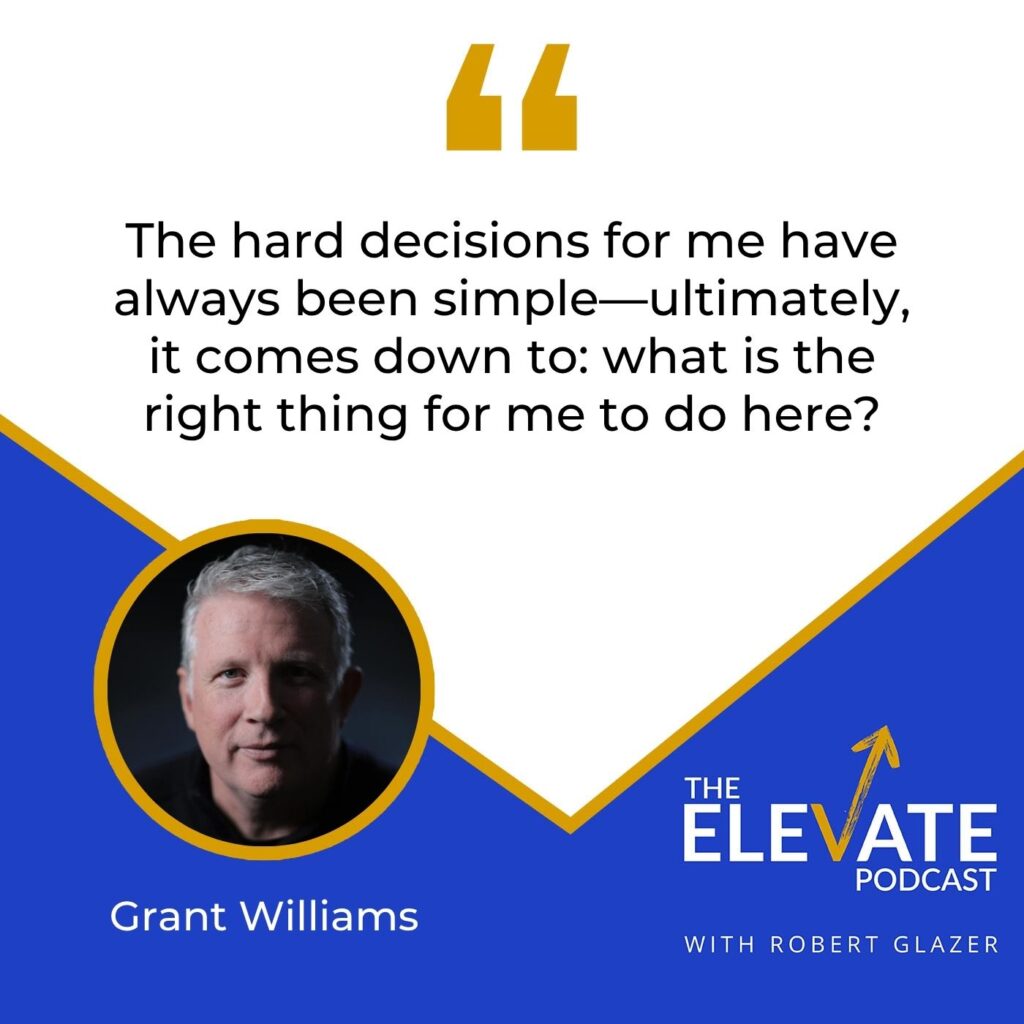
I’ve had a couple of those decisions to make in my time. I’ve found that the hard decisions for me have always been simple. Ultimately, because you boil down to, what’s the right thing for me to do here? If you can do that, you can strip the money out. Forget the money you’re going to give up by stopping this particular part of the business. What’s the right thing for you to do?
Simplicity, Trust, & Leading By Example
There’s being true about the justification. Like saying, “I don’t want to do this anymore.” You can imagine them saying, “I didn’t think you cared. You didn’t want to do this anymore.” That’s what people do. They oversell it versus sometimes, the Occam’s razor, the simplest explanation is the best.
If you can, that’s it. Simplicity is, as what da Vinci said, “Simplicity is the ultimate sophistication.” That’s very true. If you can get things down to very simple decisions, it does make life that much easier. I could have come up with all kinds of reasons why I need to stop this. I could have said, “The numbers aren’t what I’m hoping for.” There were plenty of things I could have said to try and soften the blow. I didn’t say it. We have trust.
That trust comes from my leadership. My friend knows that I’m going to take care of him because he’s my employee, my friend. I’m going to do what’s right for the business. That leadership where you work in close proximity with people. You don’t have to lead in terms of, “I need you to do this and this.” You do what you need to do. You do the job that you’re trying to do. You bring them along with you. You can call it leading by example, if you want or not. Ultimately, you’re in pursuit of the same goals. You both have a pride in the product that you’re trying to put out.
It just so happens that there are a set of decisions in that process that will fall on my shoulders. I’m comfortable with that. I don’t feel that that makes me a leader. We are a team. The leadership is because I’ve taken on the added dimension of running the business. Nothing more than that. In terms of our collaboration, every decision, we would discuss. Except once the cameras start rolling, I’m in charge of asking the questions. He’s in charge of making me not look stupid. He had, by far, the hardest job, I promise you.
That’s fair. Where can people learn more about you and your work and your show?
Very simple. Grant-Williams.com. It’s all on there. On Twitter, I am @TTMYGH, which is the acronym for Things That Make You Go Hmmm…, if you can’t remember it.
That’s a very easy thing to remember. Grant, thanks for joining us. Your perspective across market cycles, geographies, and all the leaders you’ve talked to is very helpful and very grounding.
Robert, I’m grateful. Thanks very much. I would love to have you back on my show anytime you feel the need to.
In the next book. It’s getting close. I’m almost done with the draft. It’s a new twist on leadership. It will be interesting. You can learn more about Grant and his work on the episode page at RobertGlazer.com. If this episode made you think about something differently, quick favor to ask. That is, do you mind sharing it? Text it to someone. Email it to someone. That’s how new users discover our show. Thank you again for your support. Until next time, keep elevating.
Important Links
- Grant Williams
- Grant Williams on LinkedIn
- Grant Williams on X
- The Things That Make You Go Hmmm…
- Real Vision
- Von Greyerz
- Vulpes Investment Management
- Liar’s Poker
- Raoul Pal on LinkedIn
- Remi Tetot on LinkedIn


