

Ethan Evans is a retired Amazon Vice President who spent 15+ years building and scaling major Amazon businesses – including Prime Video, Amazon Video, the Amazon Appstore, Merch by Amazon, Prime Gaming (formerly Twitch Prime), and Twitch Commerce. At Amazon, Ethan led a global team of over 800 people, holds over 70 patents, and became known for developing leaders. Since retiring from Amazon, he’s focused on paying that experience forward through his writing and his Level Up program, which helps leaders get promoted to executive roles by mastering the standards executives are actually measured by.
Ethan joined host Robert Glazer on the Elevate Podcast to discuss lessons from his leadership career and share proven strategies for building executive presence and getting promoted to the highest levels of an organization.
—
Listen to the podcast here
Ethan Evans On Building A Career At Amazon And How To Get Promoted
Welcome to the show. Our quote is one of my favorites of all time from the legendary management guru, Peter Drucker. “Management is doing things right. Leadership is doing the right things.” Our guest, Ethan Evans, a retired Amazon vice president who spent fifteen years building and scaling major Amazon businesses, including Prime Video, Amazon Video, the Amazon App Store, Merch by Amazon, Prime Gaming, and Twitch Commerce.
At Amazon, Ethan led a global team of 800 people, held 70 patents, and became known for developing leaders. Since retiring from Amazon, he is focused on paying that experience forward through his writing and his Level Up program, which helped leaders get promoted to executive roles by mastering the standards executives are actually measured by.
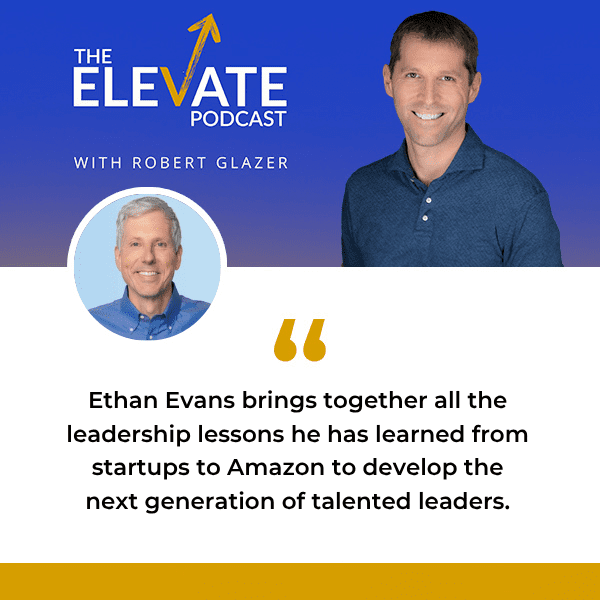
Ethan, welcome. It is great to have you on the show.
Thank you, Rob. It is tremendous to be here and to have a chance to share, to do some of that paying forward. I love that.
Looking Back To Ethan’s Upbringing And Education
We have had the chance to talk a few times now, but we will take it a level deeper. In that spirit, I always find it helpful to start a little bit with my childhood. Did you have any early interests in things like robotics and engineering or building things, or were you taking apart things in your house, or what was going on?
The sign that I was destined to be an engineer happened when I was seven. It’s early. My father and grandfather were trying to fix a broken window on the back of our house. It had broken out in a hailstorm. The window was very high, and they were trying to figure out how to get up and work on the window. They were using these ideas with ladders. I grew up on a farm, and we had a wagon, and I said, “Why do you not just roll the wagon under the window and stand on that?”
You are also an entrepreneur.
What shocked me is that they did it. A seven-year-old, I am just talking. You do not expect adults to listen to you. I see the two people I look up to, my father and my grandfather, roll the wagon up and stand on it. It opened my eyes to the fact that people would take my suggestions. Of course, I did not understand exactly why I saw that solution, and they did not until I was older, but they knew the right answer was to use ladders. Whereas, as a kid, I just knew you needed something to stand on.
I was not locked in their box. That is probably the earliest, like, “I am mechanically inclined, and I like to solve problems. I frankly love to discuss hard problems.” It grew from there. I always knew I would be, my whole family is in hard sciences. My dad had a PhD in chemistry. My mom had a master’s degree in chemistry.
You are like the inverse of my family, of which we will never have a doctor. There are just no science genes. There are a lot of marketing genes, but no science genes.
We are actually the black sheep. Most of my extended family were medical doctors. The fact that my dad was only a PhD in chemistry and not an MD was like a deep disappointment. Second class.
What about leadership? Did that show signs of earlier? Did that kind of come later?
It depends on what you call early. The leadership really came out in college. I took a job, as all good geeks do. I took a job in the computer cluster at my school, and I was at a very geeky school. Carnegie Mellon is a big computer science school.
That is hardcore.
I was working in the computer cluster, and they had a role open to be a manager. I took on the manager role, and then probably where the leadership really came out is the management there fired a really nice young guy who was a friend of mine. I organized a strike basically to push back and say, “You need us who work in the clusters to keep them open. You rely on students. We are all going to walk out, and you, the administrators, are not going to be able to operate your school unless you restore this kid who was unjustly fired.” They did, they caved.
Sounds like a future union leader.
In my early days, I was very confrontational. I have put a thin veneer of civility over that.
Let’s talk about this, but I am sure that working at Amazon requires some sharp teeth at some point, it sounds like.
I call them sharp elbows, but it’s the same idea. It was definitely an environment where, often, when I coach people, I will say to them, “Rob, you are a really nice guy.” In this context, that is not a compliment. You need to get the elbows up a little on the basketball court.
There are strengths and weaknesses, and context matters a lot. You trained as an engineer, and you describe yourself as a through-and-through geek. It is interesting. It does not surprise me now, knowing what you do. I may answer my own question here, but there are not a lot of engineers that I have seen. I know they do get passionate about leadership, but it probably helps define what you have done, which is how to engineer leadership into a repeatable skill set. Somehow, you have brought these two together.
Early in my career, I was sitting on a flight out of London with a woman who was a psychologist, and I was chatting with her, and she could not believe I was an engineer. She is like, “You are way too outgoing.” It is true. I feel I made my career largely by understanding technology, but then having the social skills to work with business and business leadership and the rest of management as a go-between. I often say I translated business to geek and geek to business. I am a unique or different engineer in that way.
Working In Startups Prior To Amazon
Before Amazon, you spent about twelve years across three startups. We will dig in heavily to Amazon, but what are a couple of leadership lessons you learned in that stretch that maybe helped you with Amazon, or what are some things you had to unlearn later on?
The big thing I learned is that in a startup, people will let you take on any job you are willing to. The great thing about a startup is they do not have rigid job roles. To foreshadow a little bit, when I got to Amazon, and I tried to step out of my lane as an engineering manager, I was very much told, “Yeah, that is not really your job. Your box is here.”
Startups will let you take on any job if you are willing to. They do not have rigid job roles.
We have a description of your box. Here it is. It is a piece of paper. At a startup, they are like, “We just have a lot of work. If you can do it, that is great.” I grew very rapidly at startups because I ended up taking on things. For example, I took on all the recruiting. I love to recruit people, and being the recruiter also led me to run human resources.
I bet you engineered the hell out of recruiting and turned it into a decision science.
It was a pipeline. I treated it like a sales pipeline and metrics at every stage, and SLA is at every stage.
It’s very predictable.
It worked really well, but I ended up being an engineering leader. I would be VP of engineering and VP of HR, which is just no one combines those. I have done really weird things for my startups, like going to an unemployment hearing to contest someone who quit and then wanted unemployment. I went to the contest.
There are all kinds of stuff. It is amazing.
That is a very odd job.
You are guilty until proven innocent, as the company is in those situations.
Absolutely. Luckily, I had emails, and I had stuff in writing.
Stories of people stealing stuff, fraud, and then unemployment. It is crazy.
To go back, I think the thing I learned was to take on anything that needs to be done or that you are good at. That is what I learned in the startups. The thing I had to unlearn was the thin veneer of civility. I had a saying I loved, which is that people say I am a loose cannon, but that is only when I am pointed at them. I was very abrasive. Eventually, that got me let go at two of the startups. They were downsizing, and when they were asking like, “Who will we enjoy having around in our tough times, and who can we live without?”
I was on the live without list, and it was because of being abrasive, not because of being ineffective. I had to learn like, “As a young engineer, you can pop off, and people will just roll their eyes and move on. As a leader, the other leaders will not put up with that.” The big thing I had to unlearn was really growing up needing to have decorum, needing to be professional. Now I actually believe and practice the idea that I can give any difficult message. I can be direct, but never angry or uncivil. I can figure out the words.
That is a good combination because most managers really suck with difficult conversations, and they start with the “I do not think we are banned in companies, but I do not know where they learn it, but maybe it is intuitive.” They do the shit sandwich. As they sit down, they start with a compliment, and then they sneak in the thing. Ethan, I am actually worried that you are going to even be a fit for the company, but keep doing great work, and we will talk next month.
The whole thing, we did training around this. Every time, I was like, “How many people think that Ethan knows that his job is on the line after this conversation?” No one would ever raise their hand because it’s just like saying, “Ethan, I got to talk to you about something. It is actually serious. I am not yelling at you, but I make sure that you understand what we are going to talk about right now.”
I agree with you. I have tried very hard. One thing people love when I teach career growth classes is that I model a few of these, and I tell a story of where this is jumping ahead to Amazon a bit, but the story is from there to illustrate the point. I wanted my first promotion, and I needed to figure out how I was going to tell my boss. I really want this, but without threatening. I really thought about the language, and I went in, I said, “I want to have a career discussion with you because my career is very important to me.”
Of course, no one can argue with that that your career would be important to you. I said, “I need to know how important it is to Amazon because if it is not as important to Amazon as it is to me, I need to think about that.” There is a threat in there, but it is very subtle. That is fair. I have put it out there. No one can really argue with that.
Seems reasonable.
My manager, there are so many ways you could say that would trigger resistance, because I could have said, as opposed to how important my career is to Amazon, I could have said how important my career is to you. That would have made it personal. It’s important to me.
You are a psychologist, too, in addition to an engineer.
I have definitely tried to become an amateur psychologist because understanding people is the art of leadership. The more you understand how people’s minds work.
If you want to lead people, maybe do not study business, maybe study organizational psychology.
I agree with that.
I want to go back to a thread that you said, though, because I actually think it is important to understand, and it will get to the Amazon thing. I agree with you. I always say early-stage companies value, I will call it, a very strong utility player. You can play third base. You can do this. That is what it rewards, right?
It rewards this versatility in doing well. We got to a point as an organization, and we had to move away from a lot of those people, because this is what culture is. You train someone on one set of things. I am like, “What can you do?” They are like, “I can play a little left field and outfield.” I was like, “I need an all-star first baseman. Would you like to be held to the standards of an all-star first baseman or third baseman or whatever it is?”
They were like, “No, I want to play a little infield.” I was like, “We do not, that is not what we need.” It is a hard transition for a lot of people. I am guessing you felt that when you went to Amazon, where it is like, “No, you are going to do this thing really well. That is how we are going to measure you.”
Part of, of course, going to Amazon was that I had been a vice president in three startups. Vice president of a startup means something different. I had a few teams and 10, 15, 20 people. Here I come into Amazon, and they are like, “Your title is senior manager, and you are going to work on this one thing with six people and deliver it.
They were paying me more. I was doing better than the startup, but the role felt so narrow. That was a big adjustment, as you say, if you have been playing, put me in coach wherever you need. Someone is like, “No, first base all the time.” You are like, “Wait, I do these other things.” They are like, “Yes, do first base.”
I do a lot of these things well enough.
Instead, they are like, yeah, do first base better. That is boring. I liked all these for that person. You are right. I had to learn how to be good at first base and only first base.
Amazon’s Two-Pizza Team Approach And Memo Culture
When you came to Amazon, how big was the company?
14,000.
What is it today? Just order of magnitude.
I would say when I left, it was 1.4 million. It grew a hundredfold. Now it is, I think, closer to like 1.6, 1.8 million.
That is insane. That is high. When you got there, this was still relatively early. What were sort of some of the unique management principles, and probably still Bezos’s DNA was on a lot of these things, where you are like, “I have not seen this before, but this makes a lot of sense?”
I guess I will cite three. The first one is that they had this idea called a two-pizza team.
Love this one.
The idea was, “Teams should be small enough. They can be fed by two pizzas.” Six engineers, a manager, and a product manager were the eight people. That is two big pizzas. The idea was to keep it small, keep the communication, the overhead, small teams of focused people are more efficient than big sprawling teams that spend all their time communicating and arguing. Their idea was to give ownership, which is the second idea. They had an idea called a single-threaded owner. The idea there was, who is the one person who is completely responsible for this and who has all the resources they need to deliver it?
Small teams of focused people are more efficient than big sprawling teams that spend all their time communicating and arguing.
They would try to put in those 8 people, 5 or 6 engineers, maybe a designer if you needed it, and a product manager. The point was that the manager, then me, the owner, was completely responsible for delivering whatever it was that needed to happen. You talked about earlier, Amazon being a little bit of a harsh place. The other language they used to use, and I am sure a spokesperson today would deny they ever said this, is that they called it one throat to choke.
That is just good organizational design.
Who do we put the Darth Vader grip on and make sure that guy hanging in Darth’s grip is motivated?
That may not be a PC term in today’s world, but it goes to good organizational design. Organizations that design split accountability around everything are a disaster, versus what we always, when we were building our organization, this came from the EOS traction scaling up world, that it is all the same. You said you can have someone’s name in two boxes temporarily, but you can never have two people’s names in one box. I always remembered that.
First thing, two pizza teams. Second thing, single-threaded owner. The third thing that was just totally different was the narrative writing culture.
The memo culture.
Jeff correctly understood that PowerPoint was a dumbing down, that we take everything that is complicated and we reduce it to three bullets, six words in a graph. The first thing about PowerPoint is that it causes you to simplify everything. You take a complex idea, and you reduce it to three bullets and to one picture. Jeff did not like that.
The second thing about PowerPoint is that if you just think about the name, Microsoft acquired that company, and it was a sales company. The whole product is about me making a PowerPoint to try to sell you something. Jeff wanted a culture of deep thought and deep discussion. Not one person convincing another.
He switched our culture to a six-page written narrative. It is a very unusual meeting culture because you spend hours, days writing this six-page explanation, and then everyone sits quietly for the first twenty minutes of an hour meeting, reading the six pages, making notes, and thinking about it in silence before you start the discussion. He felt that it brought a much deeper level of contemplation and richness.
He once said that when he read those documents, what he would do is read a sentence and then stop and ask himself, “Do I believe this?” Then read the next one and say, “Do I believe this?” He was literally going through the document with that level of study. That was probably the most different thing about Amazon.
I studied this memo thing for years, and there are a whole bunch of layers. One is that it definitely favors extroverts and people who make loud cases and speak well. Sometimes the people who have time to process or think are thoughtful or talk over. Seemed to level the playing field and take a lot of the pomp and circumstance and get people more focused on the idea.
It definitely gave the introverts all the time they wanted to at least make their initial case, because they could spend a week. Some of these documents. I think this was excessive would go through 30, 40 versions before they would get to Jeff, where you are just tuning, tuning. What is the information? What is the data? I think that might have been a little bureaucratic, but the point is, it did allow the introvert to have all that time to express their idea really well without ever needing to be a public speaker. Instead, they had to be a writer. It is a little bit different.
A thinker. I guess it was before ChatGPT, but they had to be able to express the idea. I also like that it gave time for people to have too many essentially asynchronous meetings, which makes no sense to you, as you are going to get a bunch of high executive people in a meeting and just give them a whole bunch of updates where people are not discussing. That just does not make any sense. What are we going to talk about? Let us get Ethan. Why would this work? Jane, why would this not work? For putting all this brain power in the room, why do we not use it?
Jeff, that is another, you raise another good point. Jeff very quickly learned that he had to speak last because, in a game we played as executives was, “Can we get Jeff to start talking early because everyone else is going to line up behind him, even though he does not want to?” Yes, man, he is the CEO and the founder and the mega name.
It is human nature.
If you could get Jeff to say, “I love this idea,” or something, early? No one else then was going to give you a hard time. He learned very much to sit quietly and invite each other to executive to your point, to comment and think so that they did not line up behind him. He had his own opinions, which he might keep revising. He knew that if he spoke too early, whatever he said was going to carry the room, and he did not want that.
That is true psychological safety. That is modeling psychological safety. Jeff is one of those leaders who has communicated that it is about finding the best idea, not about being right.
For sure. He talked about his ideal leader, who had strong opinions, weakly held. They knew what they believed, but they’re willing to change it in the presence of more data. You obviously studied him because every time you’re like mouthing his quotes back to me as we talk, which is great. He also said, “Look, our society, anytime someone changes their mind, we punish them.”
We call them a flip-flopper. He said, “That is silly. Why would you not change your mind if you got new information?” He very much believed he had super-strong opinions for sure. It was very difficult to get Jeff to change his mind because he had thought so deeply. He would absolutely come back, and I remember a meeting we had with him, and he and I were talking excitedly about an idea to improve Amazon Video and get more households to use it.
We had another meeting a week later as a follow-up on the same general topic of how to grow the business. He is like, “That idea we had last week was terrible.” After sleeping on it, “That was a terrible idea.” I was like, “Yes, you are right.” We were going to put antennas on people’s roofs. It was just a bad idea, but at the moment, it was exciting.
Difference Of Good And Bad Flip-Flopping
You have me thinking in the political landscape where it is what is good flip-flopping and what is bad flip-flopping. Actually, I think there is sort of a leadership parallel in what you are saying in terms of getting people to change their minds. How you get people to change their minds is by presenting them with new, intelligent information that they had not considered before. You do not yell louder and tell them they are wrong.
If you tell someone they are wrong, what is the first thing if I tell you you are wrong? You are like, “No, of course I am not wrong. You defend your ego.” You entreat.
There are literally biological defenses. You studied psychology, and they kick into play.
If I am wrong, I am vulnerable. I cannot be wrong. I have to assert dominance. To get people to change their minds. Another good leader I know taught me the question of under what circumstances. Under what circumstances would you do this, or under what circumstances? Rob, you probably have a nice home. If I said, “Rob, would you give me your house?”
You are like, “No.” If I ask you, “Under what circumstances would you give me your house?” You can answer that, right? If you paid me this much, or you had this much stock, or I wanted a boat instead. The key here is that we are having a discussion. We are not going to give you our house. No, I will not give you my house. No, I will not. Instead, how could this work?
I have seen this covered a lot. There was someone being critical of this. I will give the example. I am not trying to make a geopolitical point, but they were talking about it in the context of global warming, and they were saying, “Look, to be right, your statement needs to be falsifiable. This is a constant in science. If I do not believe that there are any black sheep, they are only white sheep. The presence of a black sheep would invalidate my theory, and he was having a dialogue with someone and saying, “I understand.”
I think a leader needs to say, “Look, what I am hearing right now is that the warm weather is a result of global warming and the cold weather is a result of global warming.” There may be reasons for that, but tell me what piece of evidence would prove that maybe the global warming is not happening as we think, or the sources of what we think. That person probably needed to answer that question. You have to be willing to have an idea that could be proven false.
Good debate and leaders that are open and stay on the ideas are so tough because why did all those great leaders working for Jeff, some of whom are amazing executives, they have either gone on to run their own companies or they run huge divisions in modern Amazon, why did they still line up behind Jeff sometimes? It’s because it is so hard under the social pressure to push back on the person who also controls your paycheck and also delivers your approval, your rating, or your opportunities.
It is so hard under social pressure to push back on the person who controls your paycheck and delivers your approval, ratings, and opportunities.
It is so hard to decide, I am going to keep arguing with this person who controls so much of my future satisfaction, paycheck, whatever. You have to be very comfortable or just very confident. That is why I saw, even though not all the time, but even leaders a level above me, they would just bite their tongues because maybe I think differently, but am I sure enough that I want to take on Jeff?
There is another matrix. I have been through this because I feel very much like I have very strong opinions, loosely held, but there is another version of that too, which is I am very opinionated on things, but my opinion may not matter or be necessary. For instance, if we are having our company event and they say, “What kind of t-shirts should we have?”
I would be like, “Do not buy the itchy ones again, buy the good kind.” You do not need to ask me about the t-shirts, right? I also think it is, for people who are generally opinionated, it is important to communicate. This is a lie on the track issue for me, or it is not. Do not confuse my very clear preference for red long sleeve t-shirts with the fact that that is an executive-level decision that I need to make.
I agree that knowing when to say, “I will give you my opinion, but I actually care much more about yours or I want you to do whatever you feel is right. Even there, I think sometimes it can be the strongest to just give no opinion at all. To just say, “I do not want to weigh in on that. Whatever you do will be fine.”
“It is not important to me.” Conversely, I think there are some things for leaders where you may not realize that this is not important to me, but this is a lie on the track issue for me, because I think it impacts our culture in ways that people are not perceiving.
I know we are talking a lot about Bezos, but one of his beliefs was that a leader needed to be willing to be misunderstood for a long period of time. What he meant by that was not misunderstood necessarily by his employees, but definitely by the market. For example, there was a lot of press when Amazon first started working on AWS. There was a front page article in Time Magazine that said, Wall Street wishes Jeff would just mind the store.
Great title.
“You are a retail business. What are you doing messing around over here? You are not IBM. What are you doing messing around in some sort of weird hosting?” Obviously, Jeff’s brilliance was that he did not feel he needed to explain that to Wall Street. He actually was like, “This is great.” They have no idea what we are doing or why.
Maybe our competitors do not understand it either.
Maybe our competitors do not either. The last thing he ever wanted to do was go issue a really clear explanation to Wall Street because, of course, Microsoft and Google are going to read that and be like, “Oh.”
By the way, the biggest profitable division of the company, right?
Correct. The same one that Time was like, “Stop doing this, just mind the store.” Maybe it was Forbes, but it was a reputable major magazine saying, “What are you doing?”
We read a lot of leadership fables, wisdom stories, and case studies. I have a line where you got some of these things that takes ten years to know whether this turned into vinegar or wine. The two case studies I grew up the most from when I was in school and studying business were the Jack Welch airplane interview, which has totally fallen apart.
Every leader that he developed under that system went on to commit financial malfeasance. That was basically what they were good at. I wrote about this recently. The other one was the famous Johnson and Johnson Tylenol recall story. They are the credo of the company. Now Gardiner Harris just came out with this book called No More Tears that Johnson and Johnson used that one good deed as a measure for two decades of borderline fraudulent behavior.
These things have to stand up to the test of time. One of the things I think I also know, Bezos talked about the empty chair, which some really smart leaders talk about, not what will change, but what will not change. Wasn’t Amazon’s orientation that people will always want it cheaper and faster?
His three things to drive retail were that people will always want more choices, lower prices, and faster delivery. The bigger context is that he would be interviewed like, “You are an internet founder, what is coming in the future?” He was like, “I do not know. I actually focus on what is not going to change because I can build a business around what is not going to change.”
Drone delivery is faster, cheaper, right?
Yes. That is why they have been working on Amazon Air as a division for over ten years. Jeff is very willing to grind away on an example that only recently became profitable. You talked about ten years. This one is more than twenty years. Amazon’s grocery business is more than twenty years. Amazon started trying to figure out how to get into groceries twenty years ago.
For a long time, they only did it in Seattle because there was like, “We are no good at this. Let us just try to do it in Seattle. If we get good, we can spread out.” They struggled and struggled. Only recently have they gotten to where they are actually making money on groceries. What makes that interesting is it is twenty years of commitment to yes, but the thing people shop for the most in life is food. If we are going to be an internet store, we have to figure out food. We have to.
We have to solve that problem. It is not going away. Maybe in 40 years, some of the synthetic protein stuff.
It is the biggest household expense and the most frequent. Jeff was like, “Books are great, but how many books can you buy?” I have a whole shelf full of books, some of which I have read, some of which I have not, but that would only be if those shelves were full of food. It would be like two weeks of food as opposed to a lifetime of books. He is like, “If you really want to go where the money is, you’ve got to go to the food. “
Building A Well-Rounded Organization Structure
Playing chess when others played checkers. You led global teams of 800 people. Obviously, Amazon has incredible systems and processes for these. As you have moved into your level-up phase, you are now spending a lot of time helping executives stand out and get promoted, and removing these barriers. You talk a little bit about invisible standards that executives can use to decide who is ready for a step up.
Tell me a little bit about it. There are a lot of things you could have done. What made you passionate about this work? I sense there is an engineering component to it. For all the people listening, who are probably the majority who do not own their own business on the show and are trying to advocate for the next role, the next level, how do they start thinking about how the organization views them and making themselves more attractive?
I started what I do. I got into it because I was frustrated by watching people pound their heads against walls. I could see.
Inside or outside Amazon?
Inside Amazon, they are pounding their head against why they are not being promoted. To me, it is obvious why they are not, whatever that thing would be. It might be different in each case, but for one person, it would be their abrasive. For another, it would be they are working really hard, but they are working on what they want to work on, not what the team really needs. They are putting in fourteen hours, but it is on this thing that they have decided.
What was the quote that we started with? Peter Drucker?
What I did was I started looking at what actually causes career success. In the end, it is delivering value and things that help the company make money. If your work is not contributing to some value for the company, it is just busy work, and it may even be a distraction.
Do people really not see that? Is there a lack of self-awareness that I like this thing, or it is fun, but it is not at or it is just not? No one else cares or does not move the needle.
I see people work all the time on stuff because you talked about having the customer at the table. They want it. It is something they believe that they would like personally, but no one else wants it. It is something where I once had an engineer who is a friend of mine say, “Ethan, I do not really care what you, as a manager, think of me or what my managers think of me. I care what my peers think. I want them to think I am a good engineer.”
That philosophy is very human. I want to be respected for my craft, but it is not very promotable. It’s because this person was literally saying, “I do not really care what the manager thinks. I care if the peers think I am an excellent engineer.” That is people being tied to their technical vision, to their artistic vision. It is also people who do not understand that sometimes the thing that needs to be done most is to take out the trash.
The non-glamorous work unblocks the money. One thing I say almost, if you look at my career at Amazon, everything I built, I would call glue code. It was not usually highly technically complicated. Instead, it was putting a bunch of pieces together, not the most glamorous work, to unblock the ability for someone to buy something. In a new way, at a better price, or with more convenience. We were not building really fascinating technology.
We were building very smooth acquisition pipelines, very smooth ways for people to buy stuff. That is part of where people get stuck. This work is not challenging. It is not cool. No, but it sure fills the bank account. One of the simplest examples I can give of that is when I worked for Amazon subsidiary Twitch, which is a video game streaming. We built a product where people could give $5 to a streamer they liked to say, “Here is a donation to help you keep doing what you do and keep entertaining me.”
What we found was that people were doing this over and over. They were giving $5, then doing it again later. We realized some people want to give more than $5. Let us let them give more at once. That doubled the business. Was there anything glamorous about changing it to let them give a bigger amount? Nothing. It literally drove the profitability of the business.
Are you familiar with Clayton Christensen, the milkshake, the job that needs to be done, his sort of thing around that?
I know about the job that needs to be done and Clayton Christensen. I do not know the milkshake part, per se.
It is similar. He was working with McDonald’s or Burger King, really dissecting what a milkshake is. Who does it serve and how does it serve them, and how important is it? It sort of reminds me of what you are talking about. Some things seem insignificant, but are really critical to the job that needs to be done.
I agree with that as well. Coming back to career, which is what you ask about, I think people get stuck. The biggest places I see people get stuck are that I am working hard, and that a word I hate should be recognized. Anytime you say should, what you are doing is you are taking the power away from yourself and waiting for someone else to do something you believe they should do. You are giving the power from you to them. “My manager should see that.” Yes, they should, but what if they do not? Many people, what they do is they retreat into resentment.
It’s like, “It is not being seen, I must have a bad manager,” or, “I will just work even harder.” As opposed to saying, “Is my manager busy? Am I doing stuff they actually value?” That is one part, but also “Are they just too busy? Should I tell them?” We get this ego thing going where, because I am working hard and I believe what I am doing is valuable, if you do not recognize it as opposed to me changing what I am doing or how I am presenting it, I instead get pissed off at you.
It is your problem.
That is the single biggest blockage I see, which is the attitude that I am not getting what I should get. You are not. People get mad at me all the time. For example, they ask about bias, and bias is terrible. Women or minorities should not get different treatment. I agree. They get mad at me because they say, “What if that does not happen? What are you going to do about it?” They are like, “You are now blaming the victim, or you are excusing the bias.” “No.” If you wait around for that biased person to do what they should, you will be old and dead before it happens. Let us do something else.
It is just an agency, the locus of control, and the most successful people I’ve seen do not focus. They do not spend their whole day focused on the things that they do not control. They step back and say, “What do I control?” I have a line that I’ve used with peers and kids recently, which is like, “Someone’s complaining. We are where we are. Now what?” It is just a much more helpful orientation. Are we going to litigate how this car broke down on the side of the road all day and whether I should have put in the gas or you should have done that, or are we going to figure out how to get home?
Absolutely. You have probably seen it. There is a great cartoon where it shows a guy stranded on an island, and he has written help with logs and he is sitting on the beach. There is another one that shows the same guy, and he has made a raft out of most of the logs. I love that idea of high agency. I use a different word, but it means high agency, which is being proactive. Go find what needs to be done. That is why I started up so much because they were always happy. If you found something that needs to be done, they are like, great, go do it. Bigger companies can be like, “That does need to be done, but that is an HR job or PR job or IT job or whatever.”
Liz, who wrote the book Multipliers, was on the show. She talks about how to be a great employee and promotable. She talks about it, and it just sounds so simple. Go figure out what the most important thing is and do it before people even ask you to do it. It is not even Liz Wiseman. That sounds complicated, but it just makes sense. We live in a supply and demand world.
The problem is, I agree a hundred percent with what Liz is saying. The challenge is that people have asked you for 200% of what you can do. You have got this full inbox and all this crap in it. You have all this work to do. To really do what Liz is saying, it is not just to see what needs to be done and do it. It is also okay with the fact that you are going to disappoint three people who want them to go back to the office space and their TPS reports. They are not going to get those.
If you are juggling three glass balls and one is worth $50 and, one is worth $1,000, and one is worth $500,000, I would probably want one to drop the $500,000 ball.
People struggle, though, in your analogy, it is really you are juggling a 50, a 100, a 150, and being able to realize, yes, but a 500 is sitting over there. I need to be willing to drop one or more of these to go pick up the thing that no one is doing, potentially. It is just extending that analogy. Of course, drop the least valuable balls, but also be looking around for what I could go pick up? I think you like quotes. Steve Jobs definitely said, “It is not only what you say yes to, but it is the 10,000 things you say no to.” Employees have a hard time saying no to something because they are going to take blowback from somebody about not doing that, or they might.
Drop the least valuable balls while also looking around for the next big thing to pick up.
How Executives Decide Which People To Level Up
What are the invisible standards executives actually use to decide who is ready to step up? I think you argue that they are not always clearly communicated.
They are not. We talked some about the true business value, the impact, the entrepreneurship, and the ownership. Is this person independent? I think a couple of standards are number one, “Can I trust this person? Because I am a busy executive, I do not have time to micromanage them. Can I trust that they are either going to do things well or at least not? I do not have to worry about them creating a disaster if I put them in this position.”
Wait, if you had to choose one or the other, if the leader is actually choosing between safety versus upside, what do you think?
I think it depends. I have watched Bezos choose both safety and upside in different cases. It really comes down to what the function is. If it is a function that has to work, but you do not feel it has a lot of leverage, like accounts payable, you choose safety. You are not going to get huge leverage out of accounts payable, but you do not want fraud.
That is a good point.
There you go for the safe operator. For something like building a drone program, maybe you go for the upside. You go for the high achiever because usually the high achiever is both more likely to succeed and more likely to fail, less middle. Jeff had some people who were his safety go-to, like this is a dumpster fire and I just need it put out, but I am not really, it is still going to be a dumpster when you are done. It just will not be burning anymore.
He had a set of people who got put on dumpster fires. He had a set of people to invent the new thing. Leaders do not always choose. This really upsets some people, too. When I tell them leaders do not always choose the highest performer, they choose the safest in some circumstances. Sometimes you just need someone you do not have to worry about. That is one thing is what is the criteria for this role?
I think that is an important distinction. A lot of people are in the wrong ones. There are some places where I need to avoid safety issues and problems. There are places where putting that, we need to fix stuff. If it is safer than it has always been, that is not a good match.
Knowing how much disruption you need. One of my good bosses at Amazon once said, “Operating Amazon for efficiency is about defect reduction, trying to get fewer defects. Trying to invent new products is actually about defect creation. You are trying to experiment on the edges, and lots of things are going to break.” You have got to understand, like, is this about reducing defects or about pushing through them faster?
Those are different. The other invisible standard is honesty, as it was expressed to me by Jeff and others, when you come into a room, do you light up the room and bring energy to it? Do you suck energy out of it? Are you fun to work with? This is a relationship piece. Do I like to work with you? Remember, I am working 60 hour weeks or 80-hour weeks. You may be good, but if you suck the life out of me by your style or your interactions, I cannot have that.
If you excite me, and you make me excited to spend hours 71, 72, and 73 of my week. If you bring that energy, I am going to be much more likely to put you on my team because I have to spend all my week with you. People get mad when they think there is anything relational in a promotion because they want it to be particularly for engineers. Want it to be all about ability. They want it to be objective. They want it to be pure and mathematical. The fact is, are you fun to work with counts? Are you someone I enjoy?
Let us think about this in the context. I say this a lot in the context of AI. If you are not reliable, not fun, a pain in the ass, mind about 30 hours a week, why would I not want to automate your job? If there is nothing else to add, as you are saying, people want to describe some meritocracy that exists where it is this pure litmus test of output. We are all going to lose to the machines in that.
What else are you bringing to the table? I watch people. This is another sort of angle on the disease of my hard work that should be recognized. They want to be recognized for what they did with no concern for themselves. They hate the idea that I chose the person who also went out to beers with me. The truth is, the person who went out to beer or whatever went out to a hockey game, went out on the road, on a business trip, whatever it is, I have a more personal relationship with them. I have more trust, and they are more fun and more energizing.
We are human.
We like people. If you are an unlikable person or not willing to put in, if you think that is beneath you, it will cost you.
Building Trust Without Sacrificing Your Well-Being
I am sure people, I know you get asked this question, so I will ask it so you can answer it. I can see you are on a call, and you are like, Ethan, and then hopefully we have calmed down a little bit on this, but you are falling into this. You are telling me that if I do not go play golf, I have got kids, and if I do not go out drinking after work, then I am at a disadvantage, and that should not be that way. I am sure you get attacked around that. What is your answer to that?
My answer is number one. Maybe it should not be that way, but it definitely is. Once we accept that some sort of relationship building is in there, then you have to ask, if I am not a go out to drinks person, how am I going to build that relationship with the boss? How am I going to build that relationship with stakeholders? Relationship, I do not know, you have studied a lot of psychology, obviously. I do not know if you have ever studied a guy named Arthur Aaron.
Arthur Aaron came up with this thing called the 36 questions. It was basically found that the way to build a relationship is to reveal something about yourself. He had this set of questions that began with a very tame question that was very safe and ended up extremely personal, and people would walk through them.
The result of his 36 questions was that college students who went through them all with each other would then often report that they felt closer to the college student they had just met than they felt to their own parents. The first question is a fun one. I will ask you, if you could go to lunch or dinner with any person, living or dead, who would you choose? You can have lunch tomorrow with anyone on earth, living or dead. Who would you choose?
I have always thought that I would go with my dad. Herb Kelleher.
That tells me you have revealed a little bit about yourself. My answer to that is Jesus Christ because such a huge figure in our history.
Might as well go big, right? If you get it over.
There is all this debate. Did he ever exist?
Tell us what happened.
Tell us the story in your own words, Jesus, please.
It was December 25th.
My mom could not get a room at the inn. You will not believe how this worked out. The point is, now you know more about me. That is how a relationship is built. It does not have to be on the golf course necessarily. It is a little bit I share, you share. How else am I going to do that?
The answer to that is if someone says, “Look, I had a kid, and I get it. I do not like going to loud, late-night things. It is not my thing. Ethan is my boss. He is at these things. I feel at a disadvantage.” The answer is, “Ethan, do you want to grab lunch or let us grab a coffee or just build rapport in my own way?”
Do not decide, “That guy is a party guy, to hell with him,” or “He is not a match.” That is the EQ to your point. That is the thing that is going to be hardest for AI. AI can replace some of that by being clever, but it cannot, I tell people now, AI cannot shake your hand and cannot give you a hug. That is for sure out of its capability for a long time yet. Those are going to be the things that those skills, that physical contact.
If we just use AI and dumb down our own skills, we are going to be worse than AI, and we do not lean into the other skills that we are more unique at as humans, we will lose that competitive advantage, right? I know I cannot process the spreadsheet better than AI, but I could build trust and rapport with you. Ethan, if you are my boss, do you feel confident having me make decisions?
Trust is that huge piece of hopefully you will like this. I have a clear model of how trust gets built. Trust is consistency over time, but it is also built fastest when I can see that you are paying for it. The ultimate trust is usually between soldiers who fought together. If I visibly put my life on the line with you, for you, and we both live, then later, when I am like, “You loaned me $10,000,” You are like, “Of course you are good for it because you put your life on the line for me.
I could trust you with my life. I can trust you with my money. I could trust you with my kids, whatever.” In a workplace, it is usually a crisis that creates that trust moment. An account has been lost. A customer is mad. A system is down. Fraud has been discovered. If you are the person who jumps in to clean up the mess, particularly if you are sacrificing, not that you have to do this all the time. If you cancel a vacation or work a weekend, or it is visible, like, “Rob is stepping up at his own pain to help.”
I am like, “Rob can be totally trusted.” That is the recipe. I actually tell people, “Look, when you see a crisis or a problem and your boss is in pain, you do not have to cancel your family vacation, but you might want to think, is this a place where I have space that I am willing to sacrifice because that is going to be paid back large.”
How To Develop And Improve Your Executive Presence
As we are running out of time here, the thing you have focused on a lot lately, let us consider executive presence at face value. People, I would assume they think they know what it means, but it’s probably not what they mean. To me, this is, as you have talked, one of the key things about who gets promoted. What is executive presence, and how does one develop and improve it?
Such a rich question. First, executive presence does not have a single definition that everyone agrees on. It is a collection of traits. Second, this is really important. Other people decide this about you. They look at you and say, “Does Rob have executive presence?” You do not get to say, “I am really good at executive presence. That would be a weird statement.” It is something others judge about you. What is it made of? The number one and two factors appear to be confidence and decisiveness.
Are you willing to make a decision? Do you seem confident in that decision? Are you willing to act on it? Those are the biggest ones. What is interesting about that is that most people associate executive presence with powerful public speaking. That is not as big, actually, as what you are saying. Are you willing to take a hard decision and act on it?
Certainly, my strongest moments at Amazon came from acting clearly and decisively. Often, when I had screwed up, there was a big situation at Amazon. We were launching a new product. Jeff was waiting for the launch. We were working to launch it all night. A new product, the Amazon App Store. The morning came, and it had not launched, and I got an email from Jeff that said, “Where is it?”
It can be a good feeling.
I had to go into damage control. I know from talking to people, he and his leadership team above, because I had failed to get this launch out, they were both considering whether I could handle fixing it. Should they fire me? I was told directly, like we were deciding whether or not to fire you. At the moment, what I did was I said, “Jeff, it is not working. It is 9:00 AM. Here is where we are. Here is what I am doing. Here is who is working on it. I will update you again at 10:00.” What that did was I was clear on what we were doing, and I was clear on Winnie here again. It shrunk his window of worrying from “Is this guy the right guy?” to “Is this plan for the next hour sane?” At the end of the hour, I would update him on the progress and the next steps.
You are building your crumbs of credibility.
I went back to crumbs of credibility, even though I was a director and led a big team. I had screwed up, and I knew my credibility was gone. What I did was that I thought you would enjoy it, and the problem got fixed. It was the next week, and I had a meeting with Jeff where I was an optional attendee. My first thought was, “I am not going to that.”
I thought for two minutes, I said, “Wait a minute, if I cannot face the CEO, I’d better pack my desk.” No one had yet told me that they were thinking of whether or not I should pack my desk anyway. I went to the room, and I sat right next to where I knew Jeff always had the same chair. I plopped down right next to it. I am like, “Let us find out where I stand.” I sit through this meeting, which is on another topic, and I am sweating bullets. Jeff knows I am right there, so he cannot avoid it.
At the end of the meeting, he actually turns to me. It is a really interesting leadership lesson. He could have said, “What the hell are you doing here? Do you not have shit to clean up?” I might have gone and packed my desk. He also could have said what many managers would say, which is, “What is the status? Give me the rundown.” What he actually said. “How are you doing? I bet it has been a tough week.” Number one, that told me I should stay right. “Everything was okay.” Number two, it also rebuilt the relationship right away.
He knew what he was doing.
I would run through a wall for Jeff because I know when the chips are down, he has my back. He could have easily said, “What the hell are you doing here? I cannot believe you are in this room when you have a broken system.”
That is a consistent trait of great leaders. I remember my business school professor wrote a book about the leadership moment, and he did a case study on Joe Torre, the manager of the New York Yankees, and how, when they were winning games, he would get all over everyone. “Jeter, you dogged it down to first base, clean that up.” When someone made a really bad mistake, he would pat him on the butt. You will get him next time. He did not kick people when they were down.
It’s because that is a fatal blow. People can, when they are doing well and they are winning, they can take feedback. When they are already down, if you kick them, it is pushing them the rest of the way off the cliff.
When they are winning, that’s when they get most complacent and set themselves up for a big mistake.
The things I talk to people about are when you are winning, you never examine, was I lucky or was I good? You just tell yourself, it is because I was good.
Attribution error.
When we fail, we actually then are a little more like, “What went wrong? What could be better?” A great human trait is to actually examine your wins as deeply as you examine your losses. Most people do not do that. It is hard to want to do that.
We have a great human trait to examine our wins as deeply as we examine our losses. But most people do not do it.
There are some things that you get right that were terrible decisions, and everything worked in your, I would say one example, this is simple and silly, but when you apply the principle of, if you drive home drunk and you make it home and do not get arrested, it was not a good decision. There are a lot of things that happen in that same way, which were brilliant. You are like, “No, you got lucky. It could have very much gone the other way.”
That is a great analogy, but most people do not really examine that. They just wake up the next morning and go, “I am in bed.” What they learn from it is that drunk driving laws are for other people.
Get In Touch With Ethan
Ethan, where can people learn about you and your work?
My website is EthanEvans.com, which has everything about me, the classes I teach, my newsletter, my mission, and my book recommendations. It is a great place. They can also find me on LinkedIn. I am Ethan Evans, VP on LinkedIn, and right there every day to share what I know.
Ethan, thanks for joining us. Hopefully, you have shared some tips that can help get some people promoted, and they will come back and listen next time.
I hope so. I love it. I hear from people who get promoted every day. I got a note this morning, and I just love to hear from people in that way. It is so rewarding.
It is a great metric of success. For everyone tuning in, you can learn more about Ethan and his work on the episode page at RobertGlazer.com. If you enjoyed this episode or the show in general, I have a small favor to ask. Would you mind just taking a minute to share this conversation with someone you think would appreciate it, benefit from it, or maybe wants to get promoted? We have grown through word of mouth, and I know I check out new podcasts when people tell me to do so. That helps us, a new audience, discover the show. Thank you again for your support, and until next time. Keep elevating.


