


Patrick Leddin is a leadership expert, disruption strategist, and the founder of The Disruption Project at Vanderbilt University. An army veteran, he led paratroopers in the 82nd Airborne Division as an infantry officer and U.S. Army Master Parachutist. He also advised senior executives at KPMG Consulting and FranklinCovey, and co-founded Wedgewood Consulting Group. His latest book, Disrupt Everything—and Win, was co-authored with James Patterson and became an instant New York Times bestseller.
Patrick joined host Robert Glazer on the Elevate Podcast to talk about his leadership career, disruption, and his writing partnership with James Patterson.
—
Listen to the podcast here
Patrick Leddin on Writing with James Patterson and Disruptive Leadership
Welcome to the show. Our quote is from George Bernard Shaw. “Progress is almost impossible without change, and those who cannot change their minds cannot change anything.” Our guest is Patrick Leddin. Patrick is a leadership expert, disruption strategist, and the founder of The Disruption Project at Vanderbilt University. An Army veteran, he led paratroopers in the 82nd Airborne Division as an infantry officer and a US Navy Army master parachutist. He’s also advised senior executives at KPMG Consulting and FranklinCovey and co-founded Wedgwood Consulting Group. His latest book, Disrupt Everything and Win, was co-authored with James Patterson and became an instant New York Times bestseller.
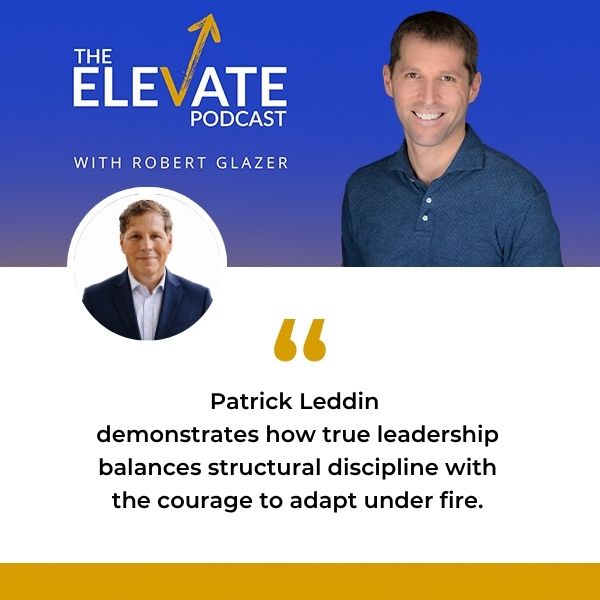
Patrick, welcome. It’s great to have you on the show.
Thanks so much for having me. I’m excited to be here.
I always find it’s helpful to start at the beginning. Tell me a little bit about your upbringing and what values or principles from those early years maybe shaped the way you think about leadership today.
My origin story, right? I grew up on the South Side of Chicago. Folks who are familiar with that area, about 139th and South State Street, Riverdale was the name of the area right there. In fact, it’s the same neighborhood the pope was from. That’s more of a claim to fame these days.
You moved up in the world.
He lived about three blocks from me. I know that area pretty well. I grew up there. I guess what was ingrained in me pretty early on was the importance of family. I’m one of five kids, the youngest of five. That was certainly a core piece in my life growing up as a family. Also just the importance of working hard and following through on commitments. My dad worked for 38 years at the phone company, laying cable and hooking up people’s phone lines for 38 years.
Is this like old school AT&T?
Yes, it was Illinois Bell before AT&T took over. He retired from AT&T, but he started off with Illinois Bell.
My mom always jokes. She worked her whole life at the phone company. She had five companies, but one job. It was like AT&T, Bell Atlantic, NYNEX, New England Telephone, Verizon, I think by the end.
There you go. Similar type of thing. I just watched my dad, and he’s a hard worker with five kids. He usually had a couple of different jobs he was juggling. I watched that unfold over the course of my life. He had served in the military, so I decided I was going to give that a shot too, because quite frankly, I needed a little bit of direction. It was helpful for me to do that so I could get going. That’s a little bit of my background growing up.
I’m curious. You started your career differently than most people in the 82nd Airborne Division and as a paratrooper. Seems like a structured environment, like the military. It doesn’t seem like an obvious incubator for someone who would spend so much time researching disruption. What did leading paratroopers in that environment teach you about handling disruption that you would have learned differently from a boardroom?
There are two sides to that coin. There is the very structured side. For me personally, I enlisted at seventeen in the Army National Guard. After college, I went on active duty for about seven years. For me, I needed that structure, that side of the coin. I wasn’t quite sure where I was going in life. I wasn’t going in a very good direction. Even at seventeen, I knew that this would probably be helpful to me.
I saw you self-selected. I’m always impressed.
I self-selected.
Some parents send people to military camps, but I’ve seen a lot of kids with ADD or whatever. They will understand. They will self-select. I have a friend whose son is like self-selecting into a military structure.
Balancing Discipline and Adaptability
The good part for me was when I went to basic training, they told me to turn left, and I just turned left. They told me to shut up, and I shut up, and all of a sudden, they’re like, “You’re a really good soldier.” I’m like, “I’m just doing what you tell me to do.” That part was good. The other side of the coin, though, is that as rigid and structured as the military is, there’s also the other side of the coin that says, do not forget the mission, and the ability to improvise and adapt and overcome in order to accomplish that mission is really critical.
It takes both things to be successful to whatever degree I was successful in the military, and that you need to, yes, follow orders and fall in line when appropriate. At the same time, you also need to realize that stuff is going to get in your way in the process of doing things. You need to use that gray matter between your ears to figure out what to do next.
After the Army went into consulting, I thought first that it was KPMG?
It was. I came out of the military, and I didn’t exactly know how an infantry officer’s how does that play over to the corporate world. I had a friend who was working at KPMG. I said, “What does that mean?” He said, “We wear suits every day, and we work on PowerPoint slides.” I’m like, “I’ll give it a shot.” I got a couple of kids. I need to get a paycheck. I went and started to do that. It just clicked for me. I was pretty good at problem-solving.
I liked the project management aspect of work in regard to things having a start and stop. I enjoyed the conversations and things I was exposed to. It just started from there. I ended up starting a firm a few years after I was at KPMG. I started a firm with my wife. That was actually, guess you would say, a side hustle now. I used to say we were moonlighting, but we were working until like 2:00 in the morning on a project. It just started to grow from there. That was the next eleven years for us.
I was going to ask you about that, but I’m curious. When you transferred from paratrooper to KPMG and not the, I guess, ladder, it’s a downward ladder, not the normal ladder, what translated and what didn’t translate from what you had learned from leadership? I guess, what was the seam and what was different?
Trying to manage a dozen priorities dilutes your impact. Focus on executing three key goals with complete excellence.
Leading Through Inspiration Instead of Rank
There were a couple of things that translated pretty well for me. One was I had pretty good leaders when I was in the military, and I learned from them, especially from the sergeants and first sergeants, the idea that you do not want to lead because of the rank on your collar, which I didn’t have a ton of rank. I was a lieutenant and a captain in the Army, but I had some rank, and you do not want to lead with that perspective. You want to lead because you inspire people and you encourage people and et cetera, etc. I brought that with me, and that was really helpful.
I also believe that I had gotten pretty good at separating the signal from all the noise. When I started working with clients, I could hear all they were saying, but I was pretty decent at picking up on the cues that really mattered and probably talking a lot less than I listened, which was helpful as well to pick up on some insights along the way. Those things were really helpful along the way. Some things were a little different, just the simple things like in the military, everybody has their name on their uniform. You do not have to remember people’s names. You do not have to network like that. You just read their name off their uniform.
The idea of jumping around from one unit to another is pretty common in the military. Most people go through rotations. After a year, they moved to a new location. Some things were just different in that world. I honestly found myself probably for that first year or so going back and forth in my mind. Did I get out? Was it the right decision, the wrong decision? What does that look like? Right around that time actually is when I got out in ‘97. A few years later, it was 9/11, and I really felt myself pulled back and forth to that point too. It was a good transition for me.
You talked about the consulting firm you and your wife founded, and eventually you built that into a business that you sold. A lot of people who start side hustles or moonlighting or whatever we call it today like, how did you decide? When was it like, “We need to do this full time? What was the threshold?”
I’ll give you a little bit of background on it. The way it works is I left KPMG Consulting, and I joined FranklinCovey. After a few years at KPMG, I decided I wanted to get more into the leadership space. I went to FranklinCovey, and a former client of mine at KPMG was interested in me finishing up a project. I went to my former partner at KPMG, and I said, “I could work through this with you if you want to work together on this.” He was like, “It’s really not that big of an opportunity for us to probably explore right now. If you want to explore it, that’s fine.”
I went home and had a talk with my wife. She was teaching college at the University of Dayton in Dayton, Ohio. I told her about this thing, and I said, “I’m not sure what to do.” The next day I came home, and she said, “I called your client,” because she knew him as well. We’ve been friends. His name was Patrick as well. She said, “I called Patrick. I can do this.” Her way of saying I can do this is she could definitely do it, but I was going to help her a little bit.
I come home from work at FranklinCovey and then work on our project until midnight, until 1:00 in the morning, until 2:00 in the morning. It basically hit the point where I said, “I’m 5, 6 months into this. We’re hiring people to work for us. At the same time, I’m trying to figure out how to go to work every day and do a good job.” It was just too much of a strain there. It was fortunate for us. We had revenue coming in from the new business we were building, which made it a little bit easier to make that decision.
I went to my boss at FranklinCovey, and I said, “I did not see this coming, but I’ve got six months with you, and I’ve already got a business that’s being built on the side. I need to choose one.” It was interesting because he said to me, and I still know him to this day, he said to me, “Why don’t we be your second client?” I left a full-time job there, but I took a contractor role, and they started hiring me back through my business to do consulting work for them. All of a sudden I had two clients, and then it just started building.
What was the focus? Was the disruption focused in that consulting firm or did that come later?
No, that came later. It was on the consulting firm side. Was predominantly human capital or talent management type of work.
You did end up on the Vanderbilt faculty where you founded the disruption project. I’m curious, like you take an academic research lens to think of a topic that most people treat as a buzzword. How did you turn it into a discipline?
We had our business for about eleven years, and I was actually on a project that took me out of the country for three months. My wife and I went on this project for three months. I came back from that trip. I was talking to my former boss at KPMG just over the holidays, winter holidays. I said, “What’s going on? We’re chit-chatting like that.” He said, “Wait a minute, you’ve been gone for three months.” I said, “Yes.” He said, “Your clients have not quit?” “No.”
“Your employees have not quit?” “No.” “You should talk to my boss. We’re looking to acquire somebody.” That’s how we ended up selling that business. Along the way, I continued going to school, and I finished my PhD at the University of Kentucky. I had that kind of built into my resume or my experience in the toolkit at that point. When I came out of the business, and we sold the business, it was that situation where you build a company for, in our case, for eleven years. You do not really anticipate you’re going to sell it. It’s like your other child.
We had two kids, and this was like our third kid. We were building this thing. We had offices in a few places. We had a really great team of people. Somebody comes on, it comes along and makes you an offer you cannot refuse. I was like, “What am I going to do in this next chapter of life?” That’s when I said, “I’m going to put this doctorate to use.” I got a job teaching at Vanderbilt, and then I became the director of undergraduate business at Vanderbilt. One of the classes I was teaching along the way was called Leading Business Through Times of Crisis.
That really got me into this change-disruption world. There was one section of the class that we would teach every semester where I would bring in guest speakers. These guest speakers were like really very experienced leaders leading sizable organizations. You can imagine one example just from the group’s perspective or the audience’s perspective. Doug Parker was the CEO of American Airlines. He’d come into class along with Sarah Nelson, the president of the flight attendants’ association. You have management and labor together talking about how they deal with crises.
It was one hit after another. That’s a really interesting class, 20 or 25 students, that type of environment. One guest speaker was a gentleman who had graduated from Vanderbilt and received his master’s degree in English literature, a guy named James Patterson. Many people know him because really successful author. He sold like 450 million book copies over the years. He’s disrupted so much in the space of publishing. He started off, he said to the students, “Are you living a good life?”
Which was different from any other question that had come up in conversation. He was very personal in that regard. He said, “I want you to live a good life. I want you to not feel like you’re on one treadmill and another treadmill and five more treadmills in life. I’m living a good life talking about myself, and I want to share with you how I did it.” The presentation that day, he called it the power of disruption. As I was listening to him talk, good research comes from a good question, I think. I’m not the only one who does that.
A lot of people think that. My question started to form. “If you’re trying to live a good life, there’s going to be moments where life throws curveballs at you. There are some people that those curveballs in life just really get them all sideways.” They feel like I cannot advance what I wanted to do. This thing messed it up for me. It happened ten years ago, and I have not recovered. All that type of thing. James Patterson has an incredible career. He used to be the president of J. Walter Thompson, the ad agency. He wrote the tagline, “I’m a Toys “R” Us kid.” He left all that to go do this.
It is like the Mad Men era.
Although he would say he was not an ad man, he was not a mad man for sure. As he was saying that, he also said he had some really down times. He was engaged to a woman in his 30s, and she was diagnosed and passed away from brain cancer. That’s the instruction you would not wish on anyone. By the time it was over, I was like, “How do people do this?” I was very fortunate. The chancellor of the university sponsored the research project.
I spent 2.5 to 3 years with a group of students, a research team, going out and interviewing. We interviewed 350 people to get their stories and then thousands more through surveys. Ultimately, James Patterson, I wrote the book about how to take the curveballs in life and use them to disrupt yourself, your relationships, your team, your family, your organization, your industry.
Effective leaders adapt their response to the situation instead of relying on a rigid persona during moments of change.
We’re going to dive into this in depth in a minute. There’s two questions that come out of that. I’ve been having this discussion a lot. I have a feeling where you’ll come out on this. One, feels like we live in an era of black swans now. There’s just constantly this global political geo something that resets everything. Two is there’s just been an expectation shift. Three hundred years ago, if you survived the day and found food, that was a win. Now, almost the expectation is that my life should go well and be good and be easy. When it’s not, then people cannot recover. I feel like they’re almost too far on the other side of that coin. What’s your thought on both of those?
Throughout history, as you mentioned, getting food alone was a big challenge for folks, and their lives were disrupted too. I’m sure if you went to go get food and it was no longer there, or water that’s no longer where it was.
It tried to kill you on the way to do that.
I go out to get food, and I never come back. That’s probably disruptive to those I share a life with. I’m not naive enough to say that everybody has not had destruction. There are a couple of things going on today. Obviously, technology is causing destruction in a different way. You can go to bed tonight and wake up in a bit of a different world tomorrow. Something you do, I do here in Nashville, Tennessee, can show up on someone’s radar in Beijing today. Those types of things are just the reality that we live in. There’s a bit of that. I also think back when we were having to go out and do that level of survival we were just talking about, our brains really got good at conserving energy because we didn’t have buffet tables everywhere.
The fact that our brain uses up so many calories, especially compared to the size of it to everything else in our body, we’ve gotten pretty good at saying, “I need to get things under control. I want consistency.” Those types of things our brain likes. As much as our brain likes that, it also has this ability to create and do new things. In today’s world, we’re tapping more into that creative side, probably, I would argue, and leveraging that in disruptive ways as we talk about in the book. I’m not naive enough to think that we have not always dealt with disruption, but there are some unique things about today and the ability to make a difference in the world.
Viewing Disruption as Fertile Ground
Now, on the other side of the coin, when you talk about, “What about people who feel sometimes like it’s outside my control or I couldn’t do it or I tried or the forces are lining up against me?” There are plenty of times where you can feel like the forces are lining up against you. What we were really trying to study and learn is how you can shift your mindset from the idea that disruption blows things up or breaks things to the mindset that says maybe disruption is fertile ground for something new and something different?
Interesting. We’re going to dig into disruption here, but there was some irony that occurred to me as I was prepping for this interview that I wanted to ask you about because you’re obviously at Vanderbilt. When I think about higher education in the last couple of years, there has been a lot of disruption on campuses. I, in particular, and my audience have been incredibly critical of the poor leadership at a lot of schools like Columbia.
Your chancellor, Dr. Diermeier, has been held up as an example of excellent leadership, like keeping the campus under control and not having problems enforcing rules that have already existed. Vanderbilt and Dartmouth and a few other schools are examples of ones that got it right so that student life is not disrupted. I’m curious about your thoughts on that and how you think about when not to disrupt and what his leadership has looked like.
I’m supportive of Chancellor Diermeier for sure. Actually, he spoke in that class on crisis leadership that I taught every semester. He spoke in that class. His area of research in the past has been around reputation and how you manage a reputation through times of crisis. You see organizations that do really well and organizations that fall apart. A couple of things I like about him specifically, and this is just my perspective, so just one data point.
From my interactions with him, first of all, he’s really good at listening to different points of view and then making a decision and sticking with that decision. You do not usually find him kicking the can down the road. Things usually do not get better if you just wait it out longer. Usually they get worse. You do not find him to be the person who does not enforce, like you said, the rules. There are rules we all agree to.
The kids at Vanderbilt who broke into his office were prosecuted. There are consequences.
He believes in the idea of the institution having what he calls principled neutrality, which is the idea that we are an institution, they are an institution at Vanderbilt that should be designed for open debate and discussion. That means everybody should be able to have their voice and not have their voice squelched by those who shout louder. In that case, he said that unless there’s a situation where the university feels like it needs to truly take a stance on something, for the most part, they’ll try to be neutral. That’s actually served them pretty well in many ways we go to.
What’s interesting is I’ve made the case. I do not think the student body shows you about culture. Again, those principles you said around neutrality and respect and stuff, that is all talked about in orientation and handbook and why you come here. I do not think the student body is functionally that different at Vanderbilt than at Columbia. It just shows you how, when different cultures and standards and leaderships, you get totally different outcomes.
He sponsored this research project for me. After I decided I was interested in moving out and actually made an appointment with him, which in general, you do not go and you do not go see the chancellor as a professor. There’s not a lot of great things that will come out of it necessarily. I went in, and I said to him, it went down like this. I tried a couple of outlines with James Patterson on the book. We had not quite gotten there.
I felt like I was on the ropes at the moment because if I do not really get the next outline right, it might not go anywhere. I went to the chancellor, and I just said to him, “I’ve got a fifteen percent chance of writing a book with James Patterson. If you give me what I’m looking for, it’ll go to 50%.” He said, “What do you need?” I said, “I need a research team and some funding to help with some of these interviews I want to do.
If I do what I promise you I’m going to do, it’ll go up 2% to 3% every month.” If you do the math on that, 2% to 3% every month, that’s 2.5% on average. You run that out for twenty months. Twenty months later, which is exactly when it would have hit a hundred percent total, we sold the book to Hachette. There was a willingness on his end to take a risk with me on that. There was some degree of tenacity on my end to hang in there and make it happen.
The disruption project interviewed 350 disruptors, including Fortune 500 execs, entrepreneurs, parents, creative soldiers, and even everyday unsung heroes. What were some of the surprises that came out of that body of research? What did you expect and what was much different than you expected?
The thing that was much different than I expected was that, as I went into it, I think that in my mind, I thought there were a few key behaviors. If there were a couple of things these people did, and we could teach everybody to do those couple of things, maybe it would make the difference. It was a naive approach. As I got into it, I started realizing. I remember coming back and working with my team. Every time you go out and do an interview, they’re an hour and a half, two hour conversation, and you get all that, the transcript from that. The team codes through it.
We try to figure out what the similarities are. What are we hearing from people? What are the behaviors they’re talking about that they bring to the forefront? I remember the team said, “There are like sixteen behaviors here.” I was like, “Sixteen, that’s a huge number. We’ve got to work on this. Are there some things that are the ultimate behaviors?” What we realized, though, as we studied it, was there are sixteen behaviors that we found, but nobody had them all maximized. There’s no perfect combination of them.
Everybody we talked to, as I’ve talked to since then, at least self-identifies that they have at least one of them. There is actually a lot of good in that because there is no magic one bullet. If you get it or you do not get it, there are a lot of different things. Some people have it. Some people just really quickly, like some people are really good at casting a vision. Some people are really good at looking at brutal reality.
We should work together.

You should have them together, because casting a vision could say, “Man, I want to be an NBA player.” Brutal reality would say you’re like 5’ 8”, 5’ 9” on a good day. You’re 57 years old. You got a vertical of an inch and a half. You’re probably not going to make the NBA. It’s both of those things working in combination. That was the thing that I do not want to say surprised me completely, but disappointed me because I thought I could just narrow this thing down. At the end of the day, you’re like, it is what it is. Let’s talk about it in ways that people can actually own the strengths that they have and bring them to the table.
I love the title in the book, Disrupt Everything and Win. One of the core concepts is what you call positive disruption. That’s interesting because, as most leaders hear the word disruption or when they think about their word about being disrupted, or particularly with AI, it’s negative. How do you flip that frame? Again, particularly with AI, I think the commentary is interesting. It’s a big new technology. It’s going to be a lot of change. I cannot remember in history the people selling it going with an approach of “This is going to destroy jobs in your life and change the world.” It seems like a very interesting marketing strategy of maybe telling, “Associating disruption with negativity and not positivity.”
Can you imagine if you were selling a car, like this is a destructive piece of technology, it’s a hundred some years ago, and it might get you to where you want to go or drive you off a cliff, I do not know. That’s probably not the way you’d necessarily position it.
Do you find it weird how the AI industry is marketing AI?
I do. Actually, I was looking at something, and I clicked on it myself just to understand it better. It was funny. Their AI chat was not working, so that was kind of funny as I was trying to do it. It is that way because it’s everything between you’ll be able to outsource all these things to agents and they’ll do them for you to, “Do this and you can streamline your business to the point where you do not need anybody.” There’s a little bit of, like, that the heart and soul of who we are at some point is the people as well. AI comes up in 80% to 90% of the client engagements I do these days.
Surprise, it’s not 100.
Maybe it is. Maybe I just do not hear it all the time. I have a partnership with that FranklinCovey company. I had a partnership with James Patterson and myself. They built a course off the book, and I do not know, tens of thousands, maybe a hundred thousand people taking that course or more. I have no idea at this point. I go into a lot of engagements with their clients, and we’re talking like Fortune 100s, and everybody’s talking about AI. The other day I did a conference myself, like a mastermind thing for entrepreneurs that I was speaking at. Everybody’s talking about AI. I was at a large government agency last week in DC talking about AI.
It’s like no matter where you go, you hear the conversation come up. What I found is that, going back to when we talk about somebody being a positive disruptor, when you think about a positive disruptor, we say this is somebody who sees disruption as an opportunity for innovation or progress. Moving forward on something they care about. Sometimes somebody might say, then what’s the opposite of a positive disruptor? Is that a negative disruptor? I do not think so. A negative disruptor is that curmudgeon, that difficult person, the one who just blows the meeting up to blow the meeting up.
The one you see on the agenda, you’re like, “I’ll just skip this session because it’s not going to be great.” That’s not what holds most of us back from being positive disruptors. Most of us are not like, “I’m not going to do that, but I’ll be the jerk in the room.” That’s not what we typically do. What we typically do is we say, “I like things the way they were.” Even though they’re changing, I want to go back to the way they were. We would say, “The status quo is a deceptive little devil. You want it, but it’s going to change.” Sometimes people say, “I got 50 things I want to do, and I’m going to try to do them all.”
They end up trying to do them all with mediocrity. We found that these people do not become. These positive destructors do not become tantalized by all the things they can do or bury their head in the sand, hoping to wait out something that’s clearly moving forward. They’re able to look at it very directly. This is a twist on a thought that, in hindsight, I like the title, Disrupt Everything and Win too. It’s what we labeled it really very early on, and it stuck. There have been people that I’ll talk to sometimes, CEOs or C-suite folks that I’ll talk to and they’ll be like, I do not know.
Choosing Stability Over Unnecessary Change
I feel like we’ve had enough destruction right now. Disrupt everything and win. Just sounds like I’m going to make things more chaotic for my people. I say, “There’s a nuance here you’re missing. We didn’t call the book change everything. We called it disrupt everything. Sometimes the most disruptive thing you can do is to say no to change. When that settles for a second, they’re like, “Imagine you’re in industry and all your competitors are doing X, Y, Z.”
Not a decision. It is a decision. Apple has made a decision to sit out round one of AI. We’re still maybe making the right decision. I do not know. They have enough money that they can probably cure it either way. That’s a big decision in itself.
Sometimes you want to lean toward change. Sometimes you want to double down on stability, but you’re not afraid. I want to say afraid of, but you’re not unwilling to at least look at the disruption and say, “That’s not for us,” or “That is for us,” or “Here’s what we can do with that as opposed to just acting like it’s going to go away.” I’ll talk with audiences sometimes, and there’ll be people closer to my age who will say something like, “AI is coming, but I think I could wait this one out.” I’m like, “Do you think so? Said it’s moving faster than you are.”
It’s like how many people in your company do not know how to use the internet or email?
I’ll say to them something like, this is a lot more like the World Wide Web than the Y2K bug. If you remember the Y2K bug at all, that was a big nothing burger.
I remember that. I was just starting in the workforce. It was all in it. Everybody was talking about.
Everybody was talking about it. There was a cottage industry around it. It was probably the last time I stayed up until midnight. I knew you were going to see if the world would fall apart, and it didn’t do anything. Just trying to help people frame it like it’s more like this. Patterson and I did a bunch of stuff when we were launching the book, and we were on a show called Squawk Box, and we were sitting on that show, and they were talking about AI, and James said a funny thing.
He said, “Anybody who comes in here and tells you what they think AI is, what AI is going to do is full of baloney.” Nobody knows exactly what’s going to happen. They can make predictions, and we can look back and say if they’re right or wrong on certain things. What we do know is it is a disruptive force. You and your people need to know how to handle disruption.
As you said, there were some people who decided not to sell online, and they appealed to the people who wanted an in-person experience, but that’s a decision about what to be or not be.
One person I had in that class years ago was William Dillard III. If people might know Dillard’s department store, it’s a great example of that because, go back when the internet started, they built a website, and when people were selling stuff on the web, they were doing like all the other retailers and selling stuff on the web. When COVID came, they were glad they had an app, and they got the ability to order stuff on the app or online.
They even did things like bring your car up front, and we’ll run out and give you your package. That was like table stakes. Everybody was doing those things. Along the way, they said, “At the end of the day, what makes Dillard’s Dillard’s is our in-store experience.” If we keep going down this path toward change, at some point, half of our store will be racks full of stuff for people to pick up. They decided to pull back from that a little bit.
Disruption isn’t meant to break your strategy. Shift your perspective and view unexpected changes as fertile ground for innovation.
The interesting thing is, if you go from 2020 to 2024, if you bought Dillard’s stock, it’s a big department store in malls, an 85-year-old company, family-run the entire time. If you bought their stock in 2020 and held onto it until 2024, it went up 1200% faster than Tesla and faster than Amazon. It was because, at some point along the way, they said the most disruptive thing they could do and the right move for them is to actually move away from the change everybody else is running to and double down on purpose and stability.
Everyone crowded into DTC and raised a ton of money, and they all went bankrupt at the end of the day. Too many people are rushing in. It almost doesn’t matter. I like Warren Buffett. What the wise man does at the beginning, the fool does at the end. It’s either Buffett or Munger. I can never tell which one.
I’ve personally been in the fool camp more times than the wise man sometimes. I’m trying to get that.
I said to someone last week when we were talking about something around whether we should change, and it was like, once you realize it’s a trend, it’s usually too late to make real money off of it. That’s jumping in.
That’s when you start focusing more on the bottom line and controlling costs. This one, yeah.
The booklies have five distinct roles people play in disruption. You’ve got the trailblazer, the torchbearer, the firefighter, the fire chief, and the tinder gatherer. How do you distinguish between these roles? How do people understand which one fits them or they are, and why are four fires and one is not?
The whole idea around the fire thing was that we were saying to ourselves, living a good life, you have to define your fire inside. Why do not we come up with some fire-related language that can help label these roles and people can remember them?
I guess trailblazer is on fire. I do not think of that one.
We are blazing a trail. We were just talking a second ago about moving toward change or moving towards stability. Two of those roles are moving toward change. One is moving toward change on your own, independently. Think about the stereotypical entrepreneur startup person, but you do not have to leave your company to be a trailblazer. You can be the one who says, “We’ve had ten customer complaints about this. I’m going to figure that out.” You blaze a trail independently and move out toward change.
A torchbearer is still moving toward the change, but I’m moving my team or my organization toward change. I’m lighting the path for us. Those are going toward change. The other two at the bottom of the chart, as we look at it, are firefighter and fire chief. Those are going towards stability. A firefighter might be, I heard about this great new piece of tech. I saw it at a conference. It’s pretty exciting. It could change everything. You go, “We’ve already had three new pieces of tech in the last month or six months or nine months or eighteen months.”
If I do this, my people are going to lose it. It’s not the right time for this incremental improvement and would not be worth it. You say, “We’re not going to do that.” The dealers would be a fire chief type of thing. We’re creating a movement across the organization toward stability. That fifth role, tinder gatherer, sits in the middle of our chart as we look at it. Typically, you show up there for one or two reasons. Either you just do not have enough information or data to make a decision.
You might want to gather more tinder like you’re building a fire, or you could say, “The role I’m in right now, my best thing I can contribute right now is to actually help other people tackle some of these other rules.” Maybe I give them the information they need in order to blaze a trail or the information they need in order to say no to something or whatever it might be. As far as taking a role on, I think we all have tendencies. You might look at the five roles, and you say, “I am a trailblazer. I like to start my own thing. I like to build something from scratch. I’m just that kind of person.”
Understanding Key Disruption Roles
Somebody else might say, I’m in a different type of role there. I would say it’s important to be aware of your tendency, but this is not a personality assessment like we often might see. A personality assessment might make you think, “I’m always a trailblazer. That’s just who I am. Deal with it, folks.” I would say to you, “It’s good that you have a tendency and you’re aware of your tendency, but you also have to put it in context of what does this situation ask you to do right now?” That grounding in this situation is so important.
When we leave context out, we slip up. We talk about how sometimes you might feel like you need to blaze a trail, but then you go, “I’m a team leader now in the company. My job is to lead people toward change. I’m not going to blaze a trail on my own. I’m going to lead my team toward it.” Sometimes you might feel like you want to blaze a trail, but you realize it’s not the right time, so I put the fire out.
The idea is to think about, “I’m going to look at this disruptive thing that’s happening. It can be big, small, positive, negative at face value, whatever it might be, something that stops me in my tracks.” I say, “What role should I take on?” That whole decision process of picking the role to take on, initially we call discernment, which is thinking about what’s the fire inside our team or organization? What are we trying to achieve? What’s this disruption causing for us? Do I see the opportunity within it? If so, what role might I take on in order to lead myself or others toward that?
I do not know. If you have a six role here, but there’s a very logical fire one that’s missing here in my mind. The arsonist.
Yes, I know.
What do they look like in Disruptment?
They’re falling in that more than negative disruptor role typically. It comes down to what your intent. If my intent of taking on a role is to make a choice that aligns with the fire inside our team or organization, I’m coming from a positive perspective. If my intent is to be difficult for difficult’s sake, that’s a problem. Now somebody might come across like an arsonist. In people’s minds, they might think like they’re destroying things. Their intent might be good; I would say they’re not an arsonist and they’re one of these other roles.
They’re arsonists.
It’s funny. Sometimes when you’re trying to pare something back to the essence of it, we had fourteen roles at one point or something like that. We had a lot of, I think we had thirteen roles at one point. We had different levels of roles, and there was a spark and the igniter and all this stuff. Eventually you’re like, “What is the essence?” It’s like anything else. You fall in love with what you’re working on because you think it’s brilliant. You realize I got too many barnacles hanging off the bottom of this boat. I’ve got to knock some of them off.
Structure creates stability, but true leadership requires adapting when unexpected challenges block your mission.
What advice do you have? It seems to me that obviously visionaries and visionary leaders are successful because they disrupt. In fact, someone once told me the definition of entrepreneur is French and entre in between, and they find new opportunities between the people they have not seen. There’s a pro to being visionary, but I also did some consulting years ago who talked about the visionary as the arsonist. What happens if you try to disrupt something every day? It just seems like you could create disruption fatigue within your organization. Your people do not know what Matt. There’s got to be some consistency amongst the disruption.
I agree with that. There is such a thing as change fatigue. I’ll often talk to clients about how much change they’re dealing with right now. Where are people’s emotional states around this change? How are they dealing with it? Every time you layer on something new, whether it’s a new goal or new project or new initiative, it’s going to run. It’s going to run headlong into whatever’s going on culturally or organizationally at that point. My friends at FranklinCovey talk about the whirlwind. Every organization has a world activity.
I love that video.
Just to keep the lights on in the business, you have a certain amount of whirlwinds. The question becomes, how many things can we accomplish in the face of the whirlwind we already have? The whirlwinds are the good, the bad, and the ugly. It’s everything you’re doing. It’s not like it’s all bad. There’s a lot of great stuff in there, but it takes a lot of your people’s time. Every time I layer something on, you’ve probably met organizations before where they are tackling not enough and organizations where they’re tackling too much. Both of those things can be detrimental.
There was a quote I heard once. I really loved it. I used it in one of my Friday messages that more organizations die from indigestion than starvation. You also have this concept of pivotal moments and how important it is to respond to those. What’s the warning sign that your organization’s at a pivotal moment?
I guess as you were saying before, some of these require action, and some of them require steadiness. The pivotal moments are interesting because, especially if you’re working with startups all the time, they’ll talk about pivoting all the time. “We raise these funds, we’re not getting this, we’re going to do that.” When you get with large organizations, they do not really talk about pivoting as much. They talk about transformation. Even when they’re talking about transformation, they’re not really talking about transformation.
There’s no pivoting consulting practices at large consulting firms. A lot of transformation.
A lot of times when they talk about transformation, they’re really not transforming. Transforming is turning ice into water and water into steam. They’re more like I’m reshaping the ice sculpture I have, which is not really transforming the organization, but it might feel pretty big to them. The question is, that’s the billion-dollar question, not even the million-dollar question. When do you know it’s the right time to double down on something? When do you know it’s the right time to rethink or move in a new direction? There’s so much. I sound so much like a consultant here, but it depends.
There are some filters and things you need to think about. For example, can you sit right now in your organization, wherever you’re at, and just think about what the disruptions are going on in the macro environment? What are the things out there that are changing? How are those, identifying those things, whether it’s AI or supply chain issues, whatever it might be? Look at what’s going on inside your organization too, what things you’re changing, organizational structure. Back in the office, whatever you’re doing, think about how those disruptions are both shaping the marketplace and also what they’re asking for you and your people to be able to do.
When you think about what is asking you and your people to be able to do, it starts to get into things like, “Do we have the right rhythm? Are we moving fast enough or too fast? Do we have the right talent in the right place? Do we have the right systems in order to support them?” This is what leaders have to think about constantly. It’s both the market side of where the opportunity to create new value in the world. Secondly, within the organization, how well are we prepared to adapt to that? It is an ongoing thing that leaders think about every day.
Pivot itself has gotten a little bit of lore. Think Slack. We all suffer from survivorship bias, and I think Slack has done society like disingenuous, been disingenuous, because it was like a one in a million pivot. Everyone talks about the Slack pivot. If they ever look at the data, most companies, when your core product market fit does not work, you’re dead on arrival. In fact, the Slack pivot was not really a pivot. They quit, gave back the money, and said, you know, we were building this product on the side to solve this problem, and actually we might think there’d be something here. I’ve seen people trying to emulate Slack. That’s given them a little bit of false hope.
There are some things like that. That is a one in a million type of thing. As you said earlier, when people feel, earlier in our conversation, when you said something, people feel like, “I tried this thing, and it didn’t work out. Therefore, I cannot do these types of things.” Those are the laws of big numbers in both situations playing out. Why am I not the Mark Zuckerberg who created this thing, my door room? Why am I not the one in a million companies that made this pivot? I like what Patterson taught me a lot as we were working together, as you might imagine. One thing he said is just about the idea of being big enough.
Evaluating Ideas for Maximum Value
This is true in carrying a book. You need to have an idea that’s big enough to carry through a book. The same thing is true in project work that you take on. Is the idea worth the return on this thing? A lot of times we get into something and realize it’s not worth it. I’m this far in. The opportunity cost. Sometimes it’s the same thing organizationally. For the project, I interviewed the two founders of Harry’s Shave. Jeff Raider, who founded Warby Parker, and Andy Katz-Mayfield, was the idea big enough? My goodness, he went into a Walgreens-type place and tried to buy a razor blade and had to pay a ton of money for it.
It was behind a lock and a key.
After that, he’s like, “This just feels like I feel I got ripped off.” Now they have a $2 billion business, and they literally changed an industry because Gillette went back and revisited their pricing and approach to the market. When you think about that, it was bigger than most people had thought because most people were going in there and probably not thinking about “I’m going to do this.” If they did, they didn’t have access to a Jeff Raider who had already started Warby Parker. They certainly had some experience there. They can get capital. They can make all these things happen. The world is full of people who have lots of ideas about what other people can do, sometimes not necessarily the willingness to do what it takes to execute it themselves.
There’s an interesting through line here too, again, across these 350 interviews. I’m curious what you learned about the cost of being a disruptor. I think this is the part that gets excluded from the highlight reel, like what it does to relationships, to certainty, to the person themselves. This is not a free endeavor, is it?
No, it does. It can come at a cost. I’ll give you a personal story on that. When my wife and I had our business, we were about nine, ten years into it. We didn’t know we were getting ready to sell it, you were two out from selling it. I honestly got myself sideways. I would travel so much for work, and I didn’t treat her the way I should have treated her as far as investing in the relationship. We’re on lots of calls together. Of course we’re talking while they’re on business calls.
You go to dinner, and you’re talking about the business and all those types of things. I remember I was in another city. I was flying back to where we lived at the time to go to an event for one of our clients. I missed my first flight because I stayed late for a meeting. I caught the later flight. I called my wife, and I said, “I’ll just meet you at the event. I’ll drive separately from the airport,” all that type of thing. When we came back, when I was driving back separately after the event was over, my car was out of gas. No joke. My car was out of gas.
The light came on. I got out to fill the car with gas. We lived outside of Louisville, Kentucky. I’m out in this kind of rural gas station. There’s no overhead cover. The sky opens up. I get dumped on. I’m driving home soaking wet because I ran out of gas. Both of those things were like, “You’re moving too fast to get gas. Not smart enough to use an umbrella.” All those types of things. I get home, and the garage door opens. I open up the garage door, and my wife is standing in the garage. She said, “We need to talk.” It was not a good talk. A talk that went on for months.
Is that ever a talk?
No. We had to unpack a lot of things at that moment, and I had to realign. I would say the reason that much of that happened was that I chose a different path, and then we were fortunate that the business exit came along, and that helped out along the way too. What had happened was I lost sight of what truly mattered most. Now the pursuit of all these other things that are good caused me to lose sight of what mattered most. I think that as much as you can, stay grounded in recognizing, at the end of the day, what the relationships are that matter most to you.

What are the outcomes that matter most to you? It makes it easier in the moment to make those shorter-term sacrifices for those longer-term gains. One of the ladies I interviewed in the research was a lady named Josie Natori. Josie Natori came from the Philippines, and she came to the US in the 1960s for school. She graduated from college and got a job on Wall Street. She became the first female vice president of any firm on Wall Street. Was at Merrill Lynch. She quit it to start a company that has been around for 50 years now that makes pajamas and undergarments predominantly for women. Sold in Saks Fifth Avenue and Nordstrom and Dillards and all these places out there.
When I interviewed her, Josie was in her, it was a few years ago, she was in her late seventies at the time. I was talking to her about the drive to come up with a new design, line of clothing every two times a year. There was this interesting balance I saw in her. There was one part where she believed things could get better. She said to me, “The next line can be even better.” That was that drive. There was also a part of her that said, “I care a lot about what we’ve built as a team and organization. Have 300 to 400 people back in the manufacturing facility in the Philippines that make their garments.
She travels to see them nearly every month from New York. The third thing, though, is also if you started talking about her family or her grandchildren, she lit up, and you started seeing pictures and stories and all of those types of things. She probably learned some lessons as I did along the way. Hopefully, not putting the garage door open and you’re soaking wet, but her own version of that moment. She had figured out what I will not say balance looked like, but what integration looked like for her and her life. That’s really critical.
I prefer that word. You got to work on James Patterson with James Patterson on this book. You mentioned that. I’m curious. What was that like, and what was the biggest lesson you took from him?
There are a few. It was a great experience. The initial part before I went and saw the chancellor about support on the project, I had tried two different outlines with him, trying to get this right. I just swung and missed two times. I realized, just from his perspective, there’s this idea that you can just sit down and just write something off the cuff. There’s the other side of it as you come up with a very detailed outline. He is definitely more on the detailed outline side. Although I like outlines, he likes them even more detailed than I do. I gained a real appreciation for that. Just process things.
The book we wrote together does not read like an academic book. There are not a ton of footnotes on every page and charts that you cannot be overwhelmed by. It reads more like a Patterson thriller in regards to you can keep the pages turning pretty quickly. The story tells a story in every chapter. I’ve learned a lot about the value in doing that. Ultimately, what I learned most from him that was most helpful to me is that I can get a little wound up at times. Put it that way. I get like, I got to get this thing done, and what was taking so long, and why are we not moving? I can get like that type of thing going on in my head. He told me one time, said, “Patrick, you have one or two choices in life.
You can drink from the cup of grief, or you can drink from the cup of joy. Which one do you want?” I was like, “I want a cup of joy.” That perspective alone, for somebody who’s had such a successful career over the years and his willingness to partner. This book came out six months ago. I still talk to him on the phone every week for sure. He’s very engaged in the project, and he’s been very helpful. He’s been a person that I’m just very fortunate to work with and consider my friend.
The last question I ask everyone, this one’s multivariate. It could be personal, professional, single, repeated. What’s a mistake that you’ve made that you’ve learned the most from?
There are a few out there. I actually would tell students occasionally they’d say, “Professor Leddin, we like your resume.” I’d be like, “Let’s sit down and talk about it. Can I have a resume like yours?” I’m like, “Let me tell you what, that’s the highlights, man. That’s all the stuff that worked out really well. The white space is where I learned everything.” I would say that there’s probably for me, it’s not like one event necessarily I’ll point to and say it’s a pattern of behavior that I have to watch out for myself.
If I fall into one of those two camps I talked about earlier, like bury your head in the sand and just hope this thing passes along or takes on too much. I naturally fall into that other category, and I just think, “One more thing.” I mentioned with my wife and the challenges, by the way, we’re going to be married 35 years this summer, so we’re in great shape. That taught me that lesson. You take it on too much. I had that signal show up at other times in my life. That idea in that video of the whirlwind that you mentioned with FranklinCovey earlier, they have this idea that you could do eleven things.
Narrowing Focus to High Impact Priorities
Many people take on eleven or more things, and they do not do any of them well. Some people take on 4 to 9 things. They do them okay. The really smart people, the most effective people, take on one to three things and then do them with excellence. What I’ve tried to get better at and the lesson I continue to learn and catch myself on, I oftentimes talk to my EA, I’m like, “You got to lock me in on this one, put some boundaries in place to help me out here,” is to really narrow my focus constantly on the few things that really matter and not miss out on delivering those with excellence.
I love that. Patrick, where can people learn more about you and your work? I assume they can buy the book wherever books are sold.
You can buy the book wherever books are sold. It’s in a lot of stores, so you can walk into stores and pick it up, as well as online. We always encourage you to buy it from any independent bookstore as well, to support them. As far as I know, just go to my website, PatrickLeddin.com, and I put out a weekly Thursday newsletter every week that says, “Here are some ways you can disrupt everything else in life.” If you’re on LinkedIn, I put out a Tuesday one about disrupt everything at work.
Patrick, thank you for joining us. This book lands at the right time. I know people feel like their whole life is disruption. I hope that it can help them make some good decisions there.
Me too. Thanks, friend.
You can learn more about Patrick and Disrupt Everything and Win on the episode page at RobertGlazer.com. As always, if you enjoyed this episode, we have two quick favors to ask. One, would you mind leaving a quick rating or review on the show? Two is just to share this episode with someone you might think who finds it interesting. Most users discover the show when our guest is from an existing user. We always appreciate that support. Until next time, keep elevating.


