

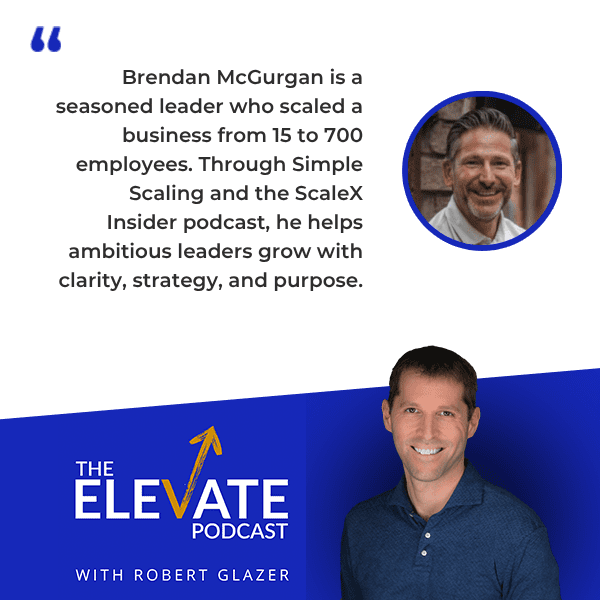
Brendan McGurgan is the co-founder of Simple Scaling and one of the leading voices on helping ambitious leaders grow global businesses. Before co-founding Simple Scaling, he spent 16 years at CDE Global — 12 of them as Group Managing Director — where he helped take the company from 15 people to nearly 700, with offices on six continents and 25x revenue growth. In 2016, the Institute of Directors named him the UK’s Overall Director of the Year. He’s also the co-author of Simple Scaling: Ten Proven Principles to 10x Your Business, and the host of the ScaleX Insider Podcast.
Brendan joined Robert Glazer on the Elevate Podcast to talk about his upbringing in Ireland, his business career, and timeless principles for scaling a business.
—
Listen to the podcast here
Brendan McGurgan On Timeless Principles That Scale Businesses
Welcome to the show. Our quote is from Marshall Goldsmith. “What got you here won’t get you there.” Our guest is my friend, Brendan McGurgan. Brendan is the co-founder of Simple Scaling and one of the leading voices on helping ambitious leaders grow global businesses. Before co-founding Simple Scaling, he spent sixteen years at CDE Global, twelve of them as Group Managing Director.
He helped take the company from fifteen people to nearly 700, with offices on six continents and 25 times revenue growth. In 2016, the Institute of Directors named him the UK’s overall Director of the Year. He’s the co-author of Simple Scaling: Ten Proven Principles to 10x Your Business and the host of the ScaleX Insider Podcast. Brendan, welcome. It’s great to have you on the show.
It’s an absolute delight to be here, Bob. I’m looking forward to this conversation. I love that quote, by the way. It’s one we cite often.
We’ll talk a lot about scaling and maybe even how the notion of scaling has changed since COVID. The ZIRP era is over. The era of growing the container of your business and hoping that people will come along with you doesn’t seem to be working. I like to dive down the path of how we got here. Let’s go right into childhood. What was your upbringing like? Were you a little lemonade stand owner? What values and principles from those early years still shape how you lead now?
We’re going right into the deep end.
Right into mom and dad is where it all lies.
Brendan’s Upbringing In Northern Ireland During The Troubles
For those who are hanging on for the lemonade stand story, there isn’t one. I grew up in Northern Ireland during the Troubles in the ‘70s and ‘80s. I was the middle child of five. My siblings often remind me that I’m very well-balanced and that I’ve got a chip on both shoulders. My parents weren’t educated. Mom left school at sixteen. She was quite unwell. She was one of ten. The classic Irish family. She was pulled out of school.
Interestingly, so was Dad. My dad was the eldest of three. His father died when he was only sixteen. He was a very academic and bright guy. He had to leave school to go and get a job to support the family. I grew up with two parents who weren’t educated. Growing up in the Troubles in Northern Ireland as an Irish Catholic, the mantra at home was, “Get educated, get a career, and get out of here.” Education was seen as the vehicle to get out of the Troubles.
Interestingly, my eldest brother was the first in our entire family to go to university. He is now a judge. He had his own law practice. He became a judge. My eldest sister is in a senior HR role in the government. I became a chartered accountant. My younger brother is a director in a construction company. My younger sister was a senior social worker. We were all educated. Education was first and foremost in our house. It wasn’t about being entrepreneurial.
It’s the core of what you do, except your students are all in a specific genre.
I grew up in a small town in Northern Ireland. It was the scene of much of the Troubles. We would walk the streets and be accosted by police regularly. There was a large police presence. I remember as a kid being escorted from home. We were stoned by the Protestant kids. It was an interesting time. That was education. My dad became a bookkeeper in a local car franchise that grew significantly. He put himself through his own training and became a group financial controller.
Hence, he was bringing these massive ledgers home from work. I watched him as the dinner table was cleared. I would sit at the end of the dinner table. He would let me use the calculator as he was calling out the numbers. I just loved the sound of this Rolodex as the numbers would be printed on it. I remember that sound. It was very visceral. He kept saying to me, “Someday, son, you will be a chartered accountant.” I had no idea what a chartered accountant was. I had no clue. I just said, “Yes, Dad, whatever. Keep calling out the numbers.” The programming was there early.
I did. I went on and became a chartered accountant. I trained in Coopers & Lybrand. I didn’t want to be in practice. I saw the chartered accountancy as a passport to travel, as an insurance policy for the rest of my life, and a vehicle for business. As soon as I qualified, it was during the dotcom boom. I was seconded into a tech business during the late ‘90s and early 2000s. As soon as I qualified, they offered me a job. It was a wonderful package. I was the group financial controller of EMEA. I had no clue what EMEA even stood for. I had never set foot in the Middle East.
That is the classic tech story. I was part of the leadership team. It was incredible training. With every good boom, there was a subsequent bust. That’s when I was invited to have a conversation with the founder of this small engineering company. It was manufacturing machinery for the quarry industry in Ireland. The guy didn’t want to be the leader of this business. He didn’t want to be the MD. He was an engineer. He loved product development. He liked speaking with customers about new projects. All of the other bits he had no interest in.
We had a conversation about his ambition level. This was before scaling was a thing. You’ll recall that scaling only became part of our lexicon around 2011. It’s very cool. We’ve all sorts of around twenty YouTubers telling us how to scale. It wasn’t a thing back then, but the ambition level was to grow. Long story short, I became the MD shareholder of that business. We scaled that from fifteen people to 700. We became the number one in our category across the globe and scaled it to over nine figures.
I set up offices on six continents. It was quite a busy time. I lived the scaling experience. Whenever I retired in 2019 and sold my shares, I had an opportunity to do that myself. One of the other co-shareholders carved part of the business. We have a couple of hundred people in India and are still trailing a path in Asia with that business. I started to explore and examine what made us successful and discovered that no one had ever codified what it is to scale a small to medium-sized business. That was the context for finding Simple Scaling.
I lived the scaling experience.
Let’s go back to when you joined CDE. They faced a pretty dangerous situation during the 2008 financial crisis. Instead of battering down the hatches, you invested in innovation. This always seems like a great thing to do in retrospect, but it’s hard to do. I made a promise to myself. The best days to invest are when the market’s going down 1,000%. Those are the days when it feels like you’re puking and incinerating money. In the long term, that was the day to invest.
I’ve tested that theory over the last couple of years. When I was nauseous, it was the day to go in. What’s the pattern that you saw there in terms of getting people to lean in, where people are like, “Dude, we need to focus on not losing our shirt.” It’s hard to drive innovation. You invested more in that downturn than has ever been invested in the company before.
The Pivot To Innovation During The 2008 Financial Crisis
It’s a great question and full of insight and wisdom. You’ve been there. In 2007, I remember taking everybody into the room and announcing our vision. It was our 2010 vision. We were going to create a $100 million revenue company. Within six months, Lehmans had collapsed. That vision was torn up. We speak a lot now about purpose. There’s a huge focus on purpose in the context of using purpose as the energy to scale a business. For us back then, our purpose was simply survival.
We had about 35 people in the team at that stage. I recall bringing them all into the small boardroom and saying, “Guys, you’ve seen the headlines. My job is as much under threat as yours. My only appeal to you right now is that we’re going to do some restructuring. Once we’ve done that, that’s it. The team that’s left is the team that we’re going to go to war with.” We had this project called Project 35. We discerned that we could extend our cash headroom on the runway for survival by a number of months.
This was survival mode.
It was, 100%, if we could take $35,000 a month from our overheads. We called it Project 35. Whenever we became much bigger, it was cultural folklore. New people were coming into the business who came into these beautiful 40,000 square foot state-of-the-art Silicon Valley premises. We had to explain, “Folks, this wasn’t always like this. Here’s the context of Project 35.” The idea was that we were going to invest in revolutionizing the industry, creating this modular technology the first time it had ever been done, and putting our eggs in that basket.
I will never forget going to a trade exhibition. It’s one of the largest in the world. It’s called bauma in Germany. The other biggest trade expo is in Las Vegas, called CONEXPO. It’s the other one we did. I remember going to bauma, sitting with our business development director at that time, who was also a shareholder, looking at him over lunch one day, and saying, “If things don’t turn around in two months, we are in a lot of trouble. I’ve done the numbers. We’re in a lot of trouble. We need this to work.”
We sold our first innovation from the stand that day. We went on to achieve 60 months of revenues, no less than £1 million, about $1.5 million for the American audience. We went on this run that turned our fortunes. We disrupted the industry with this new modular innovation. That spurred them to a catalog of innovation from that.
I’m going to jump around, but I want to get in on the vision. Years ago, we got hooked on the Brian Scudamore-Cameron Herold Vivid Vision. I saw Brian present. I was like, “I want to do this.” We did it. Everyone thought it was crazy. We hit it. Everyone thought it was crazy. Again, we hit it. I’ve coached and helped some other companies do this.
Initially, the power of it is that you write it as a future year document. It’s 2030. This is what our company looks like. People are here. People think of it initially as a little bit hokey, but every time they do it, they are shocked at how galvanizing it is for their people. They want to know which direction they’re going in. I’ve had CEOs initially be hesitant about it, but they’re surprised at how much their people lean into it.
The Power Of Creating A Vivid Vision For The Future
Let me speak to that. We navigated through the financial crisis of 2007 and 2008. In 2009, our fortunes started to change. In 2010, we still weren’t bold enough to talk about a big future again. We were creating a cash buffer at this stage. We were keeping things fairly quiet about how well we were navigating through this. By the time it came to 2011, we started thinking about what our vision could be for 2015. We can’t play the global financial crisis card here for the next ten years.
Project 35 is done. It worked. We’ve galvanized our team. We’ve created an incredible culture here. It’s time to go back out and communicate a vision for the future. To your point, we set about creating our ready for real vision, which was our vision for 2015. It was a vision to create again, dusting down the previous one, the $100-million vision. At this stage, we were probably $15 million to $20 million. It’s maybe more. The ready for real theme was a nod to the fact that we were starting to set up markets, or we started to set up offices internationally.
South America, specifically Brazil, was considered a key strategic region for us. The Olympics were going to be in Rio in 2016. We were heading into a very successful London Olympics. The news coming from Olympic Park was positive. You switched on the news in the morning and it t was positive stories. It was people winning gold medals and breaking records. I wanted to leverage the positivity of the Olympics as the theme for our vivid vision out to 2016. To your point, we achieved the $100 million to the penny. It was incredible.
We had a very similar thing.
It was incredible. That then set the platform for the 2020 vision. I completely concur. It’s a big part of what we coach on now. It’s the second principle of our ten-principle ScaleX system.
Let’s dive into that. You and Claire wrote the book with the ScaleX Framework. What was the pattern you kept seeing that made you think, “We have to write this book”? Were you working as a board member in other companies? Where did you start seeing your own stuff repeating?
What I didn’t understand, Bob, was the fact that less than 1% of small to medium-sized businesses ever achieve scale. I thought, “This is so incredibly sad.”
Defining The Technical And Practical Meaning Of Scaling
What is scale? Let’s define that.
It’s not defined in the US. It’s defined over this part of the world in Europe by the OECD. Technically, it’s 20% average annualized growth measured over a three-year period in either revenue or employee count.
Scaling is 20% average annualized growth, measured over a three-year period, in either revenue or employee count.
That employee count is going to go away since that’s no one’s metric anymore.
I always thought that was a little bizarre.
In 2016, we were winning these awards. The brag point was the number of people. A lot of the layoffs now that people are blaming on AI are BS. If you’re a public company and you lay people off, you say that because then your stock goes up. From 2020 on, people kept throwing people at problems. It became a vanity metric, not about what you’re accomplishing. It probably should be your EBITDA or your revenue rather than your employee count.
It’s a strange metric, but that’s the definition. For your audience, it’s essentially a doubling about every three and a half years.
It’s the rule of 72. Go ask Claude about it or ChatGPT if you haven’t done that.
There we go. That’s the technical definition. What is it in layman’s terms? It’s about widening your reach and deepening your impact. For us, SMBs are the fabric of our entire communities. It’s the same in the US. Ninety-nine percent of businesses by volume are small to medium-sized businesses. More than 70% of the people in the workforce are working for SMBs.
They don’t get the spotlight, which VC-backed perceived sexy startups get. They can’t command the eyeballs, which the Mag Seven gets because of their marketing spend. It’s this invisible band in the middle that holds our communities together, society, and the economies at large. That 1% who are achieving scaling are contributing more than 25% of the total GDP of our economies.
The SMBs contribute half of the GDP, but 1% of those contribute half of that, without confusing people with the math. They’re critically important. I thought, “I didn’t know this.” I was caught in the bubble of all things CD. I thought all SMBs do this. This is what they do. When we started to explore this, and that exploration came because people kept inviting me for coffee. There was a recurring theme. What did you guys do there?
You didn’t want to be a free consultant for the price of a coffee.
It was the same conversation over and over.
People always ask me when they want to know about content marketing. “What did you do? What was your strategy?” I was like, “If I had the same conversation ten times, I would write an article about it.” In the sales funnel, if you bring me a problem, Brendan, I give you advice. You think I’m giving it to you. If I point you to a two-year-old article and I say this, everyone has the same discussion. It’s a lot less personal.
This is it. We sat down. We examined the research and spent two and a half years speaking to businesses across the globe, leaders in Gymshark, for example, Skyscanner, the booking app, and more locally, Kainos, who spun out a small tech company that’s now worth an enterprise value of over $1 billion. There were recurring themes. I didn’t want to take my own lived experience and my understanding of what it was that we did to scale and say, “There you go. That’s the code.” Invite others to share their experience.
There was a consistent pattern which we codified in our book, Simple Scaling: Ten Proven Principles to 10x Your Business. Those principles are very quickly all P’s. These are psyche, purpose and vision, people, plan, process, performance, proposition, place, partnership, and held together with the keystone principle of positive growth culture. We can go any way you wish in relation to the principles.
The Importance Of Scaling Being An Inside Job
In terms of psyche, a lot of people think that a product-market fit is the hardest thing. If you don’t have it, it’s hard to get it. You have a quote in this. It’s interesting. Let’s talk about it. Where is it true? Where is it not? That scaling is an inside job. It’s more about what’s between your walls than worrying about the outside world. For some businesses, with the speed of change, they’re confused by that because they’re like, “No, my world’s changing every five minutes. I got to pay attention outside the four walls.”
Walk us through the psyche. We know some businesses haven’t wanted to grow. This will be a twelve-part question, so you can answer whatever you want. I do believe that you either grow or die. The problem with dying can be slow. I know that sounds a little direct, but at the end of the day, there are businesses that are growing, or if they’re just holding on, people aren’t growing.
There aren’t promotions. Eventually, it starts to wither a little bit. That doesn’t mean you have to grow 30% a year, but if you have growth-oriented people, they need to be in a growth-oriented environment. That was my twelve-question/statement. You can pick that apart wherever you want.
Clarity on the inside creates momentum on the outside. It’s as simple as that. You have described what we refer to as the comfort zone warrior. We have distinguished four archetypes, four personas of those who struggle to scale. The comfort zone warrior has reached a certain level of success. They’ve put the effort in.
You must have the conviction—the belief that what you’re trying to achieve can be done.
Identifying The Four Personas That Struggle To Scale
They’ve run the hard yards and want their business to stay out of these. If they could put this wall around their business as it is and for it to continue to perform as it’s currently doing. They would take that. They know inside that that’s a dangerous place to be. That’s the reference to that person. We also have the growth prisoner who builds a business that ultimately enslaves them. We have the second generation with the shadow leader, who is typically the son of a founding father who has been delegated the title of CEO.
Only trying not to screw it up desperately.
As long as the founder is there, this person doesn’t have the authority. Everyone’s still glancing at the founder for direction. They have been handed this obligation essentially exactly not to screw things up, yet they’ve been coached and parented in an entrepreneurial environment. All they know is taking risks and expansion. They’re being told to keep it as it is.
We have the graduate. This is the person leaning and nodding back to your original quote from Marshall Goldsmith. “What got you here won’t get you there.” The graduate who has hustled, scraped, and found product market fit likely raised millions of dollars. They’re buoyed by all of this. They think that what has gotten them here in terms of those traits and characteristics will ultimately support them and empower them to scale. There is a change required in terms of your psyche.
That sets the context of the psyche of those who struggle to scale. The psyche is around your belief system. We also say you can’t scale beyond the limit of your own identity. What is identity? Identity is the culmination of your belief systems. Back to that old Henry Ford quote, which your audience is very familiar with, “Whether you believe you can or you can’t, either way, you prove yourself right.”
In the context of scaling, you must hold this delusional belief that what you’re trying to achieve, the vision that you hold, can be achieved. You believe it will be achieved. We had a world record achieved in the London Marathon. Someone believed that they could break two hours. Guess what? It’s this person coming behind who was second placed. This record hasn’t been broken ever.
This happens a lot. The four-minute mile, when it was broken, then it got broken everywhere because people knew it was possible. This is something I want to dig in on because this has come up a lot lately, and maybe on the difference between a number one or a number two visionary leader. I think of a visionary leader.
When you think of founders, there is some suspension of disbelief. There’s a little bit of, “Am I lying to myself?” This is what people want from leadership for growth. They want someone to say, “See that hill and see that white flag? We’re going to go take that hill. We’re going to go get it. Follow me.” Everyone starts running. There’s someone else on the team, probably a CEO or otherwise, “How about the stream, the river, or the stairs? What if it’s windy?”
Even if it’s not possible or even if you get 80% up, you have to have some conviction that you can do it. I’ve seen this a lot with people trying to understand the leadership profile. Your company is not going to grow if you don’t have someone willing to point at that hill and lie to themselves a little bit. Everyone else knows it’s hard. Maybe it’s not true, but at least it’s worth trying.
I’m not a religious person, but there’s an old saying back in Proverbs. “Without vision, the people perish.” You must have this conviction, this belief that what you’re trying to achieve can be done. Your role as a leader is to inspire others to come with you on this crusade and to imbue them with the same level of belief. Often, you will know leaders, Bob. You’ve listened to them, and you go, “I’m not sure I caught everything they said, but wherever they’re going, I’m going.”
Someone else is sitting there with a spreadsheet for one of these vivid visions, being like, “I don’t know how it’s going to work.” That combination is helpful. You need this visionary operator. The trouble is what happens when the visionary moves on, the operator takes that role, and there are no more stretch goals because they can’t convince themselves that it’s possible.
Les McKeown was at an event. It was the funniest thing I’ve ever heard. He had every one of my team falling off chairs when he was describing the visionary, the operator, and the processor. “Your visionary comes back. We’re going to open an office in Chicago. Why? Because I met someone from Chicago on the plane.” My HR person at the time fell off her chair laughing because we thought that was the funniest thing she had ever heard. I had probably done that.
He said, “People think the visionary is a liar because anything between $600,000 and $999,000 is a $1 million sale.” I do get that sometimes, we have Elizabeth Holmes, and you get in trouble. There is an optimism, positivity, and enthusiasm around that that is needed for growth. If you’re too linear, what I’ve seen is that you will very well manage an ongoing decline.
People replay what Bob has said because that is absolutely spot on. If you take the first three principles and we lead into the fourth, because there’s a deliberate sequencing to the principles, the very first is psyche. You can only ever be in one of two states, an empowered state or a disempowered state. It’s as simple as that. Being in an empowered state as a leader is critical. When you’re empowered, then what you do is act as a multiplier in relation to the efficacy of the other nine principles.
If you take an empowered state and think about your purpose and vision to someone with an empowered state, they have a clear understanding of why they’re doing what they’re doing and where they want to go. Purpose and vision are simple. Where do I want to go? Back to Brian Scudamore’s language, paint this picture of a better future that is going to excite us and challenge us, and by the same measure, that’s going to support our own growth as people. It’s going to support our team’s growth.
It’s going to support our organizational growth. We’re going to disrupt an industry. We’ve got to hear that from our leaders. What do leaders tell us whenever we say, “Come on, folks, you have an obligation”? When you have a wonderful product or service to scale, say, “I would, but I can’t get the people.” Folks, there’s never been as many people on the planet. There are eight billion of us now.
The Gallup survey says that 80% of people in the workforce are disengaged. We have this huge population. There’s never been as many on the planet who are disengaged, who are absolutely craving to be inspired by leaders. This is where your purpose and vision are used as a sales document to go and attract those people who are currently disillusioned in their previous work and existing workplaces, but are holding tight to the salary.
They want your leadership. When you attract those wonderful people into your business, then those people create, which we speak to in the fourth principle, the plan to execute on the vision. It satisfies those people who you mentioned right at the outset, who are sitting with the spreadsheets, going, “That’s well and good, guys. That’s a wonderful speech, but how are we going to do this?”
It is the right tension for the visionary. If you have that without the vision, then you have a problem.
It’s back to that old cliche, “A vision without a plan is just a dream. A plan without vision is chaos.” Too many of us are involved with plans without clarity of an inspiring vision.
Can we amend that? A plan without a vision is a slow decline. I don’t know that it’s chaos because you have a plan but it just feels like we’re doing all the things we need to be doing, and the outcome sucks.
It’s like a slow death. There’s no excitement in it. There’s nothing magnetizing or pulling you forward with that. People will challenge and go, “What if I communicate this and people roll their eyes? What if I don’t achieve it? What will people say?”
Still, 90% of a huge goal is better than 100% of a crappy one.
What you’ve got is fear of judgment, fear of failure, and fear of letting go in many instances. FOPO, fear of other people’s opinions, is a killer.
I don’t have FOPO. There’s another principle. Let’s dive into that. We’re not going to get to all of them but maybe one or two more. Common classic problem. The founder, the visionary, doesn’t want processes. These are rigid. These slow down the organization, but suddenly, it’s not all to them. You need to be able to repeat stuff.
I was at an AI session. When they were talking about agents, the agent is going to scan against SOPs. They become a digital asset, too. If we’re clear about our processing on everything, then an agent can scan against it and follow it and not follow it. I thought it was super interesting to think about company IP. The other tension is that you process everything, and there’s no innovation anymore. It seems like this is one of the main challenges to maintaining that balance.
Herein lies the importance of having a vision. When the vision is big, bold, and expansive, it’s back to Marshall’s saying, “What got you to here won’t get you to there.” There will be aspects of that vision that can only be served and led by the founder. If the founder is still busy in your $10 million or $20 million business, processing every invoice and reviewing every invoice, we’ve got a challenge.
There are things where you want accuracy and repetition. Billing is one of them. You don’t want to be freewheeling with billing every month.
I always say to founders, and I want people to internalize this, the more valuable you are to your business, the less value your business has.
If you’ve gone through an M&A process, that particularly comes into focus. I had a chart on business value. A lot of it was how much the founder was in charge of sales. The founder was the only one with equity. One of the things that private equity firms will tell you is, “Go into your CRM. If every lead is from the founder, scrub that or change that, because it lowers the value of your business.”
We had this saying back in CDE, “Have you made yourself redundant yet?” We were constantly challenging.
That’s a good slogan, like a McDonald’s, “Have you made yourself redundant today?”
The frame was that we don’t want to be doing the things that we’re doing today in twelve months’ time, because if we are, we will not continue on our scaling trajectory. It was that understanding that we had to be consistently looking for ways of delegating a certain portion of what we were doing, so we could create capacity for our people to step up to take things from us, so they were feeling empowered. They were feeling like they were growing. They were feeling like they were learning new skills.
We were then forced to lean more forward into the vision and step out of our comfort zone to get out, speak to that potential company that we might acquire, spend a month in the US as a potential new export market, and open up that new office in Australia. Ultimately, it’s realizing that the systems that you put in place will set you free.
Michael Gerber, who wrote The E-Myth, has a wonderful quote, Bob. He said, “If you have a business, and that business is dependent on you, then you don’t have a business. You have a job. It’s the worst job in the world because you’re working for a lunatic.” That always resonated with me. Herein lies the importance of the sequencing of the actual principles themselves because ultimately, if you don’t have that vision, then you have no compelling reason to let go of what you’re currently doing.
Ultimately, if you don’t have that vision, you have no compelling reason to let go of what you’re currently doing.
The Art Of Effective Delegation And The 85% Rule
The single skill that gets in most entrepreneurs’ way is delegation. I’ll give you my take on it. I’m sure you have your own. There’s a cycle of delegation that I’ve seen. I was coaching someone on this. He’s laughing because he’s doing this. People get overwhelmed. They hire a bunch of people. They give them all the stuff. They don’t do it how they want them, and they screw it up. They go, “See, this is why I can’t trust anyone.” They take it all back. What’s missing in that, in my experience, is two key pieces in delegation.
The first is that it’s more work up front. You have AI. You need to record the screen and capture the standard process. With AI, you could do this so much more effectively than anyone else could because you could have it follow you for a day and build the thing for you. It’s probably twice the amount of time to have someone shadow you, do the same work, show them how to do it, and put it up front. That’s where everyone is already so overwhelmed that they expect them to take it over.
The second thing is your expectations. This is where I’ve said it’s the 85% rule. If you think it’s going to be 100% how you want it, you are going to be very disappointed. We all do things better than everyone else. You do things better than everyone else. I do things better than everyone else. We like it how we like it. If it’s 85% done, this is what we would train our new leaders on, and I wasn’t part of doing it, that’s a win.
You know what? I coach on the 10%. I won’t correct, but I will coach next time. I also understand that 10% or 15% is needed to give some innovation and individuality. I might not be doing it right, but that’s my soapbox. I’d be curious about you because half of these principles in this book and in this framework require people to give up stuff. That’s honestly usually the hardest place where they start.
We’re absolutely aligned. We say 80% to 85%. To affirm what you said, please understand that as the founder, no one will love this business as much as you will love this business. It’s as simple as that. No one will dot Is, cross Ts, and notice things the way you notice things.
Can I double-click on one thing there? If you say to everyone, “Think like an owner,” but they have no equity or profit share, that’s also unreasonable.
They’ve never been an owner.
You’re telling them to think like an owner, but they don’t benefit from being an owner.
We’re absolutely aligned on this. It’s recognizing that if you stay stuck in that not willing to delegate trap or not willing to let go trap, then your business will never scale. What I would invite you to ask yourself now is, do you love every aspect of this business right now? Has this business reached its potential? Is there nothing in your daily activity, weekly, or monthly, that you can let go that isn’t fundamentally critical to the success or otherwise of this business?
What happens is when we hold onto this stuff, the great people who are craving to support you in scaling this business want this stuff. They get disillusioned. They then go on elsewhere where they are getting the opportunities. You affirm to yourself, “I told you we can’t get the people. No one can do this as well as I.” You get caught in this trap, this hamster wheel of trying to delegate, not fully delegating, micromanaging, and setting unreasonable expectations.
You take it all back. It is a boomerang. You take it all back and go, “This is why I can’t trust anyone. Let’s fire all these people.”
We’re absolutely aligned. I’ll give you a little example. Herein lies the challenge. We don’t want to let things go because we’ve been validated for doing these things. We get acknowledged for doing these things. There’s this tension between wanting to let go. I know intellectually, I can rationalize that letting go of some of this stuff would undergird the scaling success of this business. If I let this go, who am I?
It’s back to psyche again, because right now, this is part of my identity. I’m acknowledged for knowing every corner of this business. I’m acknowledged by certain customers who only want to deal with me. I’m acknowledged by the strength of supplier relationships. I’m acknowledged because I have this stuff in my head, and people have to come to me. In some way, I feel good about that, contrasted with the understanding that I won’t scale if I don’t change.
If we go back to Marshall Goldsmith’s quote, “What got you to here won’t get you to where you want to go.” It’s everything. Every time you face a challenge in your business, examine the thinking and the belief system behind that challenge. You come back to your psyche each and every time. This is why we say scaling is an inside job. Start to explore any friction within your business. You’ll find that its origin comes back to you.
It’s some belief that you’re hanging on to. “No one can do the job better than me. No one cares about the business as much as me. I can’t get the people. There are no good people out there.” It’s all of those things that we believe that we’re telling ourselves, which ultimately impede the scaling success, the scaling trajectory.
Also, in terms of scaling itself, there’s a lot of societal burnouts now. I feel like companies, and this is more the venture backspace, said, “We’re going to grow this thing. It’s going to grow. We don’t care how many people don’t make it along the way.” It seems like that isn’t working as much anymore.
The cheap money world is gone. The way that you have to scale is to grow the people with the business, not think you’ll just grow the business and drag the people along. What are your thoughts on that about making sure that the way the business grows is because you’re investing in growing your people?
I’ll go back again to our own vision to inspire, connect, and enable millions of ambitious leaders of small to medium-sized enterprises to scale with purpose. It’s the with purpose piece that is so critically important because ultimately, you’re conscious of doing good by the planet and doing good by the people on this planet. Edward Abbey, the old environmental activist, said, “Growth for growth’s sake is the ideology of a cancer cell.”
This isn’t growth at any cost here. This is understanding that I have this wonderful product. I have this wonderful service. We assert that when you have that, you have an obligation to bring that to the world. You have an obligation to bring that product or service and put it into as many people’s hands where it’s going to bring value as you possibly can. When you start with that frame, you start to examine, “What’s holding me back right now?”
Typically, what’s holding you back is your psychology. It’s about bringing your people with you. Zig Ziglar says, “You don’t build a business. You build people, and people build the business.” It’s wonderful. What is a company? It’s just a building. Strip it back. At its core, it’s people. I like the etymology of words. Company is two words, they are com, which means together, and a derivative of panis, which is bread. Essentially, it’s about breaking bread together.
I did not know that. New fact.
What you want to do is understand that you’re bringing these people together. You’re going to leverage their unique talents, their unique ability, in service of executing on your vision. If I take the analogy of designing your dream home, you start with, “This is what I’d like it to look like. I love glass. We’re going to have as much glass in this building as we possibly can.”
You need to pay attention to load-bearing beams and where you need them. Your house needs a ton of electricity because it’s all glass.
What you’ve got is the founder who, in that analogy, has not only designed the building, but they’re now putting glass in. They’re doing the M&E work. They’re creating the calcs for the load-bearing beams. They’re up on the roof with the tiler saying, “No. Don’t hammer the nails in that way. Give me the hammer. You hammer them in this way.” They all quit. The house doesn’t get built.
Your role is to inspire people with this dream of what your business could look like in service of as many customers as you possibly can in terms of solving their problem or servicing their need, inspiring belief in people, acting as a coach to bring the best out of people, leveraging their talents, their unique ability, and getting them to operate in their zone of genius. We all move forward together.
It’s simple, but it’s complicated at the same time.
It’s simple. There is nothing within these ten principles that people won’t be able to grasp, but it’s not easy. It’s simple, but it’s not easy. It requires effort. I always say to people, “Knowledge is in power.” Applied knowledge is power. If it came down to knowledge alone, we’d all be millionaires with six packs because all of the knowledge is out there to have a six pack, more knowledge than we could ever digest. It’s there. All the knowledge about starting, scaling, and selling a business is out there. Never has there been a time when we can’t access wisdom. You’ve got to do it. You’ve got to apply it. That’s when people want the hack. They want the shortcut. It doesn’t work like that.
Last question. I’m going to modify this for you. I usually ask about a personal or professional mistake you made that you learned from. You can go with the personal or professional rubric, but what’s a scaling mistake that you learned from?
The Lesson On Avoiding Imposing Plans On People
Imposing my plan on our people in the early days when I launched the vision 2010 back in 2007, just before the global financial crisis hit this part of the world. I had communicated this vision. At the same time, I’d back the plan to execute it. I was trying to impose the plan on the people after I’d communicated the vision.
What I came to understand later in the scaling journey, and as I matured as a leader, is that once you communicate the vision, what you want to do is bring a group of people together, the specialists, the lasers, the stone cutters, the M&E people, the tilers, and all of those people. Sell them the vision and let them create the plan. Another common retort that I hear from leaders is, “Nobody takes ownership around here.”
They don’t take ownership because you’re constantly telling them what to do. These are clever people in your business. What they’re seeking from you is clarity of the direction of travel, where you want to go, and then leverage their skillset to support you in creating the plan. It then becomes our plan in service of your vision. That’s one. I have many.
We’ll take that. Brendan, where can people learn about you and your work? I assume they can buy the book wherever books are sold.
Get the book on Amazon. You’ll find out more about us at SimpleScaling.com. You can connect with me, Brendan McGurgan, on LinkedIn. Also, you mentioned at the outset, Bob, we have our show as well, ScaleX Insider. Like you, I’ve interviewed more than 200 leaders who have been more than candid in sharing their wisdom around the trials and tribulations of all things scaling. I look forward to hearing from people. I’d love it if people connect with me and share with me anything that resonates.
I could talk to you for hours. This has been amazing. I’ve known about your work for years, but I always love chatting and am interested in digging into this. There are a lot of tangible insights for the audience, either on how to scale their own business or scale the team or the business that they’re in. Thank you.
Thank you for having me. I’ve loved the conversation, Bob. Take care.
You can learn more about Brendan and Simple Scaling at RobertGlazer.com. If you enjoyed this episode or the show in general, you know what’s coming. Could you do us a favor and share this episode with someone who you think might share it? Maybe it’s a friend, family, or someone on your team. Text or email them. That’s how new users discover the show. Thank you again for your support. Until next time. Keep elevating.
Important Links
- Brendan McGurgan on LinkedIn
- Simple Scaling
- Simple Scaling: Ten Proven Principles to 10x Your Business
- ScaleX Insider Podcast
- The E-Myth
- Robert Glazer’s Website


