

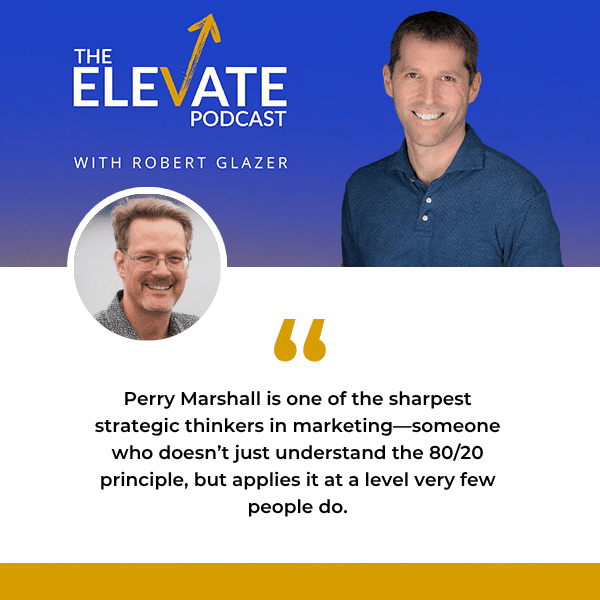
Perry Marshall is one of the world’s most sought-after business strategists and the author of ten books. He helped lay the foundations for modern digital advertising through his early Google advertising work, and his reinvention of the Pareto Principle has been published in Harvard Business Review. He also founded the $10 million Evolution 2.0 Prize, announced at London’s Royal Society, and his 80/20 Curve is used by NASA’s Jet Propulsion Lab as a productivity tool. Perry has advised companies across hundreds of industries and brings an engineer’s rigor to marketing, strategy, and the science of what truly drives results.
Perry joined host Robert Glazer on the Elevate Podcast to discuss why the 80/20 Rule is so valuable and how leadership can leverage it.
—
Listen to the podcast here
Perry Marshall On Leading With The 80/20 Rule
Welcome to the show. Our quote is from Vilfredo Pareto. “The vital few and the trivial many.” Our guest, Perry Marshall, is one of the world’s most sought-after business strategists and the author of ten books. He helped lay the foundation for modern digital advertising through his early Google advertising work, and his reinvention of the Pareto principle has been published in Harvard Business Review.
He also founded the $10 million Evolution 2.0 prize announced at London’s Royal Society, and his 80/20 curve is used by NASA’s Jet Propulsion Lab as a productivity tool. Perry has advised companies across hundreds of industries and brings an engineer’s rigor to marketing strategy and the science of what truly drives results.
Perry, welcome. It is great to have you on the show.
It is good to be here. We have time to talk about it.
From Nebraska To Engineering: Marketing As A Search For Truth
I find it is interesting to start at the beginning, a little bit of childhood. What was your upbringing like? What values and principles do you hold today that you can trace directly to those earlier years?
I was a pastor’s kid in Lincoln, Nebraska. My mom was so honest that if she was hiding Jews in the attic and the Nazis asked her if she had any Jews, she would have to think about it because you are not supposed to lie. I brought that into what I do. I believe that marketing is actually a search for the truth.
Marketing is a search for the truth.
Which is almost the opposite of what Ryan Holiday would have told you in his bestselling book Trust Me, I’m Lying. I think that was the name of it.
My definition of marketing. It is the art and science of helping people who need each other find each other. It is a sacred thing that most people have profaned, and it is an essential part of any advancement in the world. If Einstein had not figured out how to tell anybody about E=mc^2, then we would still not have that. It is extremely important.
I am curious. Do you think that because of this truth and honesty, I find these connections are always interesting, there was some draw to engineering related to that in terms of its empirical nature?
Yeah. I was an engineer first, and it really started with me building stereo equipment. I built myself a set of speakers when I was thirteen, and then I was hooked. I had my parts catalog with all the hundreds of parts and all the things that I could do. I did one version. If I want to try something else, I do not have any money, so I have to sell the old thing or sell the next thing. I make some money so I can try something else. It turned into a business.
I sold my first pair of speakers at age fourteen. I built them in shop class, and I did all the electronics, and I ran an ad in the newspaper, and a guy came and bought them. Now I had a little bit more money, and then I could do something else. Right there in that story from ages 13 and 14 is how I got into engineering and marketing. You had to have marketing to pay for the engineering.
Marketing was a necessity.
Curiosity drove the engineering. It ended up being why I went to engineering school, because when I was 13 and 14, most of my technical knowledge came from marketing brochures that I got at stereo shops. I knew that half of it was wrong, but I did not know which half was wrong. That is why I ended up going to engineering school so I could figure out how it actually works.
Over the years, I have had a lot of people who are funding companies. I am a marketing person by trade or DNA. I have had a lot of people reach out saying, “We have the best product,” or “We have this thing, and no one understands it, and no one gets it, but it is better.” I am like, it just does not matter. If you are sitting with a couple of guys in Iowa with a better product that 1/20th of the people know about, it is not like the universe makes some moralistic decision of which product is better. I think it is interesting on the marketing side. There are a couple of people who said the worst thing you could ever say is “We are a well-kept secret.”
A better product, in a way, is liability, not an asset, because people do not understand why it is better. I have spent a whole career helping people who have the better mousetrap figure out how to get the world to be a path to their door because they have to be the path to the world’s door. The world is not going to come.
A better product can actually be a liability, not an asset, if people don’t understand why it’s better.
The Physics Of The 80/20 Curve: Deep Levers Of Profit
This leads directly to one of my favorite topics that you are a world expert on, and that is the 80/20 rule, also known as the Pareto Principle. For audiences who only know this headline, and I think it really applies in marketing tremendously, we will get into how marketers budget, because I think it is an interesting discussion, too. Can you explain in plain English what it is and how it shows up everywhere in business? I have my own examples, but I would love to hear yours.
Most people have heard this, but they have way, way underestimated how powerful it is and how deep it is. I am sure that most people somewhere along the way have heard that 20% of the people own 80% of the real estate, and 20% of the people own 80% of the wealth, and the other 80% only own 20%. That is about as far as most people go.
When you really start to peel the onion on this, you start to find that it is more and more powerful. The first thing to realize is that it is not just some macroeconomic thing. It applies to almost everything creative. It applies to almost everything that has anything to do with money, but it also applies to creativity, clients, relationships, invoices, product defects, traffic sources, advertising effectiveness, or the performance of salespeople or shoplifting.
Secondly, even just the 80% for the 20%, most people do not realize that it also means that the haves have sixteen times more than the have-nots. It is not 4X, it is 16X, but it is even more extreme than that because the real punchline is the top 20% of the top 20% produces 80% of the 80%. The top 20% of the top 20% of the top 20% produces 80% of the 80% of the 80%.
The top 20% of the top 20% produces 80% of the 80%.
That means there is basically a lot of physics that somebody is going to be as rich as Jeff Bezos. It also means that 50% of your money is going to come from 1% of your customers, and 50% of your competitive advantage is going to come from 1% of your products. That means there are tiny levers that have huge power, and most people miss them. It is right under the nose.
There are a couple of examples that tend to hit it home for people. In my experience, 80% of your profit comes from 20% of your customers, 80% of your aggravation comes from 20% of your customers. I tell people, if you are ever going to know about this personally, go into your closet. You wear 20% of your clothes 80% of the time.
I joke that when I ask my wife at the store what she thinks about something, it looks like the other five things she wears all the time. You can prove this with hangers. Turn around a hanger when you wear it and look at it. People get the closet test. I could be happier if I just got rid of half the stuff in my closet. I am going to wear it, but I do not. This gets into the Marie Kondo realm. Get rid of all the stuff you do not use.
The thing that is embedded in this, which I am not sure people internalize, is that only a little bit of the stuff that you do really matters or moves the needle. That is eye-opening. The inverse is true too. 80% of the stuff you are doing really does not matter and barely moves the needle. Everyone who is busy and overwhelmed and does not have enough time should realize this is the key to not working more, but working smarter.
The Professional Sabbatical: Cutting Staff To Find Curiosity
About a year ago, a business coach that I work with said, “You need to take almost a sabbatical for a year.” Not a full sabbatical where you are completely punched out, but really back down. I am like everybody. “I have all these interesting projects, and I have all these things that I am doing, and I have a payroll.” I took her very seriously. I spent about six weeks mapping out how I am going to do this.
Most podcast conversations are supposed to be about how we scaled the company 10X. I did the opposite. I’m 80/20ed in my professional life, and I cut staff. I cut projects. I cut promotions. The truth is, a year ago, I was feeling burned out. I was also feeling like everything I was doing was super important.
You are the 80/20 guy.
We do teach what we most need to know. I did that. It is also about the third time I have done it. I cut a lot of stuff and also had the time for three-fourths of last year. I was the president of a cancer early detection venture startup on top of the other stuff that I do. That project was very near and dear to my heart. An investor came on board, and as is very common with venture startups, this investor brought in a management team.
We do teach what we most need to know.
All of a sudden, they said they do not need us anymore. I left at the end of October, and I made a conscious decision. I am not going to fill this space with something else. In fact, I am going to refuse to fill this space with something else unless or until it is obvious that it is blindingly, flamingly important.
It has to be flying off the page.
Burning. It has to. Since November, I have been running at less than half the RPMs that I was running since I was seventeen.
Are you getting more done?
The AI Sandbox: Extracting 25 Years Of Knowledge Patterns
Here is what has happened. My business is still running fine, and my relationship with my wife has blossomed. We have had the best six months of our lives. This did not happen overnight. It happened gradually. I went from feeling burned out to feeling refreshed to feeling curious. I am doing more recreational things and taking more trips with my wife.
A lot of things that people think are impossible turn out not to be if your life is not overly cluttered with things that are not moving the needle or that you feel obligated to do, but you are not actually obligated to do. About a month ago, I started going into a massive creative bender. The creative bender is almost all at this point in time, play, like a sandbox. It does not have to turn into something.
Many things that seem impossible aren’t — especially when your life isn’t cluttered with things that don’t move the needle or that you feel obligated to do.
It is R&D.
Play R&D. Some people might not think R&D sounds like a playful word.
Is it personal or professional?
Both. Here is what it has turned into. I installed the Claude Code and Obsidian on my computer, which is a completely different way of doing AI. Everybody does ChatGPT, Gemini, and Claude. Everybody knows what those are, but when you run it from your desktop and when it has access to all of your files, you are not in this thing. Once it figures out where everything is, you do not have to tell it anymore. The outputs, instead of showing up on a screen and then being in a chat, you have to go find the actual outputs. The outputs are files that show up in Obsidian.
What is obsidian cover?
Obsidian is a file manager like Evernote, and it sits on your desktop or on your phone. It makes it really easy to open things and close things. Every time Claude Code makes a new output, you can say, “Put that in Obsidian,” and it will just make a little file and put it there. I have a desktop AI in an easy container, and it knows where everything is. Here is what I started doing.
I have written ten books, and that is just the tip of the iceberg. Newsletters, seminars, transcripts, consultations, mastermind groups, recordings, videos, all of that. My staff had been putting that in one place for the last couple of years because we wanted this. I now have 25 years of stuff. I can say, “Go find that seminar we did in 2017, and I want you to extract every single story that I told in that seminar.”
It took ten minutes. “I want you to extract every framework that I taught. I want you to extract every framework that I used but did not describe, but is implicit in my presentation.” There are definitely commercial applications for this, and there are business uses for this. Right now, I am just playing in my sandbox. I am going through years of stuff, all kinds of frameworks, all kinds of models, hundreds of industries, thousands of conversations. I am extracting the patterns. It is like flipping jet fuel. It is so stimulating. I am literally discovering things about my own work every ten minutes that I did not know before.
Pattern analysis is strong. I want to go back to where you started with that. Is there a bias when we are in something, are we less objective about whether it is necessary because of emotions? For instance, you go to a conference, and you love the conference, and the people are really nice. You get home, and three months later, you have no takeaways, no leads, no follow-ups. That is why sometimes we have a hard time determining what we should cut out. I do not know that we use the right window to measure it.
Dominating The Court: The High Cost Of Easy Advertising
I love what you are saying about conferences because I have a conference coming up in a month. One of the things I have noticed is that a lot of times, people do not register the value that they got from the conference that they went to last year. They remember the experience, but they forget the takeaway and how they applied it. I will give you an example from twenty years ago. I was at a conference and Joe Polish, a very famous marketing guy, was there. I had never met him before.
It was 11:00 at night in the bar. I said, “Joe, can I ask you some questions?” I bought him a hamburger, and we sat there. He told me some stuff. This was before I wrote a Google AdWords book or anything like that. Five years later, what had happened was that I had written the world’s bestselling book on internet advertising, and it sold tons of copies. When I got into that window of opportunity, I hunkered down.
I was like, “Nobody is going to displace me. I am going to be king of the court. I am going to drive the stake as deep into the ground as I can.” I remember thinking, “How did I know to do that?” I looked back, and it was really smart. I remembered I had completely forgotten about that meeting with Joe and what Joe had told me.
Joe was, at the time, the king of carpet cleaning marketing, which is a crazy thing. He told me, “You do not just buy the easy customers. You do not just buy the cheap advertising. You buy the expensive advertising, and you go into the corners of the market where it is harder to get people, and you make it impossible for a competitor to get in anywhere. You completely dominate your topic.”
That is where I got that. It was that subconscious 11:00 at night at a seminar. Usually, at seminars, your brain is boiling, and you have happy juice flowing. Stuff happens that you do not necessarily even remember. Back to your point, we all cling to our possessions, our history, our stories, our furniture, and our beliefs. 80% of it is an elimination diet.
Some things need to be tested. I released a book in October. As part of doing that, you commit to a ton of speaking. I am still paying all those IOUs, and it has been a lot. I look around, and I do not want to be traveling this much. My last kid is going to be a senior next year, and I want to be around. I told everyone, “I am cutting my commitments 50% next year across the board. If it is not jumping off the page, I am not doing it.”
I will take a year off, and maybe I will have an empty house with my wife, and I will be looking to travel, and I will miss it. I think that is the way to test. Did I miss it at all? We tell ourselves a story that is important. I like the people and this conference, but if I think about leaving the conference, do I have those takeaways, do I have the communities? The only way to figure it out is to cut deep and then see what I never thought about again and what I was missing.
The only way to get off the hamster wheel is to get off the hamster wheel. Richard Koch teaches this better than anyone. He says, “Do not be available to clients.” He tells a story about what Bill Bain or Bruce Henderson used to do 50 years ago. He would bring somebody to a meeting and say, “Charlie knows five times more about this than I do. You are really going to enjoy working with him.”
It was true that Charlie knew more. Bill Bain was selling it, but Charlie was delivering. It was not a bait and switch. Neither was the client fully aware that this is how the relationship is managed. We are still going to keep all of our promises, and you are still going to get all the results, but you are going to be working with the people who know how to get those results. Those of us who are smart and have big egos and are used to carrying a lot of responsibility get trapped.
You have helped a lot of companies implement 80/20 work. Where do they mostly get it wrong? Is it cutting the wrong costs, chasing the wrong customers, oversimplifying complexity, or creating complexity? What are the things that people most often get wrong?
I will tell you a story that illustrates this really well. I was working about twelve years ago with a company that did small business loans. You search on Google, and you are looking for a small business loan. Back then, it was very painful faxing credit reports and getting a business loan.
Yes, Dun & Bradstreet.
Getting a small business loan took at least 4 or 5 days, if not two weeks. The sticky part was the credit reports and the credit checks. I said, “I want you to try something. I want you to run a Google ad that says, “We will approve you in 30 minutes. I want you to actually approve them in 30 minutes. I want you to just run it long enough to get stats. That is it.” I realized you are going to take a bunch of risks by approving these people fast, but do the best job you can. They did it. They ran the ads for two hours or two days. The response rates were through the ceiling.
Speed was the factor that they were missing.
They ran it long enough to figure out that if we could approve loans in 30 minutes, we would have a mob of people lined up at the door. The guy running the company paused the test because the investors were a little nervous about covering these loans. We calmed them down. They spent the next year figuring out how to get signals.
How fast do we know and how much to give them?
They spent a year finding faster ways to assess the business. They got to where they could throw the switch and approve loans in 30 minutes. They got bought out by PayPal for $183 million. That is now Loan Builder. You log into PayPal, and it says, “Would you like a small business loan?” That is where that started. To completely answer your question, where do people screw up? They pile on features and benefits that are not typically that hard to deliver.
Simplicity Is Hard: Scaling Through Strategic Subtraction
This is going to be an AI slop problem because you can code anything. The cost of publishing a book is not much now, so you have a million books a year that are only read by two people. When you can code anything, it becomes a product manager’s decision of “What do my customers want?” and “What do I not build?” As you said, most products and those things are not important. There is one 80/20 feature for me that makes it worth it.
What they do not do is the hard work of “How do I remove 80% of the friction of getting something done?” I cannot BS anybody. That is hard. Simplicity is hard. Subtraction is hard. Addition is easy. Multiplication is even easier. It is not what people want. It is not what gets your company bought for $183 million.
People fall in love with those feature charts, but you have seen the studies about the blue jeans and the jams. The more choices people get, the less sure they are about buying and the less likely they are to buy. When I go to a restaurant, everything on the menu looks like something I would like, and it is stressful. It is better when one or two things jump out, and I’m like, “The rest of the stuff is not interesting.” We just cannot handle this much stuff. We were not designed to handle it.
Here in Chicago, we have a whole bunch of Greek restaurants, and they all have a huge menu. You can get a burrito, and you can get a pizza.
I am always like, “How is this all good?”
The point I want to make is to let us contrast it to the few restaurants that have seven things on the menu, not 70 or 700. Which restaurant is more profitable? Running a Greek diner that has breakfast all day. That is not a profitable business. There is no USP.
Hidden Complexity: Why More Resources Often Lead To Worse Results
I heard once, and I do not know if this is true, but this is an 80/20 thing. The most profitable and successful restaurants had massive ingredient overlap between all of their items. There is a feta cheese appetizer, and then there is feta on one of the dishes. It had fewer ingredients and less complexity. The 80/20 rule is an eliminator of complexity. We have a lot of firms laying off a lot of people now, and they are all blaming it on AI.
I think that is actually a farce. They added a ton of people after COVID, thinking that more people would solve their problems, and they did not realize how much complexity that would add to their business. I wrote an article recently that our biggest business mistake was that we kept thinking, as we grew, that if we could centralize more functions and take responsibility off the peripheral people, they could manage more accounts.
Almost inevitably, we added centralized functions, and there was a max number of accounts that people could handle. We just had more expenses at the centralized level, and no more production out there because there is all this hidden complexity. Account managers doing some billing seems out of whack, but when they were not doing the billing, they were communicating back and forth with accountants and checking the billing. All of that hidden cost of complexity is not seen as you are making an analytical, empirical argument about why more resources will lead to a better result.
That is right. A lot of times, the signal that you are doing this wrong is how often in your day you sit there, and you quietly go, “I hate this.” You almost do not want to admit it to yourself because it seems like you are being picky or critical. Listen to your gut. I think your gut and your body are telling you.
Do you agree with that assessment that a lot of these layoffs are just easier to blame on AI than to say “We got bloated and complex and did not pay attention to what mattered?”
I am going to take a wild guess that 2/3 of the time, that is just a story, while 1/3 of the time it is actually true. I told my executive assistant and operations manager that in a few months, they will be running this whole company with some AI agents. The way that most people use AI right now is like a glorified search engine. They are serving the AI. The AI is not serving them. They have to go upload all the files, and then they have to take the answer and figure out what to do with it.
They end up just being an information manager shuffling all over the place. They are not even asking good questions in the first place. Furthermore, let us recognize that very few employees are coming to work every day and going, “What automated task could I make today that will save me three minutes every single day for the rest of my life?” Doing that over and over would create massive compound interest. Very few people are doing that.
I have a list of them. I’ve started a cloud co-work list, and I’m sharing it with people around. It is going to take some time to build each one of them. The next one I want to build, which I am super excited about, is related to travel. I have been coming home to where I have to sort through a week or two of mail, and it is all junk mail, and it drives me crazy.
I have used these services that undo junk mail, but half the time they do not work, and they have not done AI. I have a script. Take a picture of the thing, research the organization, look for all the contact emails related to unsubscribing, email and test them, see which one works, send this note, ask to unsubscribe, and ask for a confirmation.
It is going to save me time because I usually sit down once a month and do that. I learned that actually emailing the organizations was the best way to get off it. This app, which I took a picture of, was ten-year-old technology, and it got the picture wrong. I am on a junk mail warpath. That is the next one I want to build. It is going to turn a two-hour project into a one-hour process that hopefully just runs.
The 90/10 Reality: Why The Internet Is More Extreme
Only a minority of people exercise a great deal of agency in doing things like this. Another thing I want to say about 80/20 is that it has only become more true and more important with time. It is more true now than it was in 2013 when I wrote the book. Here is why. The brick-and-mortar world is 80/20, but the internet is 90/10. It is analytically demonstrably true.
The brick-and-mortar world is 80/20, but the internet is 90/10.
Let’s break this down. 80/20 means 20% produces 80%. That is 16 to 1. If 10% produces 90% and the other 90% only produces 10%, that is 81 to 1. Let me prove it to you in the brick-and-mortar world. How many car manufacturers are there? There are dozens. There’s Peugeot, Suzuki, Ford, and Toyota. How many search engines are there?
Three real ones.
They completely crushed the other 300 that tried. Everything on the internet is ridiculously unequal. The internet is an 80/20 square. I wrote another book called Detox, Declutter, Dominate. I wrote it in 2020. It has seven things that you should be doing every day. It is twice as true now as it was in 2020 because of AI.
The Five Power Disqualifiers: How to Stop Wasting Sales Time
One thing all companies struggle with is figuring out tire kickers versus responsive buyers. When I have worked with great sales leaders and marketers, they are concerned about training their team on who they focus on, but how do you identify the people that are wasting your time? I was part of an interview recently, and more senior people have rules for RFPs. They say that if they do not answer these four questions, we do not submit an RFP.
A lot of the time, an RFP is designed to check costs for a current vendor, and it will waste hundreds of hours of someone’s time. They have learned the questions to find out whether they are serious. It seems like it is even less about who is the right client, but how do you find out quickly who the wrong client is?
In 80/20 sales and marketing, there are five power disqualifiers. They are the five things that are always true every time anybody buys anything from anybody. One, they have the money. If they do not have the money, they are not buying.
It took me years to learn how to find out if they have the money.
Two, do they have a bleeding neck? If they do not have an urgent problem, they are probably not buying. Three, they buy into your USP. Four, they can say yes and not merely the ability to say no. This is a huge one with RFPs. Many times in corporate sales, you are talking to a person who can say no, and they can stop you, but they cannot say yes. You waste time. When I was a young sales guy, I tried to get out of the office and try to not to be cold calling all day long. I was afraid to find out that the person I was talking to could not say yes because I felt like I was having more fun than just calling people all day, so I would go see them.
You are having velocity, not productivity.
Find if it’s your own place.
The Discovery Contract: Why You Should Charge For RFPs
Let’s talk about RFP.
The best way to find out who is serious is to charge for the RFP. You say “We charge a $250 fee or a $2,500 fee to do an RFP. Our RFP is not just one piece of paper with a price on it. Our RFP has some serious diagnostic value. It is worth every penny of the $2,500.” No matter who you buy from, I will credit you the $2,500 if you buy. This automatically proves they have the money. It proves they have a bleeding neck because they would not spend that money if they were not serious.
The best way to find out who’s serious is to charge for the RFP.
Furthermore, it gets you inside their organization, seeing where the cockroaches actually are. It gives you the ability to figure out what I can actually guarantee that we are going to deliver if the customer buys. If you twist all of those together, you have a very powerful argument for saying “We never do free quotes.”
What you do not do is as important as what you do. I’m curious about these five things. If you were leading sales training or a sales team, would it be a goal to get those five answers after the first call?
Yes, immediately. You have to ask the five questions right away. If you are obsessed with people liking you, you will not like this.
People feel that they are productive when having conversations. I find the reps push back. They ask what I mean by wanting them to have fewer conversations. You are talking to people who are never going to buy. It is like a dead man walking. You just do not know it. Those people will waste your time more than the people who want to buy, in most cases.
Where this came from was when John Paul Mendocha came up with the five power disqualifiers and the thing of charging for quotes, which he calls a discovery contract. John says that in his entire career of about 40 years, 70% of all discovery contracts were bought. One of John’s first sales jobs was working for a defense contractor. He had already been a professional gambler in Vegas.
Because of his gambling background, he understood how easily people waste their time. His boss put 200 leads on his desk and told him to go talk to all 200 of those people. John instantly knew at age 23 that there was no way 200 of these people were worth talking to. He devised the five power disqualifiers on the spot and talked to all 200 on the phone. He made twelve appointments with twelve, and he sold six. That is 80/20 math. That is how sales actually work. You do not drive all over Los Angeles talking to 200 people. That takes six months.
It’s almost important. If I actually had to choose, it’s weird to say, “You have to figure out who is not important because they are going to get in the way of the conversations of who is important.”
I’m glad you said that because if you understand 80/20, you understand sales is not a convincing people process. It is a disqualification process.

If you ever called a rep, some of them are serious, and some of them are pretending, and they say, “We are probably not a good fit because we have an eight-week backup, and maybe we could send you to one of our lower-cost competitors.” People are inherently more interested. If you are like, “Yeah, we have opening slots anytime you want to start, how can we work with you?” They are not interested. Everyone wants the club they cannot get into.
80/20 will completely change your life. It is a way of viewing the world. Once you see it that way, you cannot unsee it. You are going from white belt to yellow belt to black belt.
Predicting The Future: Using 80/20 As A Diagnostic Tool
How should you manage your sales reps? Clearly, 80% of the commissions go to 20% of the people.
If you hire ten salespeople, two of them will outsell the other eight.
Here’s what is amazing, and here’s what I think about a lot of the leaders. This is a little off, but I’m curious. Too often, we judge leaders on their personal productivity and not their leadership. Let us say I have a sales manager, and he has a $4 million quota, and we are at 4.2 million. Perry is crushing it. Supposed to be at 4, we are at 4.2. Let us open the hood on Perry’s team. Perry has Sarah. Sarah is selling 80% of the things and crushing her quota.
Sarah has not had a raise. We have three other reps, and they are all under. One is on track, and Perry is jumping in and closing for these people and saving them. When I actually look, I have two reps who should have been fired, one rep who should have been promoted, and a sales leader who is doing sales calls. This is why 80/20 is helpful as a diagnostic because if I just said you are doing a great job as a sales leader without looking under the hood, it would not tell me the story.
80-20 predicts the future. If you know you are going to hire ten sales reps and two will outsell the other eight put together, you change your whole hiring structure. We have to try all ten, but we are going to tell everybody you are on probation for the first two months.
I’ve heard multiple people say you hire multiple reps at once, train them all at the same time. God forbid you got lucky, and you got the two upfront out of the ten, then they’re both going to sell really well and be worth whatever. The chances are, one or zero will be there. If you sequentially train them all and wait, it’s a huge waste of time and resources.
This means there’s an enormous amount of prosperity that’s right under your nose. You stop doing stuff and do a little bit more of the stuff that really works, and have some space in your life so you can think.
The $10M Evolution Prize: Skipping The Mediocre To Find Answers
Speaking of 80/20, you launched the $10 million evolution 2.0 price. What motivated you to skip into science, and how does 80/20 thinking translate into research and discovery?
I realized something, which is that all philosophical debates are eventually settled by technology. You really have to stop and think about this, but it’s true. Does the sun revolve around the Earth, or does the Earth revolve around the sun? We have satellites. It’s a practical application. I became very interested in the creation evolution question, and where did it all come from? After stumbling around in that world for a while, I became appalled at how the different camps just endlessly lob rocks at each other and never ever solve anything, don’t ever come to any conclusions.
They just dig deep. I said, “I’m going to turn this into an engineering problem. If you can figure out how to get a genetic code starting with a bunch of chemicals, which nobody’s ever done, then I’ll buy the rights from you for $10 million and partner you into the company.” I organized a prize for this. I got judges from Harvard, Oxford, and MIT.
I announced it at the Royal Society in Great Britain, where Isaac Newton used to be the president and Charles Darwin used to be a member. We have a website, and it takes submissions. That prize has now existed for nine years. No submission we’ve ever gotten has put a dent in it. What it really did was it eliminated all the wasting of somebody having another idea, another argument, another theory, another way about this. Another stone to lob back, like to show up with the answers now.
This is very interesting because when I was looking for judges for this prize, which goes back ten years, I was a marketer. I’m an engineer. I do not have a PhD. I’m not from an Ivy League school, and most professors and most scientists would not touch me with a barge pole, but the very best ones in the world thought it was really interesting. They were not afraid of the questions.
If you look at the judges, George Church from Harvard, Denis Noble from Oxford, these are top echelon, like George church’s student who won the Nobel prize for inventing CRISPR gene editing. These are really the top scientists. It is designed for something that wraps the shotgun for only serious people. Only serious people need to show up and apply. I skipped the whole middle of the mediocre people in science, and I went right to the top.
It’s no exaggeration. If you go look at my work, if you look at my book, if you look at the endorsements, these are some of the best people in the world. Go look at my podcasts. That is absolutely an 80/20, and most professions are 50 years behind state-of-the-art. Most professions are 50 years behind the state of the art.
The gap is going to close one way across most industries.
You don’t have time to go play patty cake with all of the regular, ordinary people who were educated in all the dogma. It’s the dogma that keeps industry stuck in every industry that has this problem.
Prying Off The Addicted Fingers: Letting Go To Grow
Last question for you, Perry. I’m going to augment it a little bit, given our topic. I usually ask what’s the personal and professional mistake you made that you learned the most from, but let’s talk about what’s an 80/20 mistake that you made that you learned the most from?
The original 80/20 book was written by Richard Koch 25 or 30 years ago. It’s called The 80/20 Principle, and Richard and I, about 12 or 14 years ago, became friends. In 2014, we did a famous seminar. Richard is now a billionaire. Back then, he was only worth 200 million. After our seminar, which was amazing, we had $7,500 a head. We had 80 people in the room. It was epic. I met him at his hotel the next day, before everybody went, before we both went home.
I said, “Richard, we’ve now worked together for like a year, a year and a half. Do you have any advice for me?” He is a British guy. He says, “Yes, Perry. You are the epitome of 2018. You are working on so many things. I want you to do an 80/20 analysis of all of your customers, all your product lines, all your employees, all of your projects.”
He said, “A significant amount of activities you are doing are losing you money, not making you money. What are they?” I have now done that multiple times, and every single time it was painful. I have to pry my addicted fingers off of this thing and let go of it so that I have room for something else, which again is the story I told you at the beginning of this call. Really mature people are constantly coming back to this truth.
I’m ready to do another exercise. Perry, how can we’re how and where can people learn more about you and your work?
You can go to PerryMarshall.com and subscribe to The Perry Marshall Minute. It’s usually about 300 words that’ll change your life. Everybody should read 80/20 Sales and Marketing. This book will completely change your life. It’ll change the way that you see everything in your business. It’ll change the way you make your decisions so that you can see the 1% that produces 50% of everything and has huge leverage.
Perry, I could talk about 80/20 all day, but then I wouldn’t be living it. Thank you very much for joining us.
Thank you, Roberts. Great questions. Thanks for having me.
You can learn more about Perry and his work on the episode page at RobertGlazer.com. As always, if you enjoyed this episode or tuned in generally, I would really appreciate it if you could share it. Someone in your life who needs an 80/20 analysis, shoot an email, send a text, and that is how new users discover the show. Thank you again for your support, and until next time, keep elevating.


