


Dr. Alan Barnard is one of the world’s foremost experts on decision science and the Theory of Constraints (TOC). He’s the Founder and CEO of Goldratt Research Labs, which he co-founded in 2008. Over three decades, Alan has helped leaders in organizations like Microsoft, Nike, Cisco, Tata Steel, SAP, and the UN find the leverage points that turn impossible problems into sustainable breakthroughs. Dr. Barnard is also the author of From Fragile to Robust to Anti-Fragile, a groundbreaking book on how individuals and organizations can use stress, complexity, and change to grow stronger under pressure.
Dr. Barnard joined host Robert Glazer on The Elevate Podcast to talk about how to be anti-fragile in an unpredictable world, building resilience, thriving under constraints, and more.
—
Listen to the podcast here
Dr. Alan Bernard On Anti-Fragility And Excelling Under Constraints
Welcome to the show. Our quote for today is from Eli Goldratt. “Tell me how you measure me, and I will tell you how I will behave.” Our guest, Dr. Alan Barnard, is one of the world’s foremost experts on decision science and the Theory of Constraints. He is the founder and CEO of Goldratt Research Labs, which he co-founded in 2008 with the namesake, the legendary creator of the Theory of Constraints and the author of one of my favorite books, The Goal.
Over three decades, Alan has helped leaders in organizations such as Microsoft, Nike, Cisco, Tata, SAP, and the UN find the leverage points to turn impossible problems into sustainable breakthroughs. He is the author of From Fragile to Robust to Anti-Fragile, a groundbreaking book on how individuals and organizations can use stress, complexity, and change to grow stronger rather than weaker under pressure. He has an upcoming book, From Crisis to Catch Up to Keep Up, that applies these principles to one of the world’s most urgent issues, the global housing crisis. Alan, welcome. It is great to have you on the show.
Thank you so much.
I always find it interesting to start at the beginning or with childhood. Was there something in your upbringing that drew you to research and theories, particularly when it comes to constraints or decision-making? Sometimes, some clues are lying around.
Childhood Influence On Focus
I grew up on a small farm in South Africa. It was my grandfather’s farm, and he was an inspiring guy. Even though he was a farmer, he was a deep philosophical thinker. He gave me this book on my tenth birthday called The Marquis Who’s Who. It was in the old days of encyclopedias, but it contained basically a listing of between half a page and a full-page biography of the most successful people in every field in the world.
That inspired me. It left me with this idea that I want to contribute one new thing, one useful theory or insight. He challenged me to say, “What do I notice about all of these people?” I said to him that what struck me was that none of them had good starting conditions. They often came from poverty, from cases where they had some learning disability or disorder, were maybe bullied, were abused, sometimes emotionally, physically, or sexually, even.
Yet despite all of those non-ideal starting conditions, they made an incredible contribution in their field. What I realized is that it is not so much your starting conditions that matter, but rather your starting assumptions or beliefs. That got clarified when I read Henry Ford’s book Today and Tomorrow, where he put in this famous quote, “Whether you believe you can do something or cannot, you’re right.” I thought, “What if I started off by believing that I can make a unique contribution and leave a slightly better world behind?”
That got me interested in what makes somebody successful. I realized that there were four factors. Two of them are out of your control, which are your genetics and good luck. If you are good-looking, life is going to be a little bit easier. There is no doubt about it, but it does not guarantee success. Good luck is also profoundly important, especially when you speak to successful people. You find out that there were a few key moments in their life that could have gone either way.
If you look at that macro too in the history of all the billionaires, they were the first ones at the key new thing, whether it was steel or AI or personal computers.
It often takes a long time for the market to adopt these things if you are a pioneer. Two things were out of your control. Genetics and good luck. Two things were in your control, which were hard work. It does not matter what you are going to do to be successful. You are going to have to put in your hard work and make the sacrifices. The thing I was interested in was decisions.
It is the quality and speed of your decisions, especially avoiding bad decisions, and how to make good decisions. That is what I decided to focus my life on is studying why good people make and often repeat bad decisions. I was very fortunate to meet Dr. Eli Goldratt quite early on in my career. I studied industrial engineering and read The Goal. I implemented it within the first company that I started with, which is the largest cookware company in Africa. At the time, I was head of engineering, got dramatic results, met Eli, and he volunteered to become my mentor.
I am an entrepreneur, so I went through a couple of other companies, but in the late 1990s, I joined them permanently. We started working with some of the biggest companies around the world, helping them implement the Theory of Constraints. I have developed a lot of new knowledge around this space, and a full circle coming back was on my 50th birthday. I got a copy of The Marquis Who’s Who, the latest edition, and my name was in it for my contribution to decision-making and the Theory of Constraints.
The only thing we can control is our response, and that ultimately determines the outcome.
Did you know that or not?
You get a sense when they phone you up and ask to say that you have been recommended by peers or you have been recommended by some committee. I ask questions, but you never know whether you will be accepted or not. Once you are in that, it is a permanent listing. You are there forever, which is quite remarkable.
Responsibility Vs. Victimhood
The book gets bigger. There was something you said, and not to veer us into politics, but there is an orientation that I hear a lot around victimology. You are a victim of your circumstances. This would seem to go against a lot of what you said, which is in terms of a lot of people actually developing amazing things out of constraints, but they also said, “I have to make better decisions.” It does not matter. It would seem like your research would go, I keep challenging people to find me a historical figure for whom that was incredibly successful, with a movement for whom victimization and blaming everything in history was the orienting factor. I still have not heard one.
You are absolutely spot on. One of the messages I got from Dr. Eli Goldratt that inspired and wanted me was his last words to me, because he sadly passed away in 2011. It was also almost the first words that he said to me. He said to me, “Do not dare stand in my shadow. Stand on my shoulders.” There are a few giants that I have tried to stand on. Goldratt was one of them. Nassim Taleb, with my book about Anti-fragility, is another.
The other one is Jack Canfield, who was the most successful non-fiction writer of all time, with Chicken Soup for the Soul and Success Principles. His first success principle is the fact that you have to accept 100% responsibility for the outcome of your life. That is very interesting to people. He used this formula called E + R = O, events plus response equals outcome. The events are the things that will happen to us, both positive and negative. We cannot control them.
Can we influence them? Yes, probably, but we cannot control them. The only thing we can control is the response. That is what ultimately determines the outcome. To me, the victim mentality is one of the phenomena because it is a human condition that I studied. There are two aspects to that. As a victim, if you blame the world, if you blame other people, it means that you cannot make any improvements. You will be stuck because, mentally, we are constantly looking for ways of protecting ourselves against failure.
This is cognitive dissonance 101.
When I can find someone or something to blame, it actually does give me relief.
“It is not my fault.”
My quote is, “It is not your fault, but it is your problem.”
It’s not your fault—but it is your problem.
I thought Thomas Sowell had the best quote on this. “We have reached the ultimate stage of absurdity where some people are held responsible for things that happened before they were born, while other people are not held responsible for what they themselves are doing today.”
That is a great quote. There is another dark side to victimhood. I was very lucky to have met Nelson Mandela, one of my heroes, in 1995. I asked him which words of wisdom from a mentor of his most radically changed his life. He said to me that his mentor was Chief Albert Luthuli, the first president of the African National Congress and the first African to get the Nobel Peace Prize.
He told Mandela and the other young leaders at the time, this was in the very early 1960s, at the height of apartheid. He said, “I know it looks impossible, but one day you will be in power. I want to leave you with this warning. As long as you think of yourself as a victim, you will become the next victimizer.” I think that is the other dark side of victimhood.
That explains a lot of what is going on in the world.
When people who view themselves as victims get any sense of power, whether through social media, politics, wealth, or whatever, they will become the victimizers.
Hurt people hurt people. People tend to think that power structures, whatever system they want, will go away. They exist in every possible system out there, and people try to consolidate them. It is not the reality. You have said before, genetics and luck and timing, we do not start from the same thing, but it always seems like you are about decisions, what information, this gets into stoicism, where am I now, and how do I make the best decision for us now? This is where you said that this whole question starts. Why do good people make bad decisions?
It seems emotional and baggage, and not being able to deflect from it, I saw after the housing crisis, people are buying houses and low-bidding people eight years later, and then they would not sell their house for less than they bought it for, even though you are better off buying a bigger house when your house is down and because it is down. It’s this total emotional disconnect.
Reasons Good People Make Bad Decisions
It is very true. At a fundamental level, if you ask the question, “Why do good people make bad decisions?” We have identified essentially four different reasons. The first one is that we do not understand the extent to which emotions impact our decision-making. By emotions, I am not talking about positive or negative emotions. I am talking about making decisions in our fast and automatic way of thinking. Intuition, instinct, emotional. The second reason is that we also get easily overwhelmed with complexity. When we get overwhelmed, we default to the safest possible decision. This is one of the politically very sensitive topics.
We don’t understand to what extent emotions impact our decision-making.
When you look at environments where men and women, there has been equality discrimination as for all practical reasons been removed, why is there still a major gap between the success of men versus women? There are two practical answers for that. I have a PhD student who did her PhD on this. The first one is that women make many more decisions than men. Think about what to wear for women compared to a guy. One is an hour, the other is five minutes.
Kind of true for that. We can go on Friday.
By the time they get to work, they are already cognitively overloaded. As a result, they will default to the safest possible decision, which is normally a low-risk decision. That is one. The other very interesting one is, have you ever seen the IQ graphs distribution of men and women on top of each other?
No.
Almost nobody publishes it because it is so politically sensitive. It is not sensitive from a point of view of”what is the average IQ? Men have a slightly higher IQ on average than women, but it is statistically insignificant. What is very interesting is that the distributions are very different. Men have a much flatter distribution. On the left-hand side, there are more idiots, and on the right-hand side, there are more geniuses. That is in that upper space where it matters.
Is there a nature component to that?
There is very much a biological component to that, absolutely.
I know that Zuckerberg and the people that Steve Jobs always talked about the black t-shirt, like one less decision in the day. Maybe they were onto something with that.
Wherever you can reduce the number of decisions that you are making, the better. You will see people who are very high performing. They will naturally move towards that in terms of what they are wearing. Even things like, I remember with Eli Goldratt, whenever we went out to a restaurant, he would always ask somebody else to order for him.
This is an important question. My wife and I always talk about a lot of these decisions, and she struggles with making decisions. I say sometimes it is not the decision, I think you make it. There is an assumption that decisions are right or wrong. Some things matter more, and you can make it and go with it. If I made the pizza versus Chinese food decision, there is no making it, and then there is making it and not thinking about it ever again. How much of it is not making the decision versus not caring about the decision that you make?
We make 35,000 or so decisions every day, and that is overwhelming. That is the second reason why we make bad decisions. We get overwhelmed, and we pick the safest choice, which is normally whatever is in our automatic way of thinking. The problem is that out of those 35,000, there are only a few that matter. Those are the ones where you want to slow down your thinking.
The problem is that out of those 45 days, only a few really matter—and those are the ones where you want to slow down your thinking.
This is Thinking Fast and Slow.
If you think about that equation E plus R equals O, there are a couple of mistakes that we make. Firstly, with the events, which is we pay attention to things that do not matter or that we cannot do anything about, and we let it stress us out. That is the first mistake to get rid of. The second one is that we do not respond. We react in automatic mode. We over-react and under-react. checking. Is this decision, is this event that happened, is it consequential to me, and can I do something about it?
How do I slow myself down to respond rather than to react? A mistake that we can make on the O side, the outcome, is that we seldom think about what we want. That is a way of improving the chances that we come up with a good response, think about, “This event has happened, so what, now what? What is the outcome I want to achieve, and now let me think about what is the best response?”
You did not use the terminology, but I am a big believer in the locus of control. I think some people focus on, “I do not control this, and I am not going to.” Someone once told me about global warming, “I do not stress over it, because I do not control it.” He’s like, “I can focus on the things I can do.” It would seem that the people who spend a lot of energy on the external locus of control would be less successful and exhausted because, by its nature, you are using your energy up on things that you do not have control over, versus the reaction. You have control over the reaction, or what you do, or your emotions, you have control over too.
There is an exception to that. A lot of people struggle with decision-making, which is one, and also setting goals for themselves. What is the advice for setting goals? Dr. Goldratt gave me beautiful advice soon after we met. He said, “A life goal is a dream taken seriously.” Do you have a dream? Are you taking it seriously?
The advice I like to give is to say, “What makes you happy and angry?” What in the world triggers either a massive positive emotion or a massive negative emotion? As you said, most things are out of your control, so why the hell is it triggering an emotion? It means that you somehow feel that something should be done, and you should be doing something. Make that your life goal.
What in the world triggers a massive positive or negative emotion? Most things are out of your control, so why does it affect you? It usually means you feel something should be done—and that’s what you should focus on in your life.
This is what my book was on. I think it ties to your core values. When there are things that align with your core values, or that go against your core values, you feel the need to intercede.
If you see animals being abused and it makes you angry. Your system is telling you you should be doing something. It is a sad thing. It is so sad that humans abuse animals. What can I do? I do not abuse animals, but if it triggers this enormous anger with you and frustration, then act on it. Make that your goal.
The Theory Of Constraints (TOC) Explained
Super interesting. You mentioned you met Dr. Goldratt in 1993, which led to a decades-long collaboration. He has written one of the most popular books of all time. Interestingly, when I am trying to explain my new book, The Compass Within, and I am telling people a parable, I will say, “It’s like The Five Dysfunctions of a Team or The Goal.” Some people have never read a parable. What is interesting is that this is like the default global book on the Theory of Constraints or operations, which was written as a fictional story. Give us the 10,000 feet for people who have not read or do not remember the Theory of Constraints.
The book’s story is about this character, Alex Rogo. He is a plant manager, arrives at work one day, and there is a crisis. An order is late, and the boss is there. It is one of his friends whose orders are late. Essentially, he says, “I know the order is late, we’re doing our best.” The boss basically turns around and says, “Alex, you have three months, or I will start closing down the plant. I have had enough. Send my regards to Julie,” who is his wife.
He meets this character, Jonah, who was an ex-professor of his. Jonah, frustratingly, never gives answers. He only asks questions. One of the questions that I think is highly relevant today is whether they meet at the airport, and Alex is on his way to speak at a conference about robotics. You have already been introduced to the fact that his business is going to be closed down in three months’ time, and yet he is going to a conference to talk about the benefits of robotics. The professor goes, “I’m interested in robotics.
Tell me about these robots. How have they helped you?” He says, “They’ve been a godsend. They’ve improved our productivity by 38%.” Professor Jonah says, “That’s amazing. You’re making 38% more money by putting in robots?” Alex says, “No, that’s not what I said. I said it improved our productivity by 38%.” He says, “If it’s not making you more money, how can you say it improved your productivity? Let me ask you a question. Have sales gone up?” He said, “No, not that I can think of, but what does this have to do with robots?”
He says, “Have sales gone up?” “No.” “Have costs come down?” “No, actually, it’s gone up because we had to buy the robot. What about inventories?” “Inventory has gone down.” He said, “No, inventory has gone up because we have to keep the robots busy.” He leaves him with this question: “Are you measuring the right thing?” That is what the whole book is about. It is about how we can make and create our own breakthroughs if we can find the right question. We already know the answer. We just have not been asked the right question. That is what the story is about.
If you analyze, manage, and improve the constraint of a system, you are, in fact, addressing the single biggest constraint.
In the things that you have touched, Anti-fragile, Theory of Constraints, people assume that success would be unlimited, no failures, and unlimited funds. If we look at the last ten years of the zero-interest money, companies with unlimited funds cannot find a business model. One of my examples is food delivery. If you charge 10% for food delivery, “I’ll do it.”
That is great, but you are losing money on that. When you have to charge 35%, I am like, “That’s expensive. I’ll go to the grocery market.” I have heard all these crazy stories from companies like Stonyfield Yogurt or Honest Tea, where they had no money, and they had to get super creative. They did the Honest Index, where they built a tea stand in each city, and there was a donation box, and they saw which cities were more honest about paying for the tea, and it cost them nothing, but all the newspapers covered it.
We tend to see a couple of these examples, whether in a generation it is Amazon or the next big-spending freewheeler, but all these unicorns died by having no constraints or not having to figure out the business model, or what they were good at, or having a little adversity to work themselves through.
Theory of Constraints, you asked me what that is in layman’s terms. What Alex discovers in the book is that if you are trying to analyze, improve, and manage a system like a company, the traditional way is to break it up into its parts, and you analyze, manage, and improve each part. The only problem with that is that you often improve the parts at the expense of the system. You create local optimization.
Everybody knew we should follow a systems approach, but nobody practically knew “What the hell does this mean? I cannot evaluate every decision based on the impact it has on every single part of the system.” Goldratt basically discovered a hack. He realized that if you analyze and manage and improve the constraints of the system, you are in fact analyzing and improving.
The single biggest constraint brings down the whole thing.
It is like the analogy of the weakest link. Your chain could have three links, or it could have 30,000 links that are more organized like a network rather than a chain. If you pull on that thing, it is going to break at one place, and that is your weakest link. There could be many weak links, but the question is how to find the weakest link. That is the key idea is finding the weakest link and focusing everything on that.
If the goal is to strengthen the chain, look for the weakest link. If the goal is to shorten the chain to be able to deliver food faster, you should look for the longest link. If the goal is to improve the reliability of that chain, you should look for the faultiest link. If the goal is to reduce the cost, you should look for the heaviest link or the most costly link.
It is always the one thing.
Plus, the next thing to focus on?
I will tell you, there is a story in the book where they are going on a walk, like the Boy Scout thing. I have constantly learned to put the slowest person in front in a line, which makes a big deal where then they are pushed a little more, and the line moves faster. It is about simplicity, and I think the problem is that the world is complex. I was on Yahoo Finance last week, being interviewed about some different things around companies and cultures. One of the things they asked was, “What is my opinion on this co-CEO trend?”
I’m like, “I think co-CEO is confusing.” People want to know who is in charge and who to look to, and you can have some different roles, but if there is a crisis, who is the CEO? At the same time, these companies, these 24/7 global complex jobs, are almost more jobs than one person can do. It is a burnout thing. I understand why they are getting created. It seems like all we do is add complexity these days. The jobs are faster. There is no break. I can see how it happens.
It is something that when you study people like Steve Jobs and Elon Musk, for me, they have something very powerful, which is that they have a deep sense of understanding of the cost of complexity. Elon Musk says step zero is not to optimize the process. It is to simplify the process. It is to redesign it. Find any links or linkages that are not needed now, and remove them because there is an enormous cost of complexity. Steve Jobs was the same. It’s like “How do we focus?” The focus is more about saying no to many things and only yes to a few things.
Even Amazon’s whole architecture is faster and cheaper. He said these two things will never change. Drones are faster, and certain things are cheaper.
Where things go wrong is when you allow things to become constraints because of local optimization. I will give you a great example of Amazon. I have published my new books on Amazon. One of the reasons why I love the platform is when you get new insights, when you realize you missed out on something, or you get feedback, and you can correct it, you can upload it to the platform, and within a day, it can be live.
That is the benefit of it. What about people who have already bought your book? You have to request that Amazon send them an update. The next time they look at their content library, they can see a little update button, and then they can click on it and get a new version of the book. I did this, I requested it, and it did not happen. It has taken me four weeks with Amazon to find out what is going on.
It is because their system made a decision that it is not a quality-related issue. As a result, they will not update it. I went down this horrible track, and I had to remind them of what foundation Amazon built. It is all about the speed and convenience for the customer.” I said, “You are making it complicated for me. I am your customer and the readers.”
The benefit that your platform enables is now the thing that you have rejected because somebody came up with a rule that says, “Unless it meets these criteria, I am not going to send the option to update.” We allow things to become constraints because of local optimization. A good way for me to think about it is that the ideal business has enough of everything to achieve its goal. Anything that they do not have enough of is a constraint. How do I make sure I have enough of everything?
We had this in our own experience, and I think a lot of companies are coming out of the pre-COVID days. As you are growing, you constantly add complexity. You think that’s the solution. It was not until everyone stopped growing that it hit a lot. They started looking around, and they started shutting things down or turning them off. I had friends who turned off whole things to save money.
They were like, “Revenue started growing. I thought we were cutting costs.” When you are growing, it is so hard to look at that. We had that experience as well. My answer was not that these people were not doing anything. It is not like they were quietly quitting and not working. It is just that whatever they were all doing did not actually matter or move the needle.
The ideal business has enough of everything to achieve its goal. Anything it lacks becomes a constraint.
I have a great example that I use. Do you think it is possible to improve by 100x? Most people say, “If you give me long enough time, and enough resources, yeah.” If I improve by 10% per year, in 50 years, I can do 100x. If I can improve by 100% per year, I will do it in eight years. If I can improve by 10x, it will be in two years. I give a practical example. If I asked you, Robert, how long it takes you to do a one-day task? What should be your answer?
I’m going to say one day, but the answer should be what it is, and then I should determine how long it should take.
The correct answer is that it depends, but it depends on two things. The first is that it depends on the task variability itself. You might say the task, on average, takes a day. Maybe I am a little bit lucky, and it is simpler than I thought. I could get it done in half a day, or maybe it is a bit more complicated and could take up to two days.
The Cost Of Overload
That is generally the variability around a specific task, divided by two, multiplied by two. What it depends on more is how busy you are. If you have nothing else on your plate, on average, it will take you a day. If you are 50% utilized, it will take you two days because one day that task is waiting for you to finish whatever you are busy with, and then another day of doing. That is two days. If you are 80% utilized, it will take five days now to get that task done.
If you are 90% utilized, it will take ten days. If you are 99% utilized, which is where most people are, it will take 100 days to do a one-day task. How can I get a one-day task to take one day? I cut the majority of the stuff that is in my backlog that does not help. Removing stuff that is not helping or helping only a little bit is what enables us to not do things much faster, the right things much faster, but to also do much more of them.
I remember this years ago, we started a new group and it was growing pretty considerably, but then our main revenue source, which was 95% of our revenue, slowed down. Once we cut the new thing, eventually the old thing, and I realized there was different marketing, there was different sales, there were all these hidden costs to doing other things. People are so afraid to try it. “Why don’t we try stopping this for a week and see what happens?”
In marketing attribution, this is a big thing. People want all kinds of fancy analytics because it takes four to five marketing channels to convert someone. There is a lot of arguing in science around what is the order and what is the combination if you remove one. While some intellectuals sit around all day and wax on about this, some CEOs have gone, “We’re turning off A, B, and C today for the week. Let’s see.”
You guys wax poetic about this for two months. I was around a guy at eBay who turned off paid search for $5 million a day for a month to see if it would, and turns out, some of it was not helpful, and some of it was, but there is a lot of intellectual back and forth that gets people caught up in these things.
It is interesting because, regardless of where the internal capacity or capability constraint is, the solution always involves three parts. If a resource is overloaded, it is a constraint. What do I need to do? Most people immediately jump to get more of the resource. What they forget about is that there are many options to better utilize that resource. The first one is, what can I stop doing that is not adding value? That will release a lot of the capacity and capability of that resource.
Sometimes you are not sure. You have to stop doing something to see if it is not adding value.
One of my favorite sayings is to always check your assumptions before you act, unless acting is the only way of checking your assumptions. Sometimes you have to experiment. The first thing is to stop doing stuff that is not helping or helping only a little bit. The second thing is to continue doing the things that actually make a difference, but do them much better, much more resource-intensive. Whatever resources you release from stopping, focus on that. If that is still not enough, do not go and get more of that resource.
Always check your assumptions before you act—unless acting is the only way to test them.
Stop, continue, but better, and then start new things. We all almost immediately start. Imagine a constraint is in the market. We do not have enough sales. I immediately jump to adding another product or going into a market rather than saying, “How much of the local market share do you have?” “0.001%.” Why do you not do more with your current products and current customers? Figure out how to get them to pay more, buy more, buy more frequently, and stop selling to people that you do not have a competitive advantage over. That will immediately boost your revenue and lower churn.
I have been in my career in professional services, and as the company is growing, the question is, how do we take on more projects? For a while, our answer was always, “The account manager has five accounts.” They’re doing some billing, and they’re doing some sales, and they’re doing some sales support. One after another, someone would say, “If we took all the billing off them and we hired Alan, he would do all the billing, and then they could do six accounts if we take the sales support off them.”
We would hire Alan. We would hire Stacy, and now we would add them to the P&L. What happened was they were supposed to now go from five to six clients per thing. It never happened. It never worked. It turned out that something else would fill the space, or five was as much as they could juggle. In almost every case, we now had more costs and complexity, and no material pickup in productivity at the account. We spent years undoing all of that.
Part of that is not to overload the resource, because then your lead times will grow exponentially. Your ability to make reliable commitments will decay exponentially. The interesting thing is your throughput actually starts dropping. It is not that it flatlines. The reason why it drops is imagine if I had a queue of one task or one project in front of me, how long would it take me to figure out what to work on? No time because it is one thing. Now there is a list of ten things. Now I have to figure out which one of the ten I should work on, and then I should report progress, and I should tell the others why I am not yet working on them, and soon I am spending the majority of my capacity explaining.
In theory, the billing person only had to bill, but then they had to check with ten account managers on the billing, and that back and forth was more of doing it. To your other point, there was a total, adding more, they could do more things per account. They could not do more accounts. The theory that they could take more accounts was like your $0.99 thing. How many different tasks are you doing? That was one of my biggest failure lessons.
That is the problem that we are trying to solve with the Theory of Constraints. Everybody agrees that we have to focus, but nobody has a practical way of how to do that. There are many goals, many constraints, many problems, and many solutions. How do I pick the one goal, the one constraint, the one problem, the one solution to focus on right now?
The Global Housing Crisis
Let us step forward with that. I want to talk about a couple of things. First, about what the data shows us about decision-making traps, smart people make bad decisions. How can we get better at that? You talked about this housing shortage. I followed the politics of it. It seems like the book Abundance came out and had a theory on this. It seems like people are getting in the way of the actual things that would improve housing and doing the opposite in a lot of cases.
Let us take the second one. What Abundance does well is look at multiple systems, of which the housing system is one of them, and say, “How can it be that with all the advances in technology, it is now taking years to build houses and we’re not building enough?”
Permits.
What happened? We can 3D print a house in a day. I was involved many years ago with the Habitat for Humanity world record, where we built a three-bedroom house in 3 hours 41 minutes, because you find the longest path and you keep on compressing that with innovations. The basic answer is that it used to be fast, simple, and profitable to build houses.
What has happened is that, with all the best intentions, we have added more and more regulations. You have to have an environmental impact study done. You have to check with the local community. You have to do this and this. All of those regulations have added up to it being now very complex, it is very slow, and it is unprofitable to build affordable houses. Guess what happened? They do not. They only do it if it is a regulation that says, “We’ll only allow you to build 80 luxury homes if you build 20 affordable homes, so we can mix it up.”
The numbers are staggering. The two cases that I quoted in my book are South Africa, which is my own country, where the most houses that were ever built in one year were in 1999. In the last year of Nelson Mandela’s presidency, 235,000 houses were built. The first time they ever met the demand in one year. Last year, they built 34,000. The demand is now half a million. The backlog is about three million officially.
Even if you are not an economics major, you cannot overcome supply and demand. The problem with rent control, and we saw this with the fires in California when you rent controlled. What you needed people to do was move out of their houses and list them. You needed to list them, get a ton of houses on the market, and make it so people would move. Otherwise, it did not move the equation. If it is not viable to build, then the government does not build houses. Developers build houses.
You can see we can allocate existing housing capacity a little bit better, more efficiently. Move more families into homes, but that is by far not enough to catch up. In my book, what I do is the first thing is to say, “Let us do basic math. How much do we need to do to catch up on?”
This is the catch-up method.
That is the catch-up part. A scary thing that I always use is the Rule of 70, which allows you to calculate the doubling.
I thought it was 72. Roughly, okay.
An approximation. It is a rule of thumb. 70, 72, it is about the same thing. Goldratt used to say, “It’s better to be approximately right than precisely wrong.” Imagine you have an urbanization rate of 7%. Seven percent every year is how many people are moving into the cities for better opportunities. The Rule of 70 says the number of people in the city will double every ten years, 70 divided by 7. What most people do not realize why they think we have time, which is to me one of the most limiting beliefs that you can have as a decision-maker. We still have time, if I want you to think about it.
It’s better to be approximately right than precisely wrong.
What happens when we double? We go from 1 to 2 to 4 to 8, but 8 is one more than 1 plus 2 plus 4. That means in the next ten years, we will have to provide more housing in the city than we have had in total since the beginning of the birth of the city. That is how bad the problem is. You are not going to achieve that by better allocating the few apartments that are there. You have to build, and you have to build at a rate that has never been done before.
You need an incentive to build that much, right?
Absolutely. That is where government can come in. That is their job. Their job is not to build. Their job is to see where there are backlogs and bottlenecks and create incentives for the private sector and academics to develop innovations that can overcome those bottlenecks. The bottleneck at the moment is not in the actual construction part. It is in the upfront part, which is finding the land, doing the town planning, and zoning. The good news is AI and digital twins can automate a whole bunch of that stuff.
Even simpler, there are policies on letting people turn their sheds into rentable spaces or rent their third floor. There are all kinds of policy things you could do, but you need to focus on the capacity side.
The problem with that is it is a one-off benefit, and you will see it is not enough to catch up and keep up. You will have to start building at a rate that has never been done. The foreword of my book is written by Tamio Ishibashi-san. He is the son of the founder of Daiwa House. Nobuo Ishibashi, after the Second World War, looked at Japan. It was devastated. He realized you would have to build houses at a rate that has never been done before. He went around and studied mass production systems.
Henry Ford, Eli Whitney, Liberty Ships, and came back, and they basically built houses and factories, and were able to build millions of houses. It is that type of innovation public-private partnership that is needed now. It is a problem in every single city in the world. I thought South Africa was bad. The US is even worse. The most affordable homes that were ever built in the US in one year were in 1970, 455,000. Last year, the estimates were somewhere between 50,000 and 100,000.
The backlog is now seven million. We seem to be having population declines in certain areas. It is still so far behind.
You are so far behind that you cannot catch up or keep up. You will have to figure out a way to build. That means dramatically removing unnecessary links, linkages, and regulations. Dramatically simplify the system so it becomes easy, fast, and profitable to build, and then people will build.
What is the ProConCloud method?
The Pro-Con Cloud Method
We resolve constraints by resolving conflicts. When you think about why a resource becomes a constraint, it does not wake up and say, “I want to be a bottleneck.” Somebody made a bad decision that either overloaded that resource or misallocated its capacity. That results in a decision. The decision is about doing what is good for the system or the long term versus doing what is good for the part or the short term. I have to resolve that conflict. The ProConCloud method is a practical way of resolving that conflict.
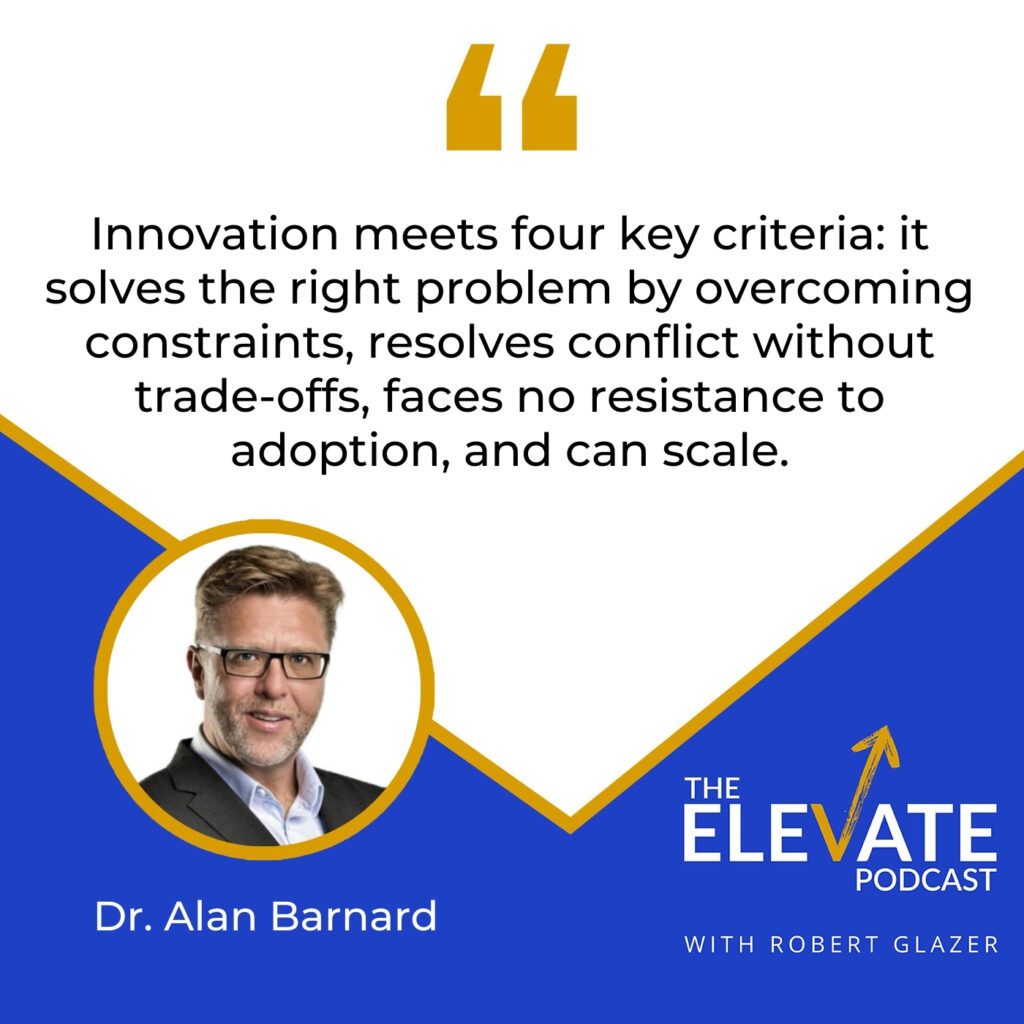
It says, “Why am I stuck?” Both options have pros and cons, and now I get stuck. What I need is a method that can create an innovation. An innovation basically meets four criteria. It solves the right problem, which in our language is that it solves the problem of why we have a constraint and how we can overcome it. What problem must I solve to get more of the goal? The second criterion it solves the conflict without trade-offs. It solves it without any resistance to adoption, and it does it in a way that you can scale.
If you imagine a personal thing, one of the things that we all struggle with is a bad habit. If I am overweight, the solution is to exercise more or eat healthily. The status quo is to keep on eating what I want. Each one of those options has its pros and cons. None of the options are viable because if I go for the exercise, I have to give up the positive of being able to eat what I want, and I have to live with the negative of the exercise.
If I keep on with the status quo, I have to give up the positive of the exercise and live with the negative of the blame and shame. Innovation says, “My unmet need is I want both pros and none of the cons.” If one of the pros of eating what I want is to help cope with stress, then I have to add that as a requirement. Eat healthy, but add a way of coping with stress, like exercising or meditating. If the cost or the effort of always making healthy choices is too high, then I will have to add something that can reduce the cost. The ProConCloud method is a practical way of generating breakthrough innovations to resolve conflicts.
You have a lot of advanced decision science principles, but to someone who struggles with baseline decision making, what are a couple of things that they could do to reduce the load of decision making?
Criteria For Good Vs. Bad Decisions
First of all, the simplest criterion to decide whether it is a good decision or not, and to avoid a bad decision, is to consider it a good decision, like a good option when you are trading an option. A good decision has a big upside if it works and a small downside if it does not. It’s like playing the lottery. The big upside is if it works, the small downside if it does not. We lose a few dollars.
Do not waste a lot of time buying a lottery ticket. Buy it or do not buy it.
Of course, it has a big upside if it works, a small downside if it does not, so it is a good option to exercise. A bad decision is one that only has a small upside if it works and a big downside if it does not. That is where we get confused as we chase certainty. We think about the probability of success.
Think about the probability of success of playing the lottery. It is one in a million. The probability of a failure is 100% almost, but it is still a good decision because it has a big upside if it works, a small downside if it does not. What about playing Russian Roulette? The probability of success is 5 out of 6. That is better odds than you will get in any game. Should you do it?
A good decision has a big upside if it works and a small downside if it doesn’t. A bad decision has only a small upside and a big downside
No, because what is the upside of winning? You stay alive, while you were alive before you started. The downside of losing is huge. You lose your head, which is quite an important part. We even teach it to kids. Is this an important decision? Is the event that happened consequential? If I do not make a decision, is it going to be harmful?
Not making a decision is a decision because it forces that decision, right?
Yes. We tend to procrastinate because of some exaggerated fear of loss, effort, or risk. The ProConCloud helps me to see what my assumptions are about the loss, the effort, or the risk because it fills in those boxes. The pros of the status quo and the cons of the change.
If you had someone in your life who was struggling with decisions, you would encourage them to make the ones that do not matter faster and spend your time on the ones that matter.
You are okay if you do it in fully automatic mode. Jeff Bezos has a great criterion that says, “Think of the decision as whether it’s a two-way door or a one-way door.” If it is a two-way door, it means you can step through, check around, “This is not what I expected,” go back out, and try the next door. If it is a one-way door, once you are in, you are stuck. A good example of that is getting married. That is a one-way door. The consequences of choosing the wrong partner are bad. Take your time.
I said this to someone last week. This is an insight that I have had after witnessing some bad divorces, but maybe there’s a theory around this. I do not think that people decide to have a child with the person with whom they married as much as they decide to marry, which is reversible, and the second one is not reversible. There is this logic like, “I am married to this person, so why would I rethink about having a kid?” That is actually the more important decision.
You are absolutely right, and it is part of the same problem as we go into automatic mode. We think that it is a little journey. We have to find somebody, and then we have to marry them, and then we have to have a kid. It’s like no.
That second decision is more consequential than the first.
Especially for the woman.
What they are seeing is that they love their kids, but they are tied to this person for the rest of their lives. Had they not had the kids and they had gotten divorced, they would have never had to talk to that person again.
What I do for people who are going through that decision, I use the same criteria. I said, “Thinking about the likely case is not helpful. Think about the best and worst cases.” If you had a kid and it were the best possible kid on the planet, how would that make you feel? If it will make you feel ecstatic, or it will make you feel, “I expected that because we are good ourselves,” versus what if it is the worst-case outcome? Will it make you suicidal or a little bit disappointed? If the thing is going to make you ecstatic if it is a best case, and a little bit disappointed if it is a worst case, kids are for you. You should do it. If it is the opposite, stay the hell away.
I am going to modify the last question for you. I usually ask what’s the personal professional mistake that you would make from, but I would say what is a decision that you made, either right or wrong, that you learned the most from?
I have interviewed a lot of successful people, and I was stunned, especially in my younger years, when I said to them, “What do you think is the most important decision that you will make in your life?” They all gave me the same answer, which is the person that you spend most of your time with as a romantic partner. I have made two bad decisions when it comes to that.
It was good decisions at the time, but bad outcomes. That’s an important thing, you have to be able to differentiate that it feels like a bad decision when it is a bad outcome. At that time, it was a good decision. When things start going wrong, when can you intervene, and how can you correct? Those are the type of things I think we can learn a lot from.
There are a lot of things throughout history that a horrible decision worked out okay. Driving home drunk and getting away with it is not a great decision.
There are good outcomes. Do not confuse those. A good decision can have bad outcomes. A bad decision can have good outcomes. My advice is to think about the outcome you want and the option you have currently. Is it something that is going to give you most of what you want and none of what you do not want, or could it be the opposite?
A good decision can have a bad outcome, and a bad decision can have a good outcome.
Dr. Barnard, where can people learn more about you, your work, and the new book?
My handle is Dr. Alan Barnard. I have a website, Dr. Alan Barnard. It’s all of my social media handles. I have a YouTube channel where I share a lot of the insights and case studies that we learn. If you go to Amazon, there are a couple of books all published under Dr. Alan Barnard.
Thank you for joining us. You have shared a lot of insights on decisions. I hope people tuning in can make some more wise decisions this week. I know I have a few takeaways that I am going to use.
Fantastic. Thank you so much for your time.
You can learn more about Alan and his work on the detailed episode page at RobertGlazer.com. If you enjoyed our episode, I have a small favor to ask. Would you take a minute and share this conversation with someone you think would appreciate it? The podcast has grown entirely through word of mouth, and I know that I find new episodes and shows when people share them with me. Take a second right now to text or email someone who you think could learn more about decision-making. Thank you again for your support, and until next time, keep elevating.
Important Links
- Dr. Alan Barnard
- Dr. Alan Barnard on LinkedIn
- Dr. Alan Barnard on Instagram
- Dr. Alan Barnard on YouTube
- Goldratt Research Labs
- The Goal
- From Fragile to Robust to Anti-Fragile
- From Crisis to Catch Up to Keep Up
- Today and Tomorrow
- The Marquis Who’s Who – Latest edition
- Chicken Soup for the Soul
- The Compass Within
- The Five Dysfunctions of a Team
- Abundance


