


Jay Papasan is a bestselling author and Vice President of Strategic Content at Keller Williams Realty International, the world’s largest real estate company. He has co-authored multiple blockbuster business books with Gary Keller, including The ONE Thing, which hit #1 on the Wall Street Journal bestseller list, and The Millionaire Real Estate Investor, a New York Times bestseller.
Jay joined host Robert Glazer on the Elevate Podcast to discuss his career, leadership lessons he’s learned, and how to find your ONE thing in life and leadership.
—
Listen to the podcast here
Thank You To Our Elevate Podcast Sponsors
- Shopify: shopify.com/elevate
- Indeed: indeed.com/elevate
- Headway: makeheadway.com/elevate (Promo Code: Elevate)
Jay Papasan On Aligning Life To Your Purpose
Jay Papasan, welcome to the show.
I’m so happy to be here. Nathan Barry introduced us. I’m thankful.
Jay Papasan And His Love For Writing
I love Nathan. He’s a good friend. I’ve been carrying your book around for years, so I’m excited to finally have this discussion. We’ll get to that in a bit. Once I get into that, we’re not going to get out, so I’m going to start a little earlier. I know you grew up in Memphis. You spent part of your early career in Paris as a translator and an aspiring writer. What were you interested in while growing up, and where did that love of writing come from?
I’m a book nerd at heart. If there’s such a thing as a wordpreneur, that’s probably what I would be called. Books are the throughline. In high school, I escaped with fiction. I was a late bloomer and a little introverted, but I ran with a smart, accomplished crowd. That was a good gift that I gave myself.
Running with a smart, accomplished crowd. It’s usually, “I ran with a bad crowd.” That’s a different phrase.

I’m not sure. I think I would have been very average if I had allowed myself to. I wanted to hang out with my friends, and they were all in the Beta Club and the class president. That’s a good influence. At that point, I wasn’t intrinsically motivated. I worked in bookstores through college. I got a job in publishing in New York. I worked as a translator and then eventually worked at HarperCollins as an editor.
I started a publishing company with Gary Keller here. Books are all the way through there. I thought in the beginning I would write fiction someday. I’m holding that out. Maybe I’ll retire, and when I don’t have to sell books, I can write books that I love that maybe won’t sell. I’ve become an unintentional expert on how-to and business books. That’s where 30 years of my career led me, and I’ve learned to love it.
There was a comment buried in there that I’d like to double-click. You said, “I wasn’t intrinsically motivated.” I assume at some point, you became intrinsically motivated. For a lot of people or people who have kids, what was the turning point for you?
I thought I could be good at everything. I was following my curiosity. If there was intrinsic motivation, it is that I have a deep-seated need to understand things and know what things mean. I remember once when I was dating my to-be wife, we were on a vacation in Vermont. We were lying in bed on a Saturday morning and talking. Some word came up in the conversation, so I left her and started wandering through the rental house, trying to find a dictionary.
Those were the days.
She pointed that out. She was like, “Are you kidding me?” I was like, “No.”
She was like, “You could have just asked me.”
Curiosity was the first half. Focused curiosity is the second. I figured out, maybe late in the game or maybe early, that I’m motivated when I can make an impact. That’s where I discovered how-to books. When someone reads a book that’s supposed to help you do things, I found I had a talent for making complex systems and ideas simple and practical. Hearing someone come back and saying, “Because I read your book, I now walk my daughter to school.” It has made all the difference. Impact is the thing that pulls me. I’m a little clearer on what my skill sets are. Maybe everybody figures that out. It took me 32 or 33 years to get even the hint of clarity around it.
What Makes A Great Self-Help Or Business Book
One of the challenges in nonfiction, and maybe it’s the nonfiction business model, is that a lot of times, people are trying to make the point and sell the point. I know people who have 3 or 4 of these nonfiction books, and they read two-thirds of them. We have an attention span problem in society. I wrote a book. It’s still my bestselling book, Elevate. It was about an hour long. People are always writing me back, “I finished your book.” I’m like, “That’s great. You read for an hour.” Do you think part of the reason is that a lot of nonfiction doesn’t get into the how, or it isn’t succinct enough for people to go do what you want them to do with the book?
That was my pet peeve. Gary, my co-author, shared it. When we compared our favorite books, they were all books that we found practical and actionable. If you are trying to learn about a category, you don’t just buy one book. You tend to buy a lot of books. If I’m like, “I’m an entrepreneur, a business leader, or an aspiring one,” I want to understand how to budget. I’m going to go read 4 or 5 books on that, and take a class to do all the things. You do tend to skim, so I don’t take that personally. My goal isn’t that they read every page. My goal is that they get something that will improve their personal or professional life.
Do you think people are selling past the close too much? Is that part of the problem?
A lot of people are writing business books so they can sell people something, and it shows. The intent of the book was to position themselves or their business as the answer, and not that the book itself would be the answer.
Give them the solution.
My publisher, Todd Sattersten, taught me this. He is one of the most brilliant business book minds of all time. I asked him, “How do you define the difference between self-help and business?” Those categories are blurring. He said, “A business book will spend 20% of the time identifying the problem and 80% telling you how to fix it. With a self-help book, you flip those ratios.”
Prolong the problem.
Eighty percent of it is about the problem and the pain, and then there’s a last chapter on “Here’s what to do.” People tend to need more.
Why is that? Are they trying to string it along? Is the solution outside the book? Are they better at the problem than the book, or all of the above? I’m curious why that is.
I went to see Brianna Wiest. I don’t know if you know who that is, but she wrote a book called The Mountain Is You. I went to see her for her last book. She is channeling something for people who have struggled with past trauma. I don’t even associate myself with being in that group. I don’t know that there’s anything practical I get from that book. Some self-help, which is where I would put her, the reader feels seen. They go, “I’m not alone. I’m in this with other people.”
That’s the mountain they’re trying to overcome.
People are lonely. They’re lonelier than ever, especially leaders. Who are their peers? Where can they show their authentic self? Let’s distinguish between great self-help books and great business books. Great self-help books help people feel seen and to see themselves. It’s not about action. It’s about recognition. Great business books help people identify the real challenge and give them some tools to address it.
There have been too many of these self-help books where the author has said, “I am the example of how you do this,” and then it turns out that they are not. They’re selling one version of their life and living another. I won’t disparage, but there was an author a few years ago who was on top of everything and is a dirty word now. They were going through a divorce while writing a book about what a good marriage looks like.
I know who you’re talking about. Here’s the thing. There’s the self-glorification that happens around some of that. The people who write “Do what I do,” whether intended or not, there’s a perceived ego attached to that. When they mess up, people will pounce. That’s the price. That’s the risk of doing that approach. I wrote a book where we talk about not multitasking. My kids like nothing more than to point out every time I do.
It depends on how you’re positioning it. I’m positioning it as we all have this problem, and here are some solutions for finding it. We have to be authentic journeyers. I can’t speak to that person’s journey, but I can separate the advice from the person giving it. Some people who are not people I would want to follow morally or anything else can give you some great advice. It is trying to separate the two.
Great self-help books help people feel seen and see themselves. Great business books help people identify the real challenge and give them the right tools to address it.
There are people who wrote my favorite novels that I probably would not want to hang out with. That’s learning to separate the two. I also don’t want to support someone who is not creating good in the world. Where I spend my money, I get that, but I also separate the two. Otherwise, every time I find a great book, do I have to go investigate the author? Are they really good?
This is not where I want to go, but this is fascinating. You’re the perfect person to discuss this with.
I’m a business book nerd, so we can go here all day long.
Consequences Of Writing Around Yourself
Here’s the distinction that somehow hit me. It was burned too many times by Dan Price and people like that. I don’t mean the book, but I’m thinking about LinkedIn, the content, and whatever. Maybe I’m too scarred at this point. You talk about frameworks and business. The best people that I like are trying to find the best ideas, synthesize them, and present them to people.
Their writing is about, “I found this. It could help you. I put a wrapper on it.” The people for whom the answer is always what they’re doing, 9 times out of 10, that person seems to turn out to be a fraud or at least not what they seem to be. That was an epiphany I came to realize. There was another one of these things, and I was like, “This is the difference. This person is sharing ideas, and this person is sharing themself.” What do you think about that?
I’ve got a list of books that are my favorites. You have Adam Grant, the Heath Brothers, and Dan Pink. You’ve got people who are synthesizing what they believe is a framework for viewing the world or a best practice for living it. I agree with you. They have a very low risk as authors. They might have gotten it wrong. A lot of people have pointed out that a lot of the companies in Good to Great didn’t turn out so good. That doesn’t mean that the principles were wrong at the time. Most companies don’t survive a generation. They have a good run, and they go away. There’s that.
When you make it about you, you now have a conundrum. What if you change your mind? It could be that someone wasn’t a hypocrite, but where they were when they wrote the book and where they are now, people transform. They change. I don’t know. I’ll say this. I can’t judge their choices. I agree with you that sometimes, it leaves me scratching my head. Was this authentic or not? I get that. Gary and I tell some of our own stories, but usually to point out that we’re on the journey, too.
You’re practicing this thing you discovered. You’re fallible within it as well.
Game sees game. People who are the masters don’t just see other masters. They see people seeking mastery, and they recognize it no matter where they are in the journey. That eight-year-old kid might be in the NBA someday because of the way he’s approaching the game. He’s not there yet. People look for journeyers. They recognize them and respect that, no matter where they are. They could be screwing up a lot or a little. I’m not going to be Tim Curry with the basketball, but hopefully, he respects my approach to business.
That’s probably Stephen Curry. Whether that was a Freudian slip or not, it was perfect. I know so little about basketball that we’re not going to get the name right.
I tried to go big because I don’t watch a lot of NBA either, but my family does.
That’s fair.
All that to say, Gary and I took an approach where when we first met, he had the book called The Millionaire Next Door and Good to Great. He goes, “What I like about this book is they went and surveyed a lot of successful people and looked for what they have in common.” That’s a great hack in life. If you want to know how to do something pretty hard, go read the books and listen to the podcast of the people who have summited Everest, but don’t listen to what they often identify as their unique talents. Listen to what they all do. All twenty people who summited Everett for the year had these things in common. That tends to be the model for success that most people can achieve. Do you go by Bob or Robert? I was going to call you Bob.
I go by either one. Anything but Rob is what I always say.
Bob did it that way. You probably have unique talents that I’m not going to emulate very well. That allows you to bring your unique value to what you do, but there’s probably a formula that you’re following that I can follow and make my own. That’s a principle we take to all of our book writing, our research, and our best practices. We look for patterns of extraordinary success among individuals and businesses. That’s a hack everybody can take to the bank. If you want to know how to do something, go study 9, 10, or maybe 20 achievers and look for the pattern of commonality. That will get you a long way.
The Millionaire Next Door was one of my favorite books, along with Rich Dad Poor Dad. I’ve read all those. I started to appreciate Nassim Taleb’s writing, and he eviscerated that book.
Which one?
The Millionaire Next Door. It’s interesting. I agree with what you’re talking about. There’s a huge survivorship bias problem in these things. That was his point. You say, “What did the twenty people who climbed Everest and made it do?” The only problem is that we should probably talk to the twenty people who didn’t make it and see if they did the same things. What’s the A/B variable? It’s interesting. That is a tactic. He explained why a lot of these things are faulted by a survivorship bias. It doesn’t invalidate them, but he was particularly critical of that book. I love that book.
The actual method that I learned is you look at the top quartile and the bottom quartile. If there’s a common trait between the two, you know that it’s probably discounted. The people who were the worst also focused on that thing. It allows the question. I didn’t want to go too far into the nerdy stuff, but I remember reading, and I’ve heard it before, that when they were looking at how to better armor fighter planes in World War II, they looked at where all the bullet holes were on the ones that landed. Someone pointed out, “That’s not where we need to armor them.” The ones that went down were the ones that were shot in other places. That’s the survivorship bias embodied right there.
Delving Into The Current Social And Political Climate
It’s almost like a drug control study. You’ve got to go find the twin of all the people who did the same thing and find out if there was something that they did differently. That’s all interesting. Flipping back, I know you had a brief deviation to Paris. Tell me a little bit about that.
I had my favorite high school teacher, this guy named Coach David Nixon. Hello, if you’re tuning in, Coach Nixon. He was my French professor. I chose French. I don’t think it’s true, but I heard that one of my ancestors was John Paul Jones. I was like, “That’s cool,” when you’re a kid. When I had the choice of Spanish or French, I took the far less practical French. I’m living in Texas. I know the bathroom and a beer, and that’s about it.
There are some regrets. I was into French culture for whatever reason and nerding out about it. He was a great professor. I was his teacher’s assistant in senior year. He taught me how to play chess. In junior year, we went on a two-week little thing that high school students do. Two of my best buddies and I went backpacking after high school for two months. It was $18 a day back then. That was how cheap you could do it if you were willing to sleep on park benches.
My daughter is abroad. I was telling her I had the book. You’re up on $50 a day, which includes lodging.
The people in the most extreme positions tend to have the loudest voices in society, and journalism usually magnifies that.
We slept on trains. We were very clever and thrifty. One of those guys, in his junior year, went abroad to France to study and never came back. We would go visit him in our senior year. I think I did it twice. He got ahead. He goes, “Jay, you can get a student visa here and work twenty hours a week.” I thought maybe a gap year or something.
I ended up landing a job, which is a long story, with a guy who ran a French medical company over there. My dad introduced me to him. Our common trait is that I played rugby in college, and he had been on the junior national team. I was failing the interview until my rugby team came in and, very inappropriately, dragged me away from my job interview at dinner to the bar. He’s like, “Who are those people?” I told him, and he was like, “When you come, you’ll stay in my home in Saint-Jean-de-Losne.” He was like, “Worst job interview ever.”
I ended up staying for three years and loved it. I was a very mediocre translator of knee and back surgeries. Thankfully, I had a surgeon working with me to make sure that I could get it 80% of the way, and then she would take it to the finish line. I only had to work three days a week. I got to travel a lot. I got to see my country from abroad. Nothing will make you appreciate and give you perspective on your home country than seeing it through another country’s eyes.
Particularly these days. I was in Europe, and I had some interesting conversations.
I was in Portugal for two weeks. I went over there to give a keynote for a company, and I added on a little vacation with my wife. People kept asking me, “What is going on with America?” I was like, “You tell us because we are very divided down the middle right now and trying to figure it out.”
It is interesting, but my anecdote to people is like, “You’re looking at our social media and hearing the loud 20% on either side. Meanwhile, I’m getting pitched stuff from your country.” In France, they put the leading opposition candidate in jail. I was like, “There’s plenty of stuff to go around here.” It is easier for people to look outside at their own place.
That’s true of everything. You nailed it. It is true in our culture. The people in the most extreme positions tend to have the loudest voices. Our system, with journalism, tends to magnify that. A lot of us who are centrist, one way or the other, probably have so much more in common than we realize. I have faith in this system, and I believe that we’ll work through it.
The problem is that each extreme brings another extreme rather than the moderates taking over.
We’ve been doing this pendulum back and forth. We’re going to reverse that and make it harder to go back, and then there’s a point at which people look up and go, “This is ridiculous.”
I long for this thing where the center is so big that the extremists have to key off to the center. That’s the problem. I try to explain this to people. If you’re going to run, it’s this four-year thing. You’re probably going to get elected because you’re centrist, but you have to spend two years having a different story and a different narrative, and pretending maybe to be something you’re not. Good people don’t want to do that.
There’s voting reform. I’ve read a few papers around ranked choice.
I have a good friend, Martin Babinec, who’s working on this heavily.
That seems smart because that allows people to run on the centrist and not have to cater to the extremes.
It takes the party’s power away.
There are plenty of reasons why that may or may not ever go through, but it’s nice that at least someone is pointing out, “There is a better way.” I hope that in time, we’ll figure it out, too.
If you haven’t heard someone pitch you on the ranked choice thing, it makes a ton of sense. The basic story is that 70% of these elections are decided in the primaries, where no one votes because of who is in the final. It changes the power dynamics around that.
The centrist candidates are not making the final selection. I am interested.
He sent me his book. He’s working on this and doing a big thing. He founded TriNet.
I gave a keynote for them in New York. It’s a cool company. They did an amazing event.
The Work Of Writing And Publishing Books
He has dedicated the rest of his life to good local jobs and trying to change this voting thing, which is interesting once you get into it. A lot of magic happened when you met Gary Keller. I think it happened by chance. Tell me a little bit about that story and how it kicked off your partnership.
The story you’re referring to is when I left New York publishing. There was no publishing in Austin. I thought, “I’ll be a freelance writer.” I ended up writing a newsletter at Keller Williams. When I was here, I was maybe two years into the journey. It was very small back then, with 27 employees, 6,700 agents. Now, we’ve got 175,000 agents in 58 countries or something. I don’t keep up because they keep adding countries. It’s been quite the journey, but we were very small back then.
I saw someone working on a book cover. That’s my reticular activator. I notice anything around books because I love them so much. I asked, “Are you working on a freelance project?” He goes, “No, Gary and our late co-author, Dave Jenks, are writing a book.” I ran into Gary, who was the chairman of the board at the time, in the bathroom. When we were washing our hands, I said, “I hear you’re writing a book. Do you remember I used to be an editor at HarperCollins?”
You weren’t going to Keller Williams to do content stuff. You were going to do real estate stuff.
A lot of times, books that break the mold do not get acquired for publishing.
I joined as a newsletter writer for their tech team. It’s a tech town. Dell was big. This is the year 2000. 2002 is the event with Gary, but when I joined, it was 2000. I was like, “If I have to get out of publishing, I might as well get into tech.” I was writing a weekly newsletter for their tech division, so I was still using my writing skills. I have since hopped around the small company because it was growing so fast. I launched a research division. I launched their website support division. It was weird. I had a headset on for a year. Not my calling.
You heard he was writing a book.
He called me into his office when he realized I had a publishing background because he had been struggling to get out of the gate for six months. This is June when this happened. He laid out a vision for writing thirteen books and pitched me on the first one, which was The Millionaire Real Estate Agent. He laid out the five books he was modeling. He and Dave had gone to the bookstore and said, “These are the books that we love. We want to steal from all of them.”
You know someone is a visionary when they give you a five-book plan.
One of them was The Millionaire Next Door. One was Good to Great. One was a book called Go for the Goal by Mia Hamm. Another one was a book called Body for Life by Bill Phillips. There’s a fifth book that I don’t remember, and neither does Gary, but we remember there were five. There were elements of each of them that they wanted to put in their book.
They wanted to make a baby out of those five books.
The executive summaries in Good to Great, he loved that for people. He was like, “Give me the points.” In Go for the Goal by Mia Hamm, she did profiles of her teammates. I’m getting chill bumps talking about it. Back then, I was freaking out because I had edited two of the books he put on the table. I showed him the acknowledgement and said, “I wrote a lot of this book, and I wrote a lot of that book.” That cinched the deal.
He did one day of interviews with me. I remember him asking, “Five years from now, what do you think you’ll be making?” I summed up my gumption. I said, “$100,000.” I was thinking so big. He wrote it down. He did the full battery of tests with me and then said, “You’re fired from your tech job, but you’re hired. You’re now going to work with me and Dave to write this book.” I had 30 days to create a business plan, and then we wrote the book in a little under 100 days.
What was the business plan for?
To show him how we would create the book. I had to give an outline. It’s like, “Here’s how we’ll attack it, and here’s how we will publish.”
It’s a business plan for the book. It’s not for what the book would do.
He and Dave were the subject matter experts, but I was an expert on the book process. I had published a lot of bestsellers, never as the acquiring editor, but usually working for them. I was an assistant editor. It was as high up as I got in six years. It’s a crazy process in New York publishing, which is a conversation for another day, but I had a great experience there. I could break down financials in a book. I knew the people to go to if we wanted to self-publish back then. Amazon was just getting out of the gates.
Did you self-publish that book?
We put it out there and got rejected by 28 publishers.
That seems to be the story of all the books that do well. I heard that Morgan Housel’s The Psychology of Money, no one would publish it.
It’s one of my favorite all-time books.
It’s the same with Tim Ferriss. No one would publish it. One person, zero advance. It’s amazing.
A lot of times, books that break the mold don’t get acquired. That’s the survivorship bias. A lot of them look like Hollywood.
If they’re familiar, but if they’re familiar, they’re not different.
They didn’t understand what we were doing. They didn’t understand that, at that time, Gary and Dave had seen a trend in our industry of people who were seen as salespeople who wanted to become businesspeople. That was the job of that first book. That was the promise. It was like, “We will take you on this journey from being a salesperson to being a business person.” We could have called it The Millionaire Small Business Owner, if I’m honest. It was about service businesses. We ended up self-publishing it. The only offer we got was from the American Management Association.
The final title was?
The Millionaire Real Estate Agent. We asked the question, “What would it take for a real estate agent or team to earn and then net $1 million a year?” We asked a big question.
That’s going to appeal to every agent.
The American Management Association offered us $25,000. I told Gary, “I wouldn’t take it. It’s not enough money for them to get behind it. You don’t need the money. You’ll give up all your control.” We self-published, and I thought we’d sell 50,000 copies lifetime. We sold 100,000 copies in the first year.
Are those all real estate agents? Who else is buying it?
This is the same in the investor world. I had a good friend. He ended up writing a book called Flip together. That was about house flipping when that was the craze. He said, “You need to understand the market for the book.” I understood how hard it was to flip a house. My wife and I had done it. It was financially scary and hard. It was a full-time second job. I was like, “There’s not a big market.” He goes, “You’re not marketing to people who flip houses. You’re marketing to people who think they want to.” Every year, there are probably 150,000 to 200,000 people who get licensed to sell real estate.
It’s a high churn, but they’re coming in, and this is like, “What does the best end state look like?”
Eighty-five percent will churn out within the first two years. It’s hard to be successful. Ultimately, our market, even though it says millionaire, was a career guide. Lots of people who were brand-new licensees were buying it. Lots of people who owned brokerages were buying it. Because it was a timeless approach, it appealed to all of them. There was no guidebook at that time for how to build a team in real estate. It wasn’t even allowed in most of the brokerages.
What’s the next book?
That book that I thought would sell 50,000 copies has sold 1.7 million. It shows what I know. We did catch a movement. Our last book was The ONE Thing. We’ve written twelve. We’ve republished a couple that needed to be updated, but the last big book we came out with was in 2013.
Ironically, your last book out of twelve is The ONE Thing. There’s a little bit of irony. You can’t overlook that.
That has been the most successful. It has sold close to 3.6 or 3.7 million copies at last count in 40-something languages. That’s the book. Both of those books, the first one and the last one, are the kind of books every author dreams about. You tapped into some zeitgeist.
Even you were 2 out of 10. It shows you how hard it is. Michael Bungay Stanier is a friend of mine. He wrote The Coaching Habit. I was like, “Michael, don’t you almost not want to write another book?” A million copies for a self-published book is a 0.1% thing. He has written another book, and it’s not that. I feel the same way about James Clear. I feel like he should almost retire from that book. Unfortunately, you’ll get the huge advance this time and the better things, and probably sell a couple of million. Twenty-four million copies are hard. It’s like all the singers. It’s hard to want to do something knowing it’s not going to catch the same.
I don’t believe that. They don’t either. I don’t think you write a book knowing the industry to make money because most of them don’t.
I don’t mean the money. I mean, when you know even your better thing or the after might not be as “successful.”
To finish a great book, you have to be called to write it on some level. I know people are doing it with AI and are churning out a lot of crap. If you’re trying to write a great book, there’s some sort of labor and love involved. Some people screw up their track records. Sometimes, their follow-ups won’t be as good. That’s just the breaks. I think we all want to do something bigger.
Sometimes, the audiences are different. My book that’s coming out, which I’m super excited about, is the first one I’ve written for anyone, which is a bigger audience. The one I had a concept of working on after that, which I have a ton of passion about, is going to be a much smaller sliver, but I’m as passionate about that topic. That’s the trick.
Guess which one is going to be easier to market.
The first one.
The one that’s got the niche. We had a horrible time trying to market The ONE Thing because it’s an approach you can apply to your health and your marriage.
That’s fair.
It was not like that with The Millionaire Real Estate Agent.
You knew the one place to market it.
Rule number one of starting a business is whether you clearly identify your customers. When you say a book is for everyone, you can market it to no one. We got lucky. We had two audiences that grabbed onto us. First was the real estate audience that knew us. Now, we call them creators. Back then, I called them the Etsy moms because they all had Etsy stores, and they were trying to open up craft businesses as side hustles. I got picked up by some big bloggers and big podcasters. The CrossFit gyms started passing around The ONE Thing because it makes a lot of sense for someone. All the little bits appeal to the CrossFit mind. Those three sequential audiences blew us up.
You have a professional football player take your unsold book of 50 years and have it on the Super Bowl sideline. Someone has got to be working on a product placement for that that’s inorganic.
It doesn’t always work. It’s so weird.
If you are trying to write a great book, there is some sort of labor and love involved.
I know. The organic stuff works better than the inorganic. That was an incredible story, that book.
A. J. Brown was reading The Inner Excellence. He’s seen reading on the sidelines of playoff games. My publisher, Todd, is a football fan. When that happened, he called me up and said, “This is weird. Let’s watch this one because people are talking about it.” The week before, it sold five copies, and then the next month, it sold 67,000. That’s incredible. It’s supposed to be a pretty good book.
I’m surprised they could print them that fast. It’s probably the thing that no one was stocking for that long.
Inside baseball, they were using Ingram, which is a distributor. It was IngramSpark. It’s a print-on-demand. Credit to them, they saw it and started printing books as fast as they could, ahead of demand. You almost never got out of stock. It’ll be one of the inside baseball great publishing stories about how that thing exploded, but it couldn’t have exploded if they couldn’t sell the book.
Setting The Right Goals And Priorities
The core question behind The ONE Thing and its success, and I’ll tell you about how I incorporate it into my life, was, “What’s the one thing I can do that by doing it, everything will be easier and unnecessary?” What do you think made that resonate so deeply?
I have a theory of bestselling books. I think the ones that go on to sell a million copies are all catching some sort of societal wave, whether they’re aware of it or not.
Zeitgeist.
James Clear has a platform. He blogged for eight years. When he came out, he had 200,000 or 300,000 people on his list. He was going to be a million-copy bestseller. He was selling 3,000 copies a week. By the end of COVID, it was 7,000. The next six months, it was 15,000. He started doubling. At one point, it was 30,000 a week. I could not get my head around it. He wrote a very simple book. He curated a bunch of other people’s best ideas, but he has a talent for putting them in a package that people could quickly understand. Great cover and great title. He did everything right. He is a scientist. I have all the respect. I’m not saying he was lucky.
We’re all lucky.
He took advantage of the luck he was given. I do think that it was the right book at the right time. There are probably 50 other ones that could have been the book, but he caught the wave, and all the other surfers face-planted and got churned in the surf. That’s something I look for when you see a book blow up like that. Think about it. The iPhone came out in 2008. By 2012, when we were getting ready to publish, I couldn’t even remember what percentage of people had a smartphone, including school kids. We’re all connected all the time, and we haven’t, in any way, come up with adaptive systems, knowing, “Am I at work, or am I at home?”
We’re more multitasking and more overwhelmed. There are more to-do lists and more goals.
People who show up at our door for our training or in my keynotes, the keywords are “too much” and “overwhelm.” They know that burnout, breakdown, anxiety, or all of those things are coming because they haven’t figured out how to filter the noise to get to what’s important. We could have called the book Focus, and we wouldn’t have sold a copy because people are like, “I know what that is.” Everybody says, “Just focus.” We were not going to sell books. I remember we had two titles. One was The Success Habit. There was The Power of Habit that came out after we had submitted the book and titled it.
The basis of a lot of what James Clear’s book was on Charles Duhigg’s book.
Also, BJ Fogg. They looked up, and we said, “What’s the biggest takeaway from this book?” I said, “Ultimately, people could use this to identify the thing that matters most in their personal or professional life and build a success habit around it. Before we publish the book, we always teach it to test the ideas. That was an idea that hooked a lot of people. We had one mocked up that said The Success Habit and one called The ONE Thing. From day one, we referred to it as The ONE Thing. We went to New York to the Book Expo. All the business buyers and all the buyers for all the big chains are there. My publisher took a survey. It was 79% of them.
This one, you went with a publisher
Yeah, Ray Bard. It’s a hybrid. It’s its own thing.
They took you to New York to see this?
Yeah. Ray and I are there. He’s doing a survey, and the results are clear. Eighty percent of book professionals clearly wanted The Success Habit. They were like, “I can sell that book.” The ONE Thing was met often with curiosity or ridicule. One lady, one of the biggest book buyers in the world, laughed. She goes, “What do you mean it’s one thing? That’s ridiculous,” and dismissed the book.
I remember our marketing director at the time, a woman named Ellen Curtis, said, “I hear the research. Usually, we always go with the research, but my gut says that it’s The ONE Thing.” Gary is like, “Me, too.” We looked to our marketing director, because we had four people. We were like, “Is she going to go with the research?”
We have the authors going with our guts, and we’re at an impasse. She said, “I’m stressed out all the time, running all the marketing. If I see a book that says The Success Habit, I’ll be honest with you, it sounds hard to me. It sounds like one more thing that I have to do. If I see something called The ONE Thing, I’d be like, ‘Tell me what that effort is because I want to know.’”
It’s not a hack, but it appeals like, “Give me the first principle here.”
If people are willing to entertain it, it’s a provocative thing to ask, “I’m not sure I believe you yet, but tell me more.” That’s how it ended up being called The ONE Thing. That was the basis of this coaching question that Gary had used. When he got people to make a list of their priorities, he was always frustrated that they would do some of them, but almost never the thing they said was the most important. It went out of frustration.
He said, “If you could only do one thing to advance your goals this week, what are you committing to do?” They would list it. What he found out is there’s no place to hide. You said you’re going to do one thing, so you better do it. They tended to do all the other junk, too. It blew his mind. He started hanging his hat on that principle and the question that we call the focusing question, which is, “What’s the one thing I can do, such that by doing it, everything else is easier or necessary?” That became the lever.
You can only truly be focused on one thing at a time.
It’s a little like the make-your-bed thing, too. There’s the foundational habit aspect of it.
You’ve got the keystone habit idea. We wanted the keystone habit to look for your most leveraged priority around the thing that you most want. It’s like, “I want to do this thing. What is the action that is the most advantageous for me to take?” If you ask a very specific question, I was afraid people wouldn’t know the answers. A lot of them did, but because they were too busy to ask, they felt guilty all the time.
I always tweak things. I have a goal-setting process for each year. I would have the things I wanted to do and then these twenty other things that needed to get done. I read The ONE Thing, and I read the domino thing. That clicked the most for me. If you look at my list, there’s one thing for each area. There’s one thing for my personal and one thing for my professional. I list all the 10 or 15 things, like, “I want to have a bestselling book.” There are 20 things that I need to know for that to happen.
I pyramided all of them. These are all tactics. The real thing I want to do is this. Tactics are swappable. This is what I want to get to. For instance, I always had a health goal. I would try to do something I hadn’t done before. This year, I wanted to do an Olympic triathlon. Someone was putting on this London to Paris bike ride of 180 miles. Could I have that other thing on my list, but then I was like, “The goal was to do something that challenged me and my health.” I’m just swapping the tactic out, and it changed that.
In one of my presentations, I talked about the domino. The domino is such a great thing. How many does it take to knock over the Empire State Building is a great quiz. Some people are like, “One.” I’m like, “It can’t be one. I told you the rules. It knocks down 150%. It can’t be one. That’s a terrible answer.” The other is the prism and the laser. If you take a certain amount of light and refract it in a different direction, you get a lot of pretty colors. If you focus it, it will cut glass. Since I read the book, I collect all the things that I wrote and I’m like, “Which of these are tactic dominoes, and which is the thing I want to fall at the end?”
That’s the big question because you could only truly be focused on one thing at a time. I’m a parent, a spouse, and an entrepreneur. You’ve got all the different hats you wear. I’m a son to my aging parents. You got all those roles. At any given moment, are we being appropriate to our one thing at the moment? That’s just the habit of always recentering around, “What’s my priority right now?”
It’s the chicken and the egg. If your priority is to spend quality time with each child, then there are different ways to do that rather than getting too stuck up where you’re like, “I want to take this trip with this kid,” but it’s not happening, and feeling that’s a failure. That was the real click for me. It’s the things that are little dominoes, and then what’s the big domino at the end of the chain?
We have a whole ten-week coaching program that we do with people. Because they’re busy, almost everybody shows up at our company doors, going, “I’m overwhelmed.” We designed a workshop with my coach because I went through a season where I had everything happen at once, and I was drowning. I’m like, “I’m such a fraud. I’m trying to juggle all these things.” Life happened all at once, like it does sometimes.
We created a system for triaging that. We tell people, “We’re going to give you four hours back a week by giving you a better filter for saying no and saying yes.” We call it the first domino. The domino metaphors can not go for one that’s 50% larger. Almost every achiever looks at those dominoes getting progressively larger. Ten is as tall as the doorway. Eighteen is as tall as the Leaning Tower of Pisa. Twenty-five is as tall as the Empire State Building.
They get exponentially bigger. Since they’re achievers, they’re like, “I’m going to strap on my football helmet and pads, and I’m going to skip all of these little dominoes and go knock over the Leaning Tower because it’s already leaning.” They do this gargantuan effort and usually end up hurting themselves or are broken down afterwards. People are great at doing the aggressive sprint, but success is a marathon.
The goal falls if you do all the little things.
It’s so much easier.
This is the EOS Traction concept, which is to line up all the little dominoes correctly in the organization. If you do that right as the leader, you don’t need to do anything with your rock other than let them all come and knock it over.
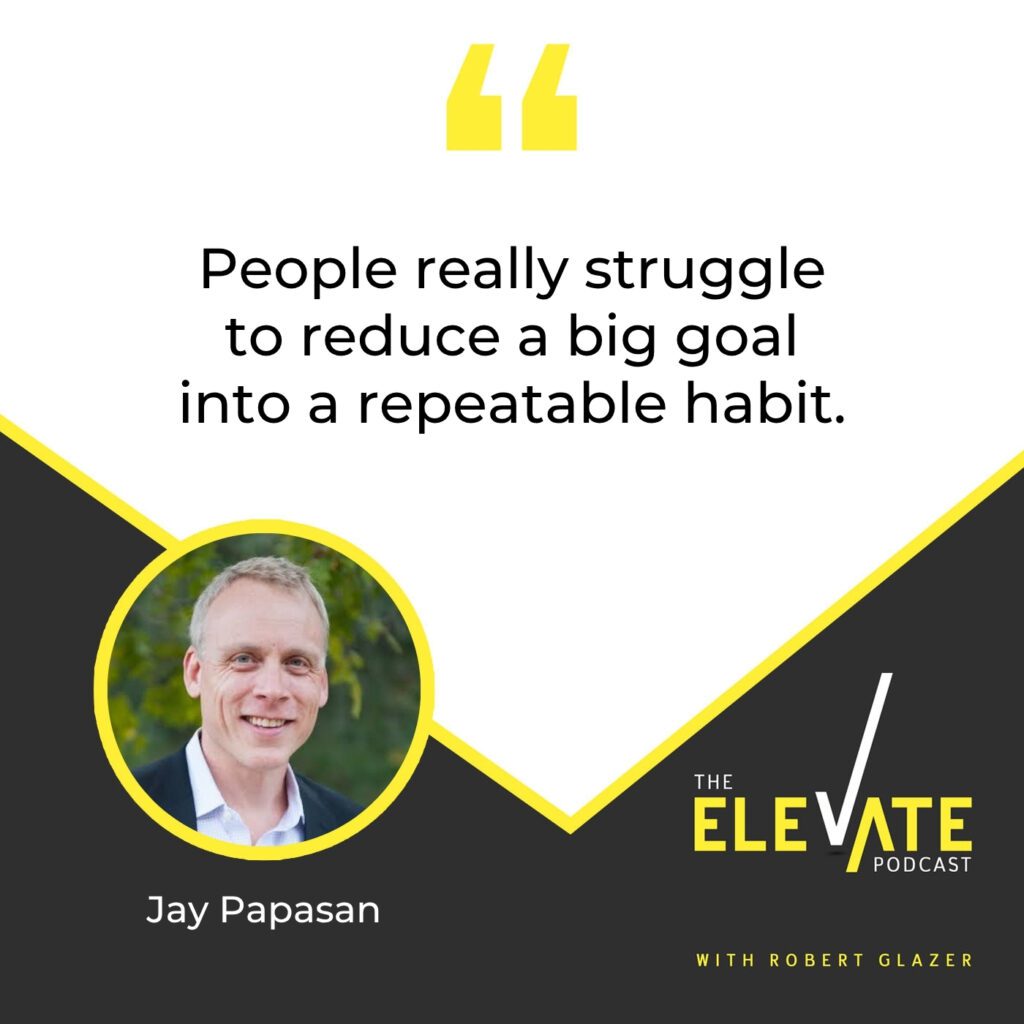
Celebrate them. Stand behind them, not in front of them, doing the work. There are so many benefits to it. People struggle to reduce a big goal to what we call a time blockable. What is something that I can put on my calendar regularly that is a bite-sized enough chunk that I can achieve success every day, and that success will add up to far more? The whole goal of the course is to identify that and start people knocking that sucker down. Smart people get confused or overly ambitious. It happens.
I always talk about the mountain and then the little things. You have this goal. If you take 90 repeatable efforts every day over a quarter, it’s amazing. You can write a book in ten minutes every day that you would have been looking at friends’ feeds on Facebook. What you do is you see that the mountain is far away. You’re like, “I’m going to deal with the junk mail today and this and that. I knock that over because that’s easy.” I look up the next day, and I’m like, “That’s far, big, and hard to climb.” Unless you take five steps, it’s always going to look big. We’re wired to try to get something done. We’re like, “Five steps and it doesn’t feel like anything,” but pretty soon, it’s not an insurmountable mountain.
Differences Between Activity And Productivity
The key phrase in the book that I love to highlight is the difference between activity and productivity. You can do a lot of activity that amounts to nothing, but if you’re acting on your actual priority, that’s what productivity is. People often confuse activity for productivity, which is why they spin and live like a groundhog year.
They wake up on January 1, making the same resolutions that they fell apart on last year. Because it’s the same set of overambition, they’re overextending themselves and spreading themselves thin instead of believing and taking the faith, like, “I can sequentially start having smaller successes. They will amount to much more than I imagine.”
The lie about success that you’re debunking is that everything matters equally, or that multitasking is effective, which is probably one of the biggest lies of our time.
In fairness, there were engineers at Google and Apple who were paid lots of money to tempt us with our phones all day long. In the book, we write about finding your bunker. Can you design your workspace so that if you go there to do your professional thing that matters most, you’ve got a better chance of not being distracted and getting in a couple of hours a day or whatever that is? What we’re realizing is that what we have to focus on is a digital bunker.
Since you wrote this book, we’ve become far more distracted as a society. It’s even needed more.
That’s one of the things we have to teach people. If you want to live this book in your work or at home, do you have a strategy for your digital bunker when it matters? It doesn’t matter all the time. It’s okay if you want to check your phone and Instagram while you’re waiting to get into the movie. I remember interviewing Ryan Holiday in a period where he was reading a book a day on average.
I was like, “How do you do it?” He goes, “I keep a book with me at all times. When everybody else is on their phone, I’m reading ten pages, and they add up.” That’s the same thing. That was so many years ago when he told me that. It blew my mind. I realized that on average, people are on their phones for 4.5 to 5 hours a day.
Cal Newport has some great stuff about this and taking the apps off. This is where people lie to themselves. They’re like, “I don’t have time to write a book. I don’t have time to do this.” I’m like, “If I added up all of the time you were looking at people’s meals and commenting on them on Facebook, this is what it took after a quarter, and this is what it cost you.” The calendar audit is a powerful tool with people who are lying about, “I don’t have any time.” It’s like, “Are you going to be proud in your eulogy at some of these high uses of time?”
Empty your inbox not for productivity but for your mental health.
We wouldn’t let our teenagers do it. In coaching, your greatest tool is your imagination. If I’m working with someone or we are, I’d be like, “Who’s a younger person that you truly love and want only the best for?” For most people, it’s their kid, or maybe their uncle if they don’t have kids. I say, “You see them doing their homework, and they’re switching back and forth to their phone.”
It’s ten minutes to re-engage or something that the data says.
Almost 30. That’s the way to fully re-engage. If you had the ability to, and they would still love you as an uncle or whatever, a lot of parents set screen time rules. The reality is that everybody agrees to do that.
I do. I’m the worst parent in the world. No one else does this.
You’re the evil parent. The kids are like, “You’re ruining my life, Dad.” I got it, but we have that hard conversation because we love them so much. We don’t parent ourselves. With the tools that are there for parents, the screen time on the Apple, and I want to say health and well-being on the Android, you can go in, and it’ll show you exactly how much time you’re on your phone and what apps are taking the most. You can set limits.
I’ll be the first to say I’m not perfect. Instagram, because I’m a word guy, has mostly pictures, so it feels like a little mental vacation. My work brain doesn’t engage. I set limits. I took what I used to be doing and I halved it. If I were spending 40 minutes a day in all those little moments as a productivity expert, self-soothing, or getting my dopamine, and it’s not a useful activity, then I would cut it in half.
Guess what? On my phone, I’ve parented myself. It’ll say, “You have five minutes of Instagram remaining today,” and then it grays out the app. I love it because it took me from unaware to aware. You have to get it out of your subconscious into your conscious mind to take action. A little safeguard like that, you don’t have to block everything. You don’t have to not have a smartphone.
You’re like, “I had no idea it was on for an hour,” when that warning comes on.
It’s like a time machine. Email is the same way for people. Email and social media are like little time machines. You go in, and you don’t know when you’re going to pop out, unless I set an alarm on my watch. That’s my favorite. I pay so much for this Apple Watch. My number one use is I’ll use Siri. I’ll set a 30-minute timer or set a 20-minute timer for grilling, also.
That and finding your phone is the number one use of my watch. I’m like, “Where is my phone?”
We call it batching. You know batching. If I’m going to do a low-productivity but necessary act like email, then I’m going to set a time limit. I’m like, “How much can I do in the next 20 minutes?” I’ll be focused on that, and I can knock out a bunch of emails. I do not believe in inbox zero. You’re doing that for your mental health, not for productivity. If you need it, you need it.
I’m a little of the opposite. When I see some with a red thing on their iPhone and 12,000 emails, I’m like, “I don’t understand.” I’m hyperventilating. I don’t have to be zero, but I can’t deal with that.
For some people, it’s all the tabs. We all have our thing that triggers us. If that’s you, then deal with it. Don’t confuse it with productivity. Nobody got a promotion for emptying their inbox.
That’s correct.
Differentiate between activities we do for our own personal well-being versus our productivity. Sometimes, they overlap, which is wonderful, but I usually tell people, “Go crazy. What’s the one limitation you could place on your smartphone that would improve your productivity?” They’re like, “I’m going to limit my access to TikTok. I can only look at it outside of work hours.” You can set all those things. You won’t unintentionally blow 30 minutes. You’re now working on your laptop after dinner instead of hanging out with your kids. There’s usually a cascade effect to these little unconscious bad decisions. You don’t want people to have regrets.
Breaking The Illusion Of Work-Life Balance
There’s another thing we share that I believe in deeply. We are all juggling work, family, and personal life. I heard Randi Zuckerberg years ago talk about how you can have 3 out of 5. This is someone who is a billionaire. She’s like, “Probably in a day, you can have family, health, food, and exercise, or where you can’t do all of it.” There’s this notion of balance as a myth. I know we’ve talked about it. What is the counterbalancing philosophy?
The principle is that the idea of being hyper-focused on things means that you’re letting other things sit. Our fundamental belief is that in work, most people are highly rewarded for getting good at one thing. A company that’s good at one thing distinguishes itself and gets market share. That allows them to do other things. At work, you can do that.
In other areas of your life, whether it be your health or your relationships, if you neglect things for too long, they may not be waiting for you when you get there. If you skip your 12-year-old’s birthday party to work, you don’t get a makeover or a do-over on your 13th. You may have a resentful teenager who won’t talk to you. What we generally say is that in every area but work, you tend to counterbalance.
If I’m doing a big keynote, and this is one of the things they want me to cover, I’ll say, “Everybody, stand up. I’ll need you, if you’re physically able, to stand on one foot.” You see everybody balancing. I would be like, “Are you balanced or balancing?” Everybody is like, “Balancing.” I’m like, “You get an A on the test. Sit down.” That’s the point. People talk about a balanced life as if it’s a place you would arrive at. They’re like, “I get everything situated just so, and my life is great.”
It’s sequencing. It’s not a teeter-totter.
It’s also realizing, “I came back from a convention where I worked a lot. My work may be in a good place after that, but my health is suffering. I need to purposefully over-index on the things I was missing for that period of time.”
It’s a portfolio. Over a month, it’s an integration. I like the term integration. Over a month, you have committed meaningfully to the things that you said were important. I had a picture I shared years ago. I liked integration. On a Zoom call, I said to a mom with a baby on her lap while working, “This is not anyone’s definition of work-life balance that they want.” They want to do their work and play with their baby. Multitasking has made people think it all happens at once.
My dog knows when I’m not paying attention and scratches his head. He’ll start batting me, like, “I need a focused scratch right now because this is not cutting it.”
There’s a famous story I heard. I don’t know if it’s true or if it’s a fable. This dad was closing a big deal in M&A, so he wasn’t home for two weeks. He came home every week. Right before bedtime, he played with his son or whatever it was. After two weeks of the deal being over and it was done, the son said, “Dad, is the deal over?” He’s like, “Yeah. I’m glad it’s over. I’m going to be home a lot more.” The kid was bummed. He was sad. It turned out that because the dad was only home for a little amount of time, he had come home and spent that whole hour playing with the kid before bed. The times when he was physically there, it’s not like that was any better. I always thought that was a powerful little anecdote.
The kids spell love as time. They want you fully present. They’re often good at asserting that if we watch and listen to them. It goes to our spouses, too. We owe them our undistracted attention when we’re with them, more or less. I know that there are always exceptions to the rule, but we try not to have phones at dinner time unless there is something actively happening in the background. On Thursday, my niece was in labor, so we had our phones out because we were waiting for the picture to pop up. If you’re going into a Broadway show, you would turn your phone off, or they will kick you out. We don’t treat our personal time with that much respect.
That’s fair. What’s your one thing, personally or professionally?
There are a couple of things that I focus on with my coach every other week we meet. Probably the number one for me is that I’m hitting a certain number of writing days per week and per month. If I have the writing time blocked and live my calendar, a lot of magic happens. The podcast comes out, the newsletter goes out, and then I make progress on my book. That’s where I make my stand.
What’s on the horizon is that I’ve got a new book coming out in September 2025. It’s a real estate title called The Rookie Real Estate Agent. It’ll be the first one with just my name on it. When I’m not focused on creating new things, I’m probably going to be focused on trying to support that baby as it goes out into the world.
It is birthing a baby. The writing is easier than the marketing, in some ways.
I agree with that statement. There are probably some people who prefer the marketing, but I would rather do the hard work of writing it than have to go do the selling of it.
The writing doesn’t involve coordination with tons of outside people. That’s probably the big difference. It’s not the time.
I’m introverted by nature. For someone who can stand in front of 15,000 on a stage, I tend to go back to my room and curl up in the fetal position.
Becoming Good At The Selection Process
We’re the same person. I’m an extroverted introvert. I love hanging out with people. I love talking to people. Although stages are geared more towards introverts because they don’t have to talk to every person. It’s delivering a thing. I always say that at these conferences. I love it and I’ll talk to everyone, but then, at 8:00 PM, I’m out of gas. You’ll crash, recharge, and have your quiet. This is the last question for you that I ask everyone. This is multi-variant. It could be single, repeated, personal, or professional. What’s a mistake that you’ve made that you learned the most from?
The most painful mistakes are all in one category. They’re around people and relationships. From a business standpoint, Gary and I agreed that if we could only master one skill, it would be around selection. If we can get the right people in, we’re less likely to deal with the wrong people down the road. The culture is good. The productivity is good. They don’t even need to be managed when we have a good person. Can we get good at the selection process? The worst business stakes I’ve made are around hiring the wrong people and giving them too much authority or room to run because they can do a lot of damage to both your customers and your team.
That resonates with me.
I can’t name anybody specific for obvious reasons. That would be wrong.
Get In Touch With Jay
The best way to fix a culture is to hire the right people. You can spend a lot of years trying to fix the wrong people. Where can the audience learn more about you, your work, and your books?
Everything about me is at JayPapasan.com. To date, this is still a true statement. We had 9 billion people on Earth, or is it still 8 billion? I don’t know.
I thought it was a little less. We’re shrinking, but I could be wrong.
Out of 7.5 billion people, there’s only one Jay Papasan that Google finds. Even if you misspell it a little bit, you’re going to find me. My chief of staff and I answer any inquiries from that. Most people find me at The1Thing.com because that’s the place that I’ve been living the most for the last few years, hosting the podcast and all of that fun stuff.
Thanks for sharing your story with us. The ONE Thing framework had a huge impact on how I think about things and plan for my family and my work. It was fun having you in person to talk about it.
Thank you for a wild and fun interview, too. We got to talk about books. We ended up skirting politics tactfully, I hope, and then getting into The ONE Thing. I had a lot of fun. Thanks for having me.
It’s all connected in some way.
Important Links
- Jay Papasan
- Keller Williams
- The ONE Thing Book
- The ONE Thing
- The ONE Thing Podcast
- The Millionaire Next Door
- The Millionaire Real Estate Agent
- Flip
- Elevate
- The Mountain Is You
- Good to Great
- Rich Dad Poor Dad
- Go for the Goal
- Body for Life
- The Psychology of Money
- The Coaching Habit
- Inner Excellence
- The Power of Habit


